
The Vanuatu government system is a representative parliamentary democracy with a written constitution as the supreme law. It features a separation of powers between the executive, legislative, and judicial branches. The Prime Minister serves as the head of government, while the President acts as the ceremonial head of state, overseeing a unicameral parliament elected by universal suffrage.
Vanuatu, an archipelago nation in the South Pacific, operates under a unique political framework that blends Western democratic principles with traditional Melanesian customs. Since gaining independence from the Anglo-French Condominium in 1980, the Republic of Vanuatu has established a robust, albeit dynamic, political environment. Understanding the Vanuatu government system is essential for investors, legal scholars, and travelers seeking to comprehend how this island nation functions on a sovereign level.
This comprehensive guide explores the intricacies of Vanuatu’s governance, from the supreme authority of its Constitution to the integration of customary law (Kastom) within modern jurisprudence. We will dissect the roles of the Executive, the Legislature, and the Judiciary to provide a clear map of power and responsibility within the Republic.
The Supreme Law: Constitution of Vanuatu
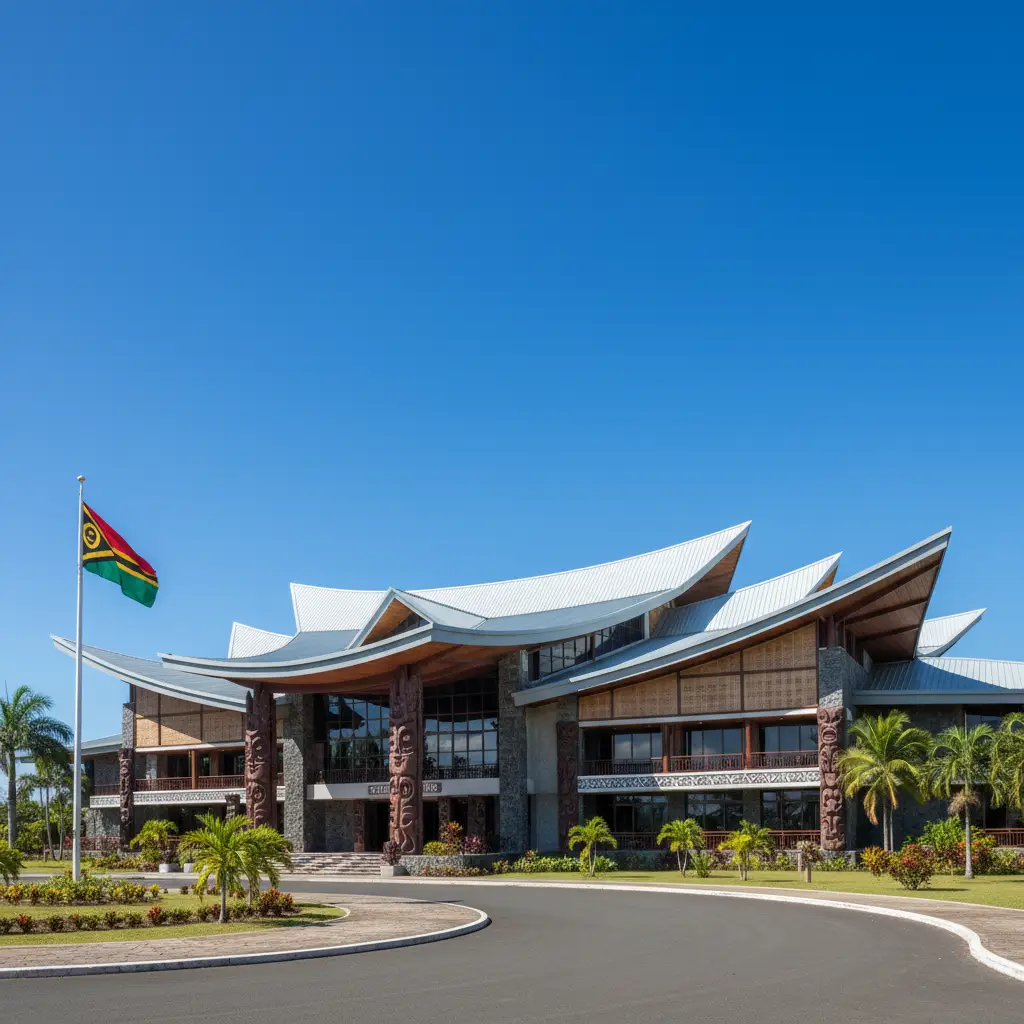
At the heart of the Vanuatu government system lies the Constitution, adopted upon independence on July 30, 1980. It is the supreme law of the Republic, and any other law that is inconsistent with the Constitution is considered void to the extent of the inconsistency. The Constitution establishes Vanuatu as a sovereign democratic state, emphasizing the fundamental rights and freedoms of the individual.
The Constitution is notable for how it explicitly recognizes the dual heritage of the nation. While it structures the government along the lines of the Westminster system (derived from the British parliamentary model) and French republican traditions, it places a heavy emphasis on “Kastom”—the traditional customs and values of the Ni-Vanuatu people. This legal framework guarantees protection for fundamental rights including freedom of expression, assembly, association, and protection of the law, regardless of race, place of origin, religious or traditional beliefs, political opinions, language, or sex.
Fundamental Rights and Duties
The Constitution not only outlines the machinery of government but also serves as a bill of rights. It ensures that the judiciary remains independent and that the public service remains politically neutral. Furthermore, it outlines the duties of citizens, which include respecting the rights of others, promoting national unity, and safeguarding the natural wealth and environment of Vanuatu. This environmental stewardship is a constitutional mandate, reflecting the deep connection the Ni-Vanuatu people have with their land.
Parliamentary Democracy and the Legislature
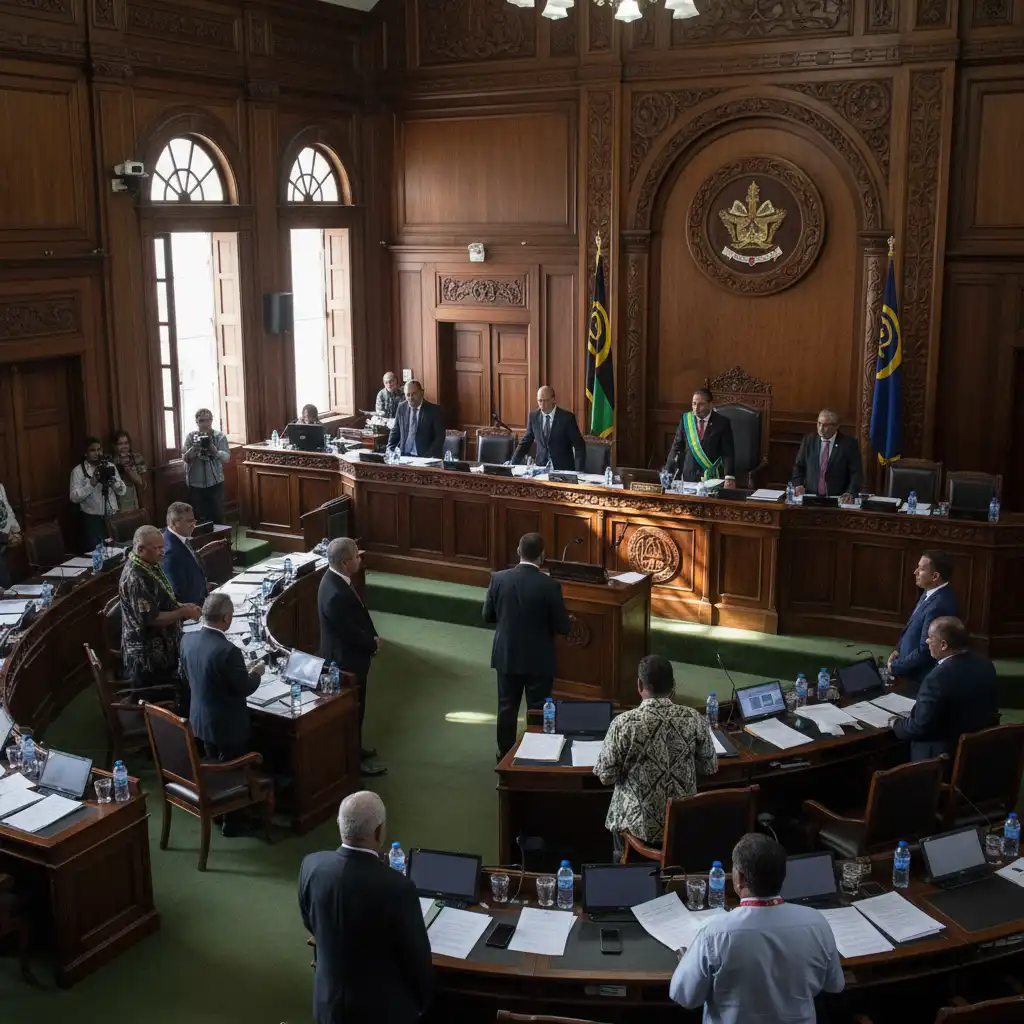
The legislative power of the Republic is vested in a single-chamber Parliament. This unicameral body is the engine room of the Vanuatu government system, responsible for debating and passing laws, approving the national budget, and scrutinizing the actions of the government.
How is the Parliament Structured?
The Parliament consists of 52 members elected by universal adult suffrage for a four-year term. Members of Parliament (MPs) represent multi-member constituencies, a system that encourages a diversity of political representation but often leads to coalition governments due to the fragmentation of votes. The electoral system used is the Single Non-Transferable Vote (SNTV), which is relatively rare globally but allows for significant local representation in Vanuatu.
Parliament meets in two ordinary sessions per year, though extraordinary sessions can be called by the Speaker at the request of the Prime Minister or a majority of members. The Speaker of Parliament, elected by the MPs from among their own ranks, presides over the sittings and ensures orderly conduct. The Speaker is a pivotal figure; in the absence of the President of the Republic, the Speaker acts as the Head of State.
The Legislative Process
For a bill to become law, it must pass through several stages of reading and debate within the Parliament. Once a bill is passed by a majority of the members present, it is presented to the President of the Republic for assent. However, if the President considers that a bill is unconstitutional, they may refer it to the Supreme Court. This check and balance ensures that the legislature does not overstep the boundaries set by the Constitution.
The Executive Branch: President and Prime Minister
The executive branch of Vanuatu is bifurcated, distinguishing between the Head of State and the Head of Government. This separation is crucial for maintaining stability and defining clear roles within the administration.
Who is the Head of State?
The President of the Republic represents the unity of the nation. The role is largely ceremonial, symbolizing the sovereignty of the state. The President is elected for a five-year term by an Electoral College consisting of the Members of Parliament and the Presidents of the Regional Councils (provincial government heads). This unique electoral method ensures that the Head of State has a mandate that extends beyond the capital, Port Vila, to the outer islands.
While the President does not hold executive power, they possess significant reserve powers, including the ability to pardon convicts and the responsibility to appoint the Chief Justice (on the advice of the Judicial Service Commission). The President is the guardian of the Constitution and the symbol of national peace.
The Role of the Prime Minister
The Prime Minister holds the true executive power within the Vanuatu government system. Following a general election, the Prime Minister is elected by the Parliament through a secret ballot. This process requires a simple majority. Once elected, the Prime Minister appoints a Council of Ministers (Cabinet) from among the Members of Parliament.
The Council of Ministers is collectively responsible to Parliament. This means that the government must maintain the confidence of the legislature to govern. If a motion of no confidence is passed against the Prime Minister, the government falls, often leading to a new coalition or fresh elections. The Prime Minister and the Council of Ministers are responsible for the day-to-day administration of the country, policy formulation, and the implementation of laws.
The Malvatumauri: Council of Chiefs
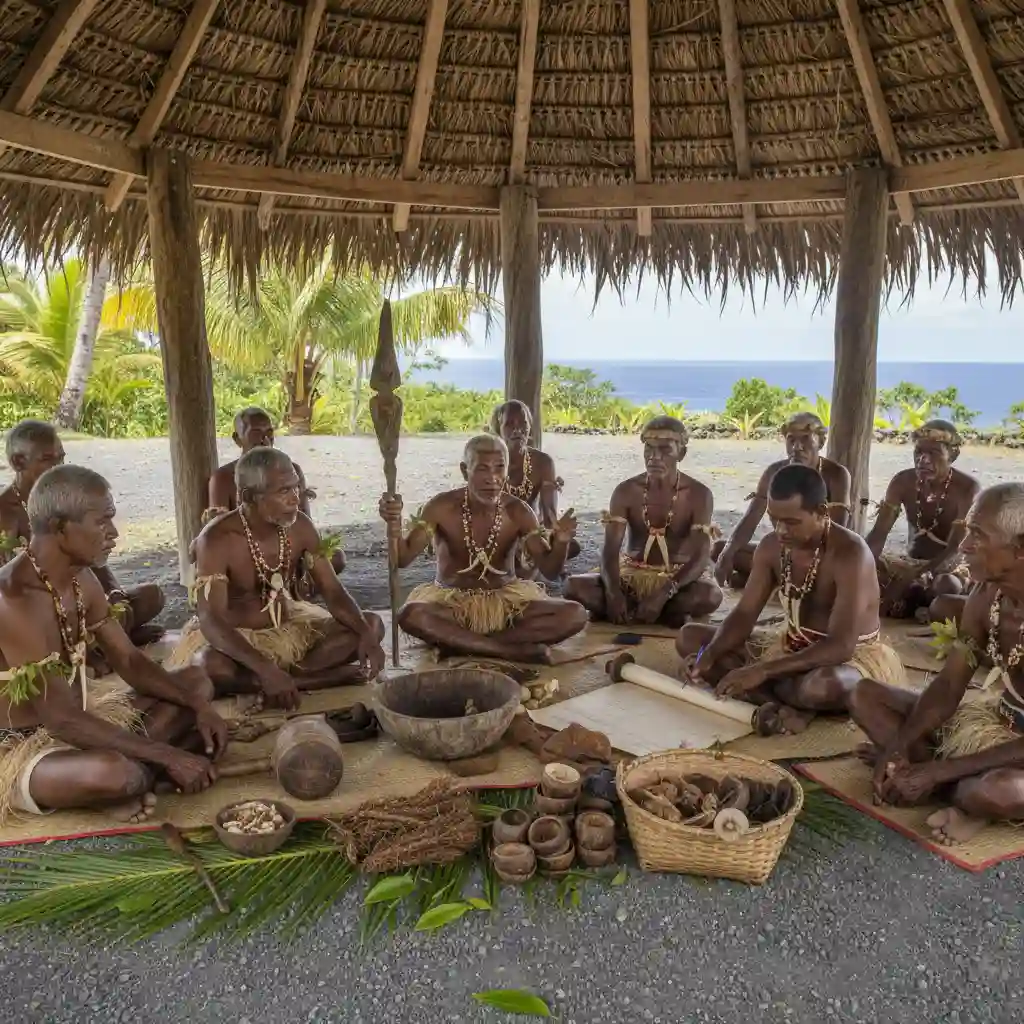
A distinctive feature of Vanuatu’s governance that separates it from many other democracies is the formal constitutional role of traditional chiefs. The National Council of Chiefs, known as the Malvatumauri, is established under the Constitution to advise the government on all matters concerning Ni-Vanuatu custom and language.
The Malvatumauri is composed of custom chiefs elected by their peers from the various Island Councils of Chiefs. While the Malvatumauri does not have legislative power in the sense of passing statutory laws, its influence is profound. Parliament is constitutionally required to consult the Malvatumauri on any bill relating to land tenure or custom. This body ensures that modernization and development do not erode the cultural heritage that defines the nation.
The Judicial System and Customary Law
The judiciary in Vanuatu is independent of the executive and legislative branches, acting as the interpreter of the law and the Constitution. The legal system is a fascinating hybrid, derived from English Common Law, French Civil Law, and indigenous Customary Law.
Structure of the Courts
The hierarchy of courts in Vanuatu is structured as follows:
- The Court of Appeal: The highest court in the land. It hears appeals from the Supreme Court and is constituted by two or more judges of the Supreme Court.
- The Supreme Court: Has unlimited jurisdiction to hear civil and criminal cases. It is presided over by the Chief Justice and other judges. It also has the exclusive jurisdiction to interpret the Constitution.
- The Magistrates’ Court: Handles less serious criminal and civil matters. It is the first point of contact with the formal legal system for many citizens.
- Island Courts: These are unique to Vanuatu. They deal with disputes regarding land ownership and minor disputes, applying customary law rather than strict statutory law.
The Critical Role of Land Tribunals
Land is the most valuable asset in Vanuatu, and under the Constitution, all land belongs to the indigenous custom owners. Disputes over land ownership are frequent and complex. The government has established a system of Customary Land Tribunals to resolve these issues. These tribunals operate outside the standard court hierarchy to settle disputes according to the specific customs of the island or village where the land is located. Decisions made here can eventually be appealed to the Supreme Court, but only on points of law, not on the determination of custom.
Decentralization: Provincial Governments
To ensure that governance reaches the remote islands of the archipelago, Vanuatu is divided into six provinces: Torba, Sanma, Penama, Malampa, Shefa, and Tafea. Each province has a Provincial Government Council responsible for local by-laws, regional planning, and the delivery of basic services.
This decentralization is a vital component of the Vanuatu government system. Given the geographical challenges of an island nation, the central government in Port Vila relies on these provincial bodies to implement national policies. The provinces are funded through a combination of central government grants and local taxation. While they have autonomy in local matters, they remain overseen by the Ministry of Internal Affairs to ensure alignment with national objectives.
Political Parties and Stability
Vanuatu’s political landscape is characterized by a multiplicity of political parties. It is rare for a single party to win a majority in Parliament. Consequently, coalition governments are the norm. While this ensures that various interest groups are represented, it can also lead to political instability, with frequent motions of no confidence and reshuffling of cabinets. However, despite these fluctuations, the democratic institutions of Vanuatu remain resilient, and the transfer of power is consistently peaceful.
Conclusion
The Vanuatu government system is a complex but functioning example of a Pacific democracy. It successfully integrates the rigid structures of Western governance with the fluid, consensus-based traditions of Melanesian culture. From the ceremonial President to the powerful Prime Minister, and from the Supreme Court to the village Island Courts, the system is designed to navigate the challenges of a modern developing nation while honoring the “Kastom” that binds its people together.
People Also Ask
What type of government does Vanuatu have?
Vanuatu is a representative parliamentary democracy with a written constitution. It has a Prime Minister as the head of government and a President as the ceremonial head of state.
Who holds the executive power in Vanuatu?
Executive power is held by the Prime Minister and the Council of Ministers. They are responsible for the day-to-day administration of the country and are answerable to Parliament.
What is the role of the President of Vanuatu?
The President is the Head of State and symbolizes the unity of the nation. The role is largely ceremonial, though the President has reserve powers to appoint the Chief Justice and pardon prisoners.
How often are elections held in Vanuatu?
General elections for the Parliament are held every four years. However, elections can occur sooner if the Parliament is dissolved early due to political instability or a vote of no confidence.
What is the Malvatumauri Council of Chiefs?
The Malvatumauri is a constitutional body composed of custom chiefs. It advises the government on matters relating to custom, culture, and language, playing a vital role in preserving traditional values.
Is the judiciary in Vanuatu independent?
Yes, the Constitution of Vanuatu guarantees the independence of the judiciary. The courts operate separately from the executive and legislative branches to ensure fair and impartial justice.