
Bislama is the national language of Vanuatu, an English-based creole that serves as the lingua franca across the archipelago. To learn Bislama phrases effectively, travelers should focus on phonetic English pronunciations and master the universal preposition “long” and the transitive marker “em.” Gaining proficiency in these basics allows visitors to navigate islands confidently, negotiate fair prices, and demonstrate deep cultural respect to the Ni-Vanuatu people.
What is Bislama and Why Should You Learn It?
Vanuatu is one of the most culturally linguistically diverse nations on Earth, boasting over 113 distinct indigenous languages across its 83 islands. However, the unifying thread that binds this nation together is Bislama. For the intrepid traveler, the decision to learn Bislama phrases is not merely an academic exercise; it is the master key to unlocking authentic experiences in Vanuatu.
Bislama is a form of Melanesian Pidgin, closely related to Tok Pisin in Papua New Guinea and Pijin in the Solomon Islands. Its vocabulary is approximately 95% English-derived, yet the grammar and syntax are distinctly Melanesian. This unique hybrid history dates back to the “blackbirding” era of the 19th century, where laborers from across the Pacific developed a common tongue on plantations in Australia and Fiji before returning home.
When you speak Bislama, even brokenly, you signal to the local Ni-Vanuatu (Ni-Van) population that you are not just a tourist observing from a distance, but a guest willing to engage on their terms. It transforms transactions into interactions and smiles into genuine connections. While English and French are also official languages, they are often viewed as the languages of school and government. Bislama is the language of the heart, the home, and the street.
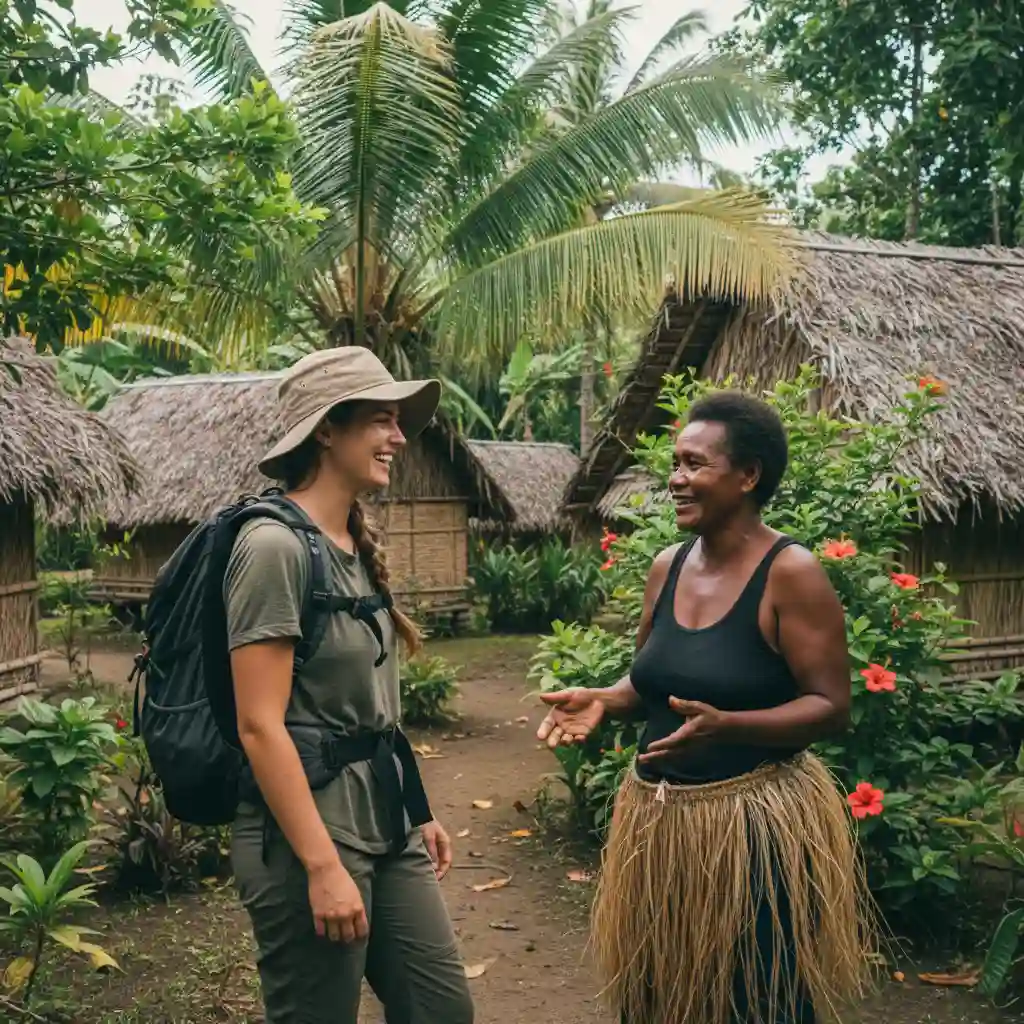
Essential Greetings and First Impressions
In Vanuatu, acknowledging others is a strict social norm. Walking past someone without a nod, a smile, or a verbal greeting is considered rude. The culture is warm and communal, and your greetings set the tone for all subsequent interactions.
Common Greeting Phrases
The most fundamental word you will use is “Halo.” While it sounds exactly like the English “Hello,” it carries a weight of recognition. However, to truly sound like a local, you need to expand your repertoire.
- “Halo, olsem wanem?” (Hello, how are you?): This is the standard opener. “Olsem wanem” literally translates to “All the same what?” or “How is it?”
- “Mi gud, be yu?” (I am good, but you?): This is the polite response. It is crucial to reciprocate the question.
- “Gud moning” / “Gud aftenun” / “Gud naet”: These are self-explanatory, but note that “Gud naet” is usually used only when parting ways to sleep, not just as an evening greeting.
- “Nem blong yu wanem?” (What is your name?): Literally “Name belong you what name?”
- “Nem blong mi [Name]” (My name is [Name]): Use this to introduce yourself.
- “Tata” or “Lukim yu” (Goodbye / See you): “Lukim yu” implies you will see them again, which is a nice sentiment even if you are leaving the island.
Cultural Tip: The “eyebrow flash” is a non-verbal greeting used constantly in Vanuatu. If you make eye contact with someone from a distance, raising your eyebrows quickly is equivalent to saying “hello” or acknowledging their presence.
Understanding the Grammar: The Key to Fluency
You cannot simply memorize a dictionary to learn Bislama; you must understand the engine that drives the language. Bislama is efficient. It strips away the complexities of English tense and conjugation, replacing them with markers. Understanding two specific words will accelerate your learning curve by 50%.
The Magic Word: “Long”
In English, we struggle with prepositions: at, in, on, to, from, with, about. In Bislama, there is essentially only one preposition: “Long.”
- “I go to the market” = “Mi go long maket.”
- “The cup is on the table” = “Kap i stap long tebol.”
- “I am from Australia” = “Mi kam long Ostrelia.”
This simplification makes constructing sentences incredibly fast for English speakers once they stop overthinking the specific preposition.
The Transitive Marker: “Em”
If a verb is being done to something, it usually ends in “-em” (derived from “him” or “them”).
- Like becomes Laekem (e.g., “Mi laekem bia” – I like beer).
- Want becomes Wantem (e.g., “Mi wantem wota” – I want water).
- Eat becomes Kaekae (intransitive) or Kaekaem (transitive).

How to Ask for Directions in Vanuatu
Whether you are exploring the bustling streets of Port Vila or trekking to a waterfall on Espiritu Santo, knowing how to ask for directions is vital. While Google Maps exists, it is often unreliable in the outer islands. Local knowledge is king.
The primary mode of transport in towns is the minibus. These are identifiable by the “B” on their license plate. You don’t look for a bus stop; you simply wave them down. To get around, you need these phrases:
- “Yu go long [Destination]?” (Are you going to [Destination]?): Always ask the driver before getting in.
- “Wea rod blong go long…?” (Where is the road to go to…?): Essential for hikers.
- “Stop!”: Shout this when you want to get off the bus.
- “Hamas long pas?” (How much for the fare?): Usually, fares are fixed (e.g., 150 Vatu in town), but always good to check.
Directional Vocabulary
Locals might not use “left” and “right” as frequently as cardinal directions or landmarks, but these terms are understood:
- Left: Lefsaed
- Right: Raetsaed
- Straight ahead: Stret
- Go up / Go down: Go antap / Go daon
- Close by: Klousap
- Far away: Longwe
Shopping, Bargaining, and Numbers
Shopping in the “Mamas Markets” is a highlight of any Vanuatu trip. The produce is organic, vibrant, and sold directly by the growers. A critical cultural note: Bargaining is generally NOT practiced in Vanuatu markets. Unlike in Bali or Thailand, the price marked is the fair price. Attempting to haggle over 50 Vatu can be seen as disrespectful to the hard work of the vendor.
However, you still need to discuss prices and identify items.
Key Shopping Phrases
- “Hamas long hemia?” (How much for this?): Point to the item (often a pile of vegetables) and ask.
- “Mi wantem pem…” (I want to buy…): Use this to initiate a transaction.
- “Yu gat…?” (Do you have…?): Useful if you are looking for something specific, like “Yu gat banana?”
- “Tankyu tumas” (Thank you very much): Always finish with gratitude.
Counting in Bislama
Numbers are straightforward and English-based:
- One: Wan
- Two: Tu
- Three: Tri
- Four: Fo
- Five: Faef
- Ten: Ten
- One hundred: Wan handred
- One thousand: Wan taosen
Currency is the Vatu (VT). Locals often speak in thousands, so “Tu taosen” is 2,000 VT (roughly $25 AUD/USD depending on exchange rates).
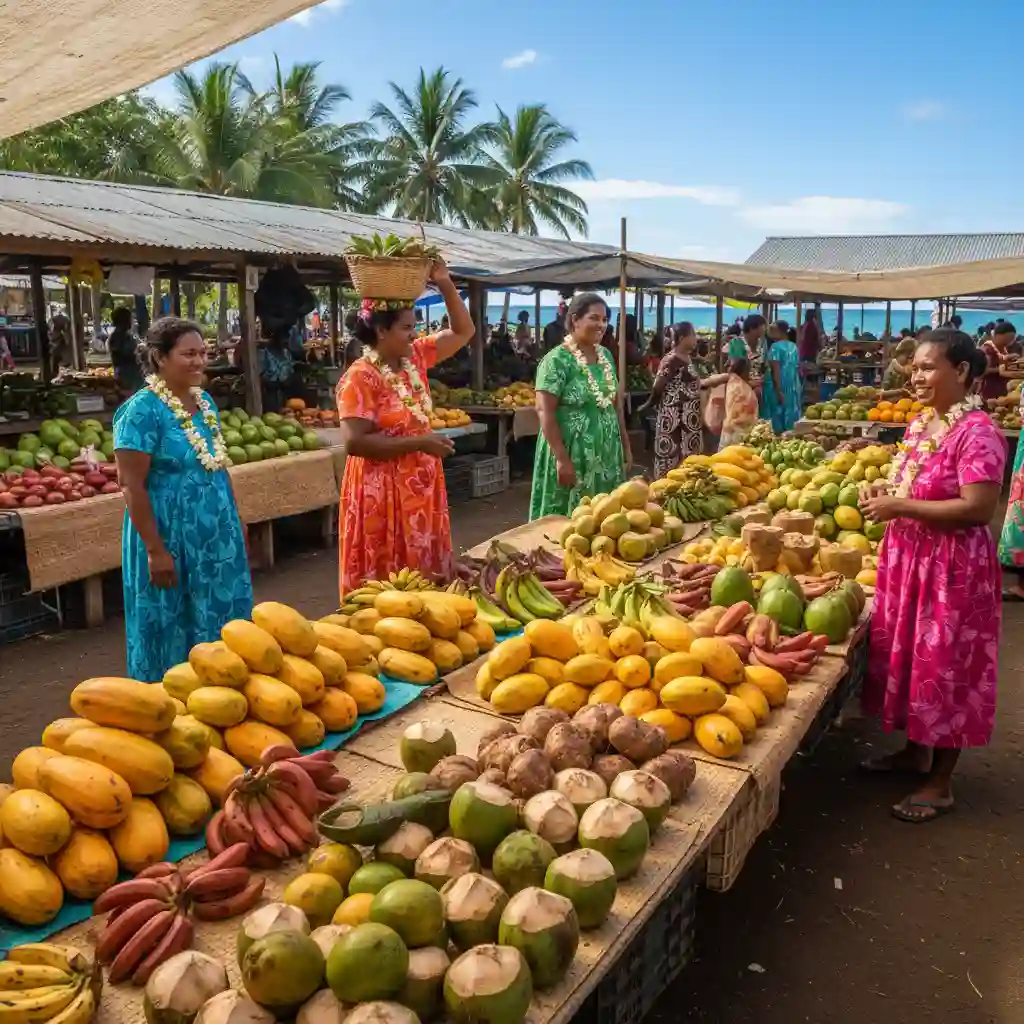
Dining and the Nakamal Culture
Food is love in Vanuatu. Local cuisine often involves root vegetables like taro, yam, and manioc, along with fresh fish and coconut cream. However, the true social hub of Vanuatu is the Nakamal (Kava bar). Kava is a sedative drink made from the pepper plant root, and knowing the etiquette here is a rite of passage for travelers.
Restaurant and Food Phrases
- “Mi hanggre” (I am hungry): Use this to express your state.
- “Mi tosta” (I am thirsty): Often used when asking for water or beer.
- “Wota” (Water): Simple enough.
- “Bia” (Beer): Usually Tusker, the local brew.
- “Swit” (Delicious/Sweet): “Kaekae ia i swit tumas” means “This food is very delicious.”
- “Fulap” (Full): “Belly blong mi i fulap” (My stomach is full).
Kava Terminology
If you visit a Nakamal (usually indicated by a red lantern outside), keep your voice low (whispering is the custom) and use these terms:
- “Wan shell”: A standard serving of kava, served in a coconut shell.
- “Taso”: A small snack eaten immediately after drinking kava to cleanse the palate (often fruit or a savory bite).
- “Kale”: The feeling of the kava taking effect (relaxation).
Emergency Phrases and Health Safety
While Vanuatu is generally very safe, accidents happen. Being able to communicate distress or medical needs in Bislama can be critical, especially if you are in a remote village where English proficiency might be lower than in the capital.
The word for “sick” is “Sik.” The word for “pain” is “So” (Sore).
Critical Phrases for Help
- “Help!”: “Help!” (Universally understood, but “Helpem mi!” is the Bislama phrase).
- “Yu save helpem mi?” (Can you help me?): A polite request for assistance.
- “Mi sik” (I am sick): General statement of illness.
- “Leg blong mi i so” (My leg hurts): You can replace “leg” with “hed” (head), “bell” (stomach), or “bak” (back).
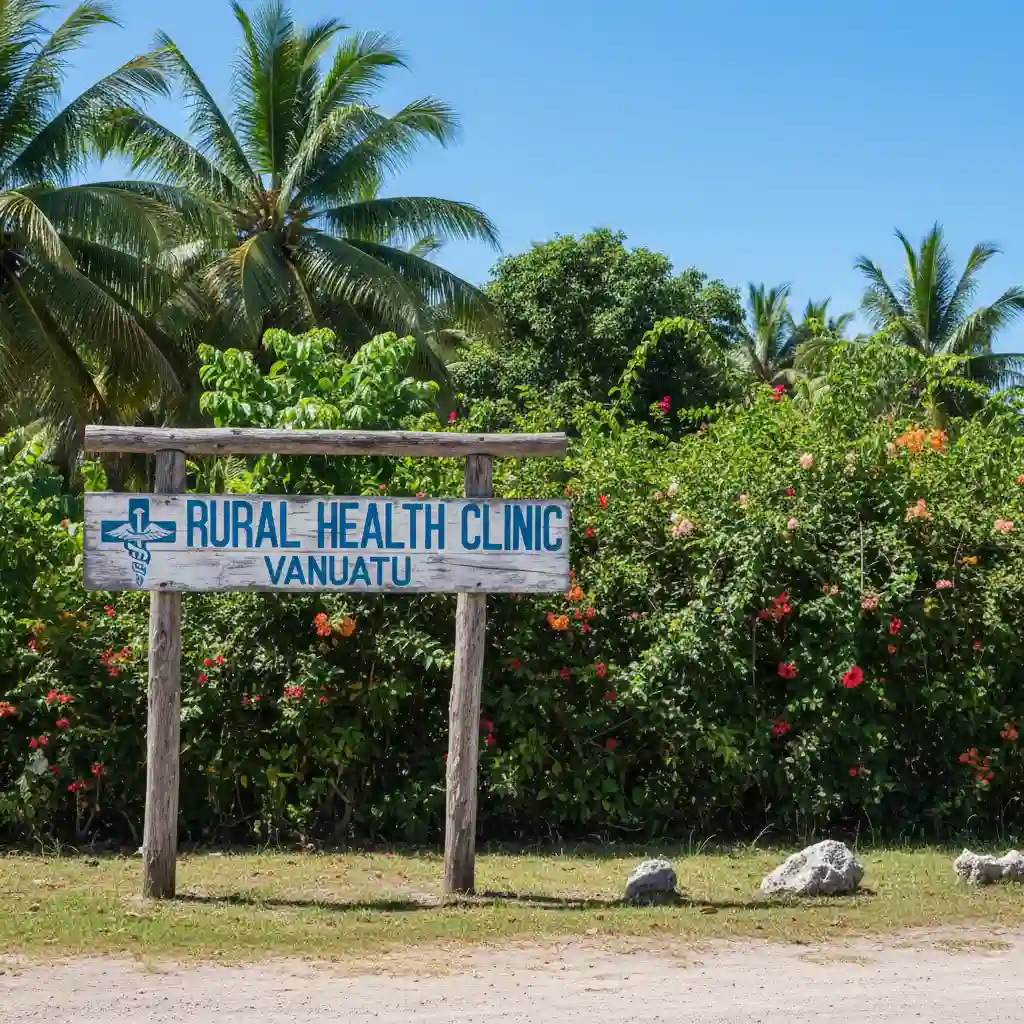
- “Wea haospitel?” (Where is the hospital?): In smaller areas, ask for the “Dispensari” (Dispensary/Clinic).
- “Mi lus” (I am lost): Crucial if you lose your way on a hike.
- “Singaotem polis” (Call the police): “Singaotem” means to call out for or summon.
Tropical Health Terms
Because of the coral reefs and tropical climate, two common issues are cuts and dehydration.
- “Krak” or “So”: A cut or wound. Coral cuts get infected easily, so ask for “Meresin” (Medicine/Antiseptic).
- “San i bonem mi” (The sun burned me / Sunburn).
Conclusion: Practice Makes Perfect
The beauty of learning Bislama phrases lies in the reaction you will receive. Ni-Vanuatu people are incredibly encouraging teachers. They will not mock your accent; they will celebrate your effort. By mastering these essential phrases—from the simple “Halo” to the navigational “Wea rod?”—you bridge the gap between visitor and friend. You stop being a spectator of the island paradise and become a participant in its vibrant culture.
Start with the greetings. Use them every single day. Listen to the rhythm of the locals, observe their body language, and don’t be afraid to make mistakes. In Vanuatu, a smile and a genuine attempt to speak Bislama are the only passports you need to the heart of the nation.
People Also Ask
Is Bislama hard to learn for English speakers?
No, Bislama is considered one of the easiest languages for English speakers to learn. Since 95% of the vocabulary is derived from English, the words are familiar. The grammar is also much simpler than English, with no complex verb conjugations or gendered nouns.
Do everyone in Vanuatu speak English?
While English is an official language and taught in schools, not everyone is fluent, especially in rural areas and outer islands. Bislama is the true lingua franca spoken by almost everyone. French is also widely spoken in certain regions.
What does ‘Tankyu Tumas’ mean?
‘Tankyu Tumas’ translates to ‘Thank you very much.’ It is the standard and polite way to express gratitude in Vanuatu. ‘Tumas’ comes from ‘Too much’ (meaning ‘a lot’ or ‘very’).
How do you say ‘Goodbye’ in Bislama?
You can say ‘Tata,’ which is casual. A more common phrase is ‘Lukim yu’ (See you), or ‘Ale’ (Okay/Bye) which is used frequently to end a conversation and part ways.
Is it rude not to speak Bislama in Vanuatu?
It is not considered rude to speak English, as locals understand you are a visitor. However, learning a few basic phrases like greetings and ‘Thank you’ is seen as a sign of great respect and will result in warmer service and friendlier interactions.
What is the best way to practice Bislama before traveling?
The best way is to listen to Bislama radio stations online or watch YouTube videos featuring Ni-Vanuatu speakers to get used to the accent and speed. Reading Bislama news sites can also help you recognize the phonetic spelling of English words.