
Bislama grammar rules follow a Subject-Verb-Object structure characterized by the absence of verb conjugation for person or tense. Instead, it utilizes pre-verbal markers like “i” and “oli” to indicate the subject, while tense is denoted by separate markers such as “bae” (future) or “bin” (past). Notably, Bislama features a complex pronoun system distinguishing between inclusive and exclusive “we,” as well as singular, dual, trial, and plural numbers.
Bislama is more than just a lingua franca; it is the heartbeat of Vanuatu. As one of the three official languages alongside English and French, it serves as the primary bridge between the archipelago’s 83 islands and over 113 distinct vernacular languages. For travelers, expatriates, and linguists alike, mastering Bislama grammar rules is the key to unlocking authentic interactions in this Pacific nation. Unlike English, where grammar is often hidden in inflection, Bislama wears its logic on its sleeve, making it accessible yet deeply nuanced.
While often categorized as a form of Melanesian Pidgin English, Bislama has evolved into a fully creolized language with a standardized orthography and distinct grammatical consistency. Understanding these rules is not merely an academic exercise; it is a sign of respect that opens doors to the local “kastom” (culture) and allows for deeper connection with the Ni-Vanuatu people.
What Are the Rules for Bislama Pronouns and Verbs?
The most distinct and initially challenging aspect of Bislama grammar rules for English speakers is the pronoun system. While English relies heavily on context to differentiate between “we” (you and I) and “we” (me and them), Bislama makes this distinction explicit. Furthermore, Bislama retains a feature common in Oceanic languages: number specificity beyond just singular and plural.
Understanding the Four Grammatical Numbers
In Bislama, pronouns change based on how many people are involved. You must determine if you are speaking about one person, two people, three people, or four/more people.
- Singular: One person (Mi, Yu, Hem).
- Dual: Two people. This usually ends in -tu (e.g., Yumitu).
- Trial: Three people. This ends in -trifala (e.g., Yumitrifala).
- Plural: Four or more people. This is the general plural form.
The Inclusive vs. Exclusive “We”
This is the most critical rule to master to avoid confusion. When saying “we,” you must decide if the person you are talking to is included in the group.
- Inclusive (Yumi): Includes the speaker and the listener. “Yumi go long market” means “You and I (and perhaps others) are going to the market.”
- Exclusive (Mifala): Excludes the listener. “Mifala i go long market” means “I and my group are going to the market, but you are staying here.”
Comprehensive Pronoun Chart
Here is the breakdown of the subject pronouns:
- 1st Person Singular: Mi (I)
- 2nd Person Singular: Yu (You)
- 3rd Person Singular: Hem (He/She/It)
- 1st Person Dual (Inc): Yumitu (We two, including you)
- 1st Person Dual (Exc): Mitufala (We two, excluding you)
- 2nd Person Dual: Yutu (You two)
- 3rd Person Dual: Tufala (Those two)
- 1st Person Trial (Inc): Yumitrifala (We three, including you)
- 1st Person Trial (Exc): Mitrifala (We three, excluding you)
- 2nd Person Trial: Yutrifala (You three)
- 3rd Person Trial: Trifala (Those three)
- 1st Person Plural (Inc): Yumi (We all)
- 1st Person Plural (Exc): Mifala (We, but not you)
- 2nd Person Plural: Yufala (You all)
- 3rd Person Plural: Olgeta (They)
Verb Markers: The Role of “i” and “oli”
In English, verbs change form (run vs. runs). In Bislama, the verb stays the same, but a predicate marker is inserted between the subject and the verb. This is a non-negotiable Bislama grammar rule.
- “i”: Used for 3rd person singular (Hem), and 1st/2nd/3rd person dual and trial, and inclusive plural (Yumi).
Example: Hem i kakae (He eats). Tufala i wokbaot (Those two walk). - “oli”: Used exclusively for 3rd person plural (Olgeta) or when the subject is a plural noun.
Example: Olgeta oli slip (They sleep). Ol dog oli bark (The dogs bark). - Exceptions: The markers are generally omitted after “Mi” and “Yu”.
Example: Mi kakae (I eat), NOT Mi i kakae.
How Is Sentence Structure Formed in Bislama?
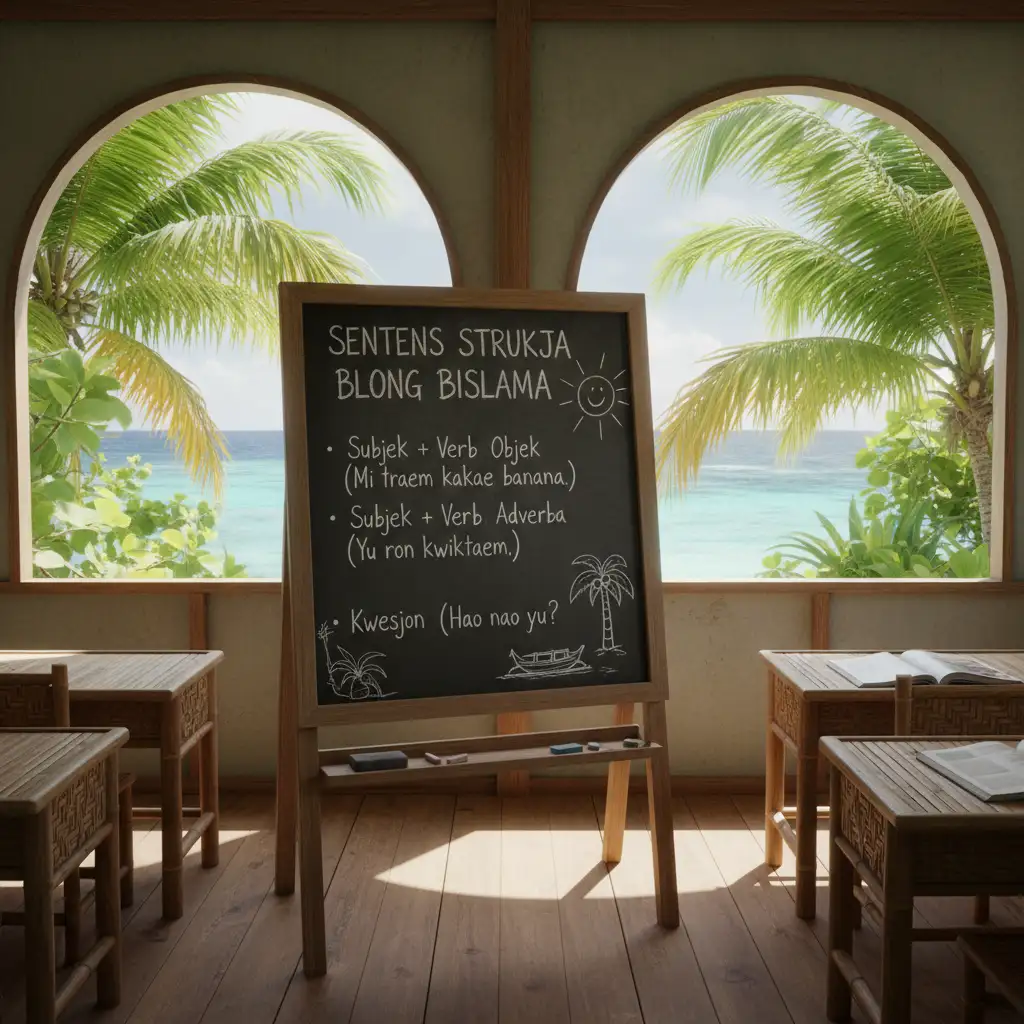
Bislama strictly follows a Subject-Verb-Object (SVO) pattern. However, the nuance lies in how adjectives are handled and how transitive verbs are marked.
Transitive Verbs and the “-em” Suffix
If a verb has a direct object, it almost always takes the suffix -em (or sometimes -im/-um depending on vowel harmony, though -em is standard). This signals that the action is being done to something.
- Intransitive (No Object): Mi kakae. (I am eating.)
- Transitive (With Object): Mi kakaem kumala. (I am eating sweet potato.)
- Intransitive: Yu dring. (You are drinking.)
- Transitive: Yu dringim wota. (You are drinking water.)
Tense Markers
Since verbs do not conjugate, Bislama uses specific words to indicate time. These are placed before the verb (and usually before the predicate marker “i” if present, though placement can vary slightly with “bae”).
- Future (Bae): Bae mi go. (I will go.) / Hem bae i go. (He will go.)
- Past (Bin): Mi bin go. (I went.) / Hem i bin go. (He went.)
- Continuous/Progressive (Stap): Mi stap kakae. (I am eating.) / Hem i stap slip. (He is sleeping.)
Adjectives and the “-fala” Suffix
Many common adjectives in Bislama take the suffix -fala when they precede a noun. This is a derivation from the English “fellow” but serves purely as a grammatical marker.
- Bigfala man (Big man)
- Smolfala haos (Small house)
- Niufala trak (New truck/car)
However, when the adjective comes after the verb (predicate adjective), the suffix is dropped:
Man ia i big. (That man is big.)
How to Use “Long” and “Blong” Correctly?
Bislama simplifies the complex English preposition system (in, at, on, to, from, with, by) into essentially two powerful words: Long and Blong. Mastering these is essential for constructing complex sentences.

“Long”: The Universal Preposition
“Long” covers almost all spatial and temporal relationships. Context is key to understanding its meaning.
- To: Mi go long Vila. (I go to Port Vila.)
- At/In: Mi stap long haos. (I am at/in the house.)
- From: Mi kam long Santo. (I come from Santo.)
- On: Buk i stap long tebol. (The book is on the table.)
- With (Instrumental): Katemaot long naef. (Cut it with a knife.)
- About: Yumi storian long politik. (We are chatting about politics.)
“Blong”: Possession and Purpose
“Blong” (derived from “belong”) indicates ownership, origin, or purpose.
- Possession: Haos blong mi. (My house / The house of me.)
- Country of Origin: Man blong Ostrelia. (Man from Australia.)
- Purpose: Wota blong dring. (Water for drinking.)
What Are Common Bislama Idioms and Phrases?
To sound less like a tourist and more like a local, you need to incorporate idioms. Bislama is rich in metaphorical language that reflects the island lifestyle.

Essential Idioms
- Ale: This is the most versatile word. It can mean “Okay,” “Alright,” “Goodbye,” or “I understand.” It is often used to end a conversation.
Usage: “Ale, tata!” (Okay, goodbye!) - Storian: To chat or tell stories. It implies a relaxed, informal conversation.
Usage: “Kam, yumi storian.” (Come, let’s chat.) - Kilim: Be careful! While it comes from “kill,” it usually means to hit, strike, or beat. To say “kill dead,” you say kilim i ded.
Usage: “Kilim moskito.” (Swat the mosquito.) - Swim: This usually means to bathe or shower, not just swimming in the ocean.
Usage: “Mi go swim.” (I am going to take a shower.) - Garem: To have or possess (from “got ‘im”).
Usage: “Yu garem mane?” (Do you have money?) - Sperem: Literally “spear him,” but often used for piercing or going through something.
Usage: “Sperem bus.” (To trek through the bush/jungle.) - Antap: Literally “on top,” but often used to mean “high quality” or “awesome.”
Usage: “Kakae ia i antap!” (This food is excellent!)
Tips for Fluency in Bislama
Learning Bislama grammar rules is the foundation, but fluency comes from immersion. The vocabulary is largely English-based (approx. 90-95%), but the grammar is Oceanic. This “False Friend” effect can trick you into thinking you understand more than you do.
1. Listen to the Rhythm: Bislama has a distinct cadence. Listen to VBTC (Vanuatu Broadcasting and Television Corporation) radio online. Pay attention to how the markers “i” and “oli” flow into the verbs.
2. Don’t Translate Word-for-Word: Avoid translating English sentences directly. For example, “I am hungry” is not “Mi em hangri.” It is “Mi hangri” (I hungry). The “to be” verb is generally omitted in descriptive sentences.
3. Use the “Check” Question: If you aren’t sure if someone understood you, end your sentence with “…si?” or “…i stret?” (is that right?).
4. Master the Eyebrow Flash: In Vanuatu, a quick raising of the eyebrows is a standard non-verbal greeting or affirmation (Yes/I agree). Using this correctly will earn you immense local credibility.
People Also Ask
Is Bislama hard to learn for English speakers?
No, Bislama is generally considered one of the easiest languages for English speakers to learn. Since about 90% of the vocabulary is derived from English, the learning curve for words is low. The main challenge lies in mastering the distinct grammar rules, specifically the pronoun system and verb markers.
What is the difference between ‘yumi’ and ‘mifala’?
The difference is inclusivity. ‘Yumi’ (inclusive) means “we” including the person you are speaking to. ‘Mifala’ (exclusive) means “we” excluding the person you are speaking to. Using the wrong one can change the meaning of a sentence entirely.
How do you say hello in Bislama?
There isn’t a single word for “hello.” The most common greetings are “Gud moning,” “Gud aftanun,” or “Gud naet.” Informally, you might say “Halo” or simply raise your eyebrows in acknowledgment.
Do verbs change tense in Bislama?
No, verbs in Bislama do not conjugate or change form for tense. Instead, tense is indicated by placing markers before the verb: ‘bae’ for future, ‘bin’ for past, and ‘stap’ for continuous action.
What does ‘long’ mean in Bislama?
‘Long’ is the universal preposition in Bislama. Depending on the context, it can mean to, at, in, on, from, with, or about. It connects verbs to nouns in almost all spatial or temporal contexts.
Can I just speak English in Vanuatu?
While English is an official language and widely spoken in Port Vila and Luganville, Bislama is the primary language of daily life and the only language common to all islands. Knowing Bislama grammar rules is essential for travel to outer islands and for respectful cultural interaction.