
Vanuatu body language relies heavily on subtle cues and respect-based hierarchy known as Kastom. Key behaviors include using the “eyebrow flash” to signal agreement or acknowledgement, avoiding prolonged direct eye contact with authority figures to show deference, and strictly refraining from touching anyone’s head. Understanding these non-verbal signals is essential for respectful communication in Ni-Vanuatu culture.
The Cultural Context of Non-Verbal Communication
In the archipelago of Vanuatu, communication extends far beyond the spoken word. While Bislama, English, and French are the official languages, and over 100 vernacular languages exist, the silent language of the body remains a universal dialect across the islands. For the Ni-Vanuatu people (citizens of Vanuatu), non-verbal communication is deeply rooted in Kastom—the traditional culture, law, and religion that governs daily life.
Understanding Vanuatu body language is not merely a travel tip; it is a fundamental requirement for anyone wishing to engage deeply and respectfully with the local population. In a society where community harmony and hierarchy are paramount, the way you hold yourself, where you look, and how you move can speak louder than your words. A traveler who masters these silent cues demonstrates a level of respect that is instantly recognized and appreciated by the locals.
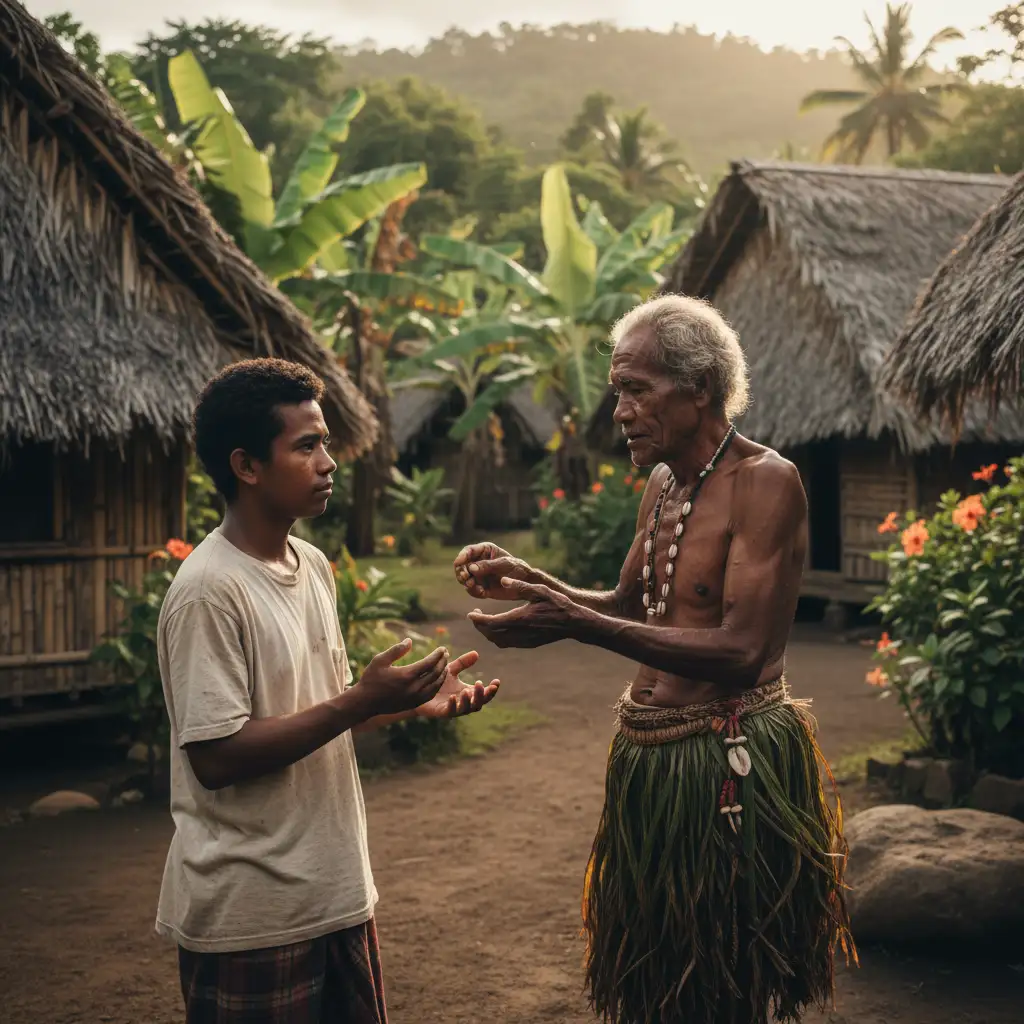
Unlike Western cultures, which often prioritize directness and assertiveness, Melanesian communication styles are often indirect. This indirectness preserves social harmony and prevents loss of face. Therefore, reading between the lines—or rather, reading the body—becomes a critical skill. Whether you are negotiating a taxi fare in Port Vila or participating in a kava ceremony on Tanna, your non-verbal conduct sets the tone for the interaction.
Greeting Customs in Vanuatu
How do people greet each other in Vanuatu?
Greetings in Vanuatu are warm, genuine, and unhurried. The standard greeting involves a handshake, but it differs significantly from the firm, pump-action grip common in the corporate West. The Ni-Vanuatu handshake is typically soft, loose, and lingering. It is not uncommon for two people to hold hands for the duration of a conversation, regardless of gender. Pulling your hand away too quickly can be perceived as cold or dismissive.
When walking through a village or even along the streets of Luganville, it is customary to acknowledge everyone you pass. Ignoring a passerby is considered rude. A simple nod, a smile, or the raising of eyebrows is sufficient. This constant acknowledgement reinforces the communal bond that defines island life.
The Eyebrow Flash
One of the most ubiquitous and versatile non-verbal signals in Vanuatu is the “eyebrow flash.” This involves a quick raising and lowering of the eyebrows.
- Agreement: If you ask a question like “Is this the way to the market?” a silent raising of the eyebrows means “Yes.”
- Acknowledgement: When passing someone on the road, the eyebrow flash serves as a silent “Hello.”
- Understanding: During a conversation, it signals that the listener is following what you are saying.
Travelers often mistake this gesture for surprise or skepticism, but in the context of Vanuatu body language, it is almost always an affirmative or positive signal.

Personal Space and Physical Contact
What are the rules regarding personal space?
Concepts of personal space in Vanuatu are fluid and context-dependent. In public transport, such as the ubiquitous mini-buses, passengers often sit packed tightly together without complaint. Physical proximity in these functional settings is not seen as an invasion of privacy but a necessity of shared resources.
However, distinct rules apply to gender relations. While Ni-Vanuatu people are very tactile with members of the same sex—men holding hands with men, and women with women is a common sign of friendship—public displays of affection (PDA) between couples are generally frowned upon, especially in rural areas. Kissing or hugging a romantic partner in public can cause embarrassment to locals. It is advisable for traveling couples to maintain a modest distance in public spaces to respect local sensibilities.
The Sacred Head
Perhaps the most critical rule regarding physical contact involves the head. In Melanesian culture, the head is considered the most sacred part of the body, the seat of a person’s mana (spiritual power). Consequently, you should never touch someone’s head without express permission.
This rule applies even to children. While it may be a reflex for Westerners to pat a cute child on the head, this gesture can be deeply offensive to traditional parents. If you accidentally touch someone’s head, apologize immediately. Furthermore, you should avoid passing objects over someone’s head or standing in a position where your body is physically higher than a seated chief or elder, as this symbolically places you “above” their mana.
Eye Contact and Facial Expressions
Is direct eye contact considered rude?
In many Western societies, direct eye contact is associated with honesty and confidence. In Vanuatu, the dynamics are more nuanced. While eye contact is used during greetings, prolonged or intense staring can be interpreted as aggressive or challenging. This is particularly true when interacting with someone of higher status, such as a village chief, or across gender lines.
When speaking with someone of authority, a local might lower their gaze as a sign of respect. If a Ni-Vanuatu person avoids your eyes while you are speaking to them, do not assume they are being dishonest or evasive. They are likely showing you deference. Reciprocating this by not maintaining an unyielding stare can help put your counterpart at ease.

The Smile of Embarrassment
Smiling is a universal sign of happiness, and the Ni-Vanuatu are famous for their genuine, radiant smiles. However, a smile or a giggle can also mask embarrassment, confusion, or a lack of understanding. If you ask a question and receive a smile but no clear answer, it may mean the person did not understand you but does not want to be rude by saying so, or that the answer is negative, and they wish to avoid the directness of a “no.” In these situations, rephrasing the question gently or letting the matter drop is the polite course of action.
Gestures to Avoid and Taboos
How to beckon someone correctly
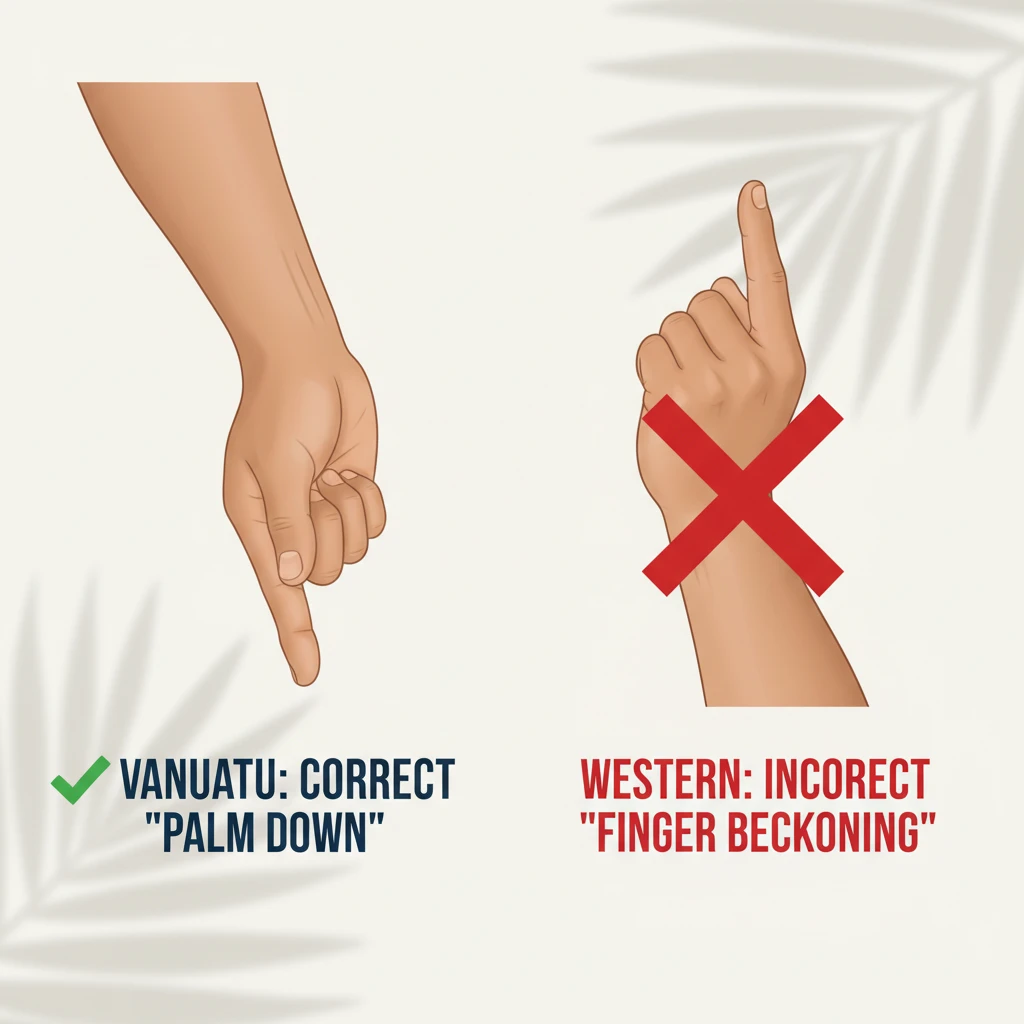
Gestures that are innocuous in one culture can be offensive in another. A prime example in Vanuatu is the method of beckoning someone. Using a single index finger to call someone (curling it towards you) is considered extremely rude and is often associated with calling an animal.
To beckon someone respectfully in Vanuatu:
- Extend your arm forward.
- Turn your palm to face the ground.
- Make a scratching or sweeping motion with your fingers towards your body.
This “palm-down” wave is the standard and polite way to signal “come here” to a taxi, a waiter, or a new friend.
Hands on Hips
Standing with your hands on your hips (the “akimbo” stance) is frequently interpreted as a sign of aggression, arrogance, or anger. In a village setting, adopting this posture can inadvertently signal that you are looking for a fight or that you disapprove of the situation. It is best to keep your hands by your sides or clasped loosely to convey openness and relaxation.
Stepping Over People
In the communal living arrangements of traditional villages, people often sit on woven mats on the floor. It is strictly taboo to step over a person’s legs or body. If you need to pass, you must walk around them. If space is tight and you absolutely must pass near them, you should crouch low, extend a hand downwards, and say “skus mi” (excuse me) while passing behind them if possible. This lowers your physical height and demonstrates respect for their personal space.
Dress Code as Non-Verbal Communication
Your attire is the first non-verbal signal you send before you even come within speaking distance. In Vanuatu, modesty is a virtue. While swimwear is perfectly acceptable at resorts, beaches, and designated tourist swimming holes, wearing bikinis or shirtless attire in villages, markets, or town centers is considered disrespectful.
By dressing modestly—covering shoulders and knees—you signal that you respect local Kastom. This non-verbal display of respect often results in warmer hospitality and more authentic interactions with locals. Women, in particular, should be aware that wearing very short skirts or revealing tops in rural areas can be seen as an invitation, or simply as poor manners.
Frequently Asked Questions
Do people shake hands in Vanuatu?
Yes, handshakes are the standard greeting. However, they are typically soft, loose, and may last for a long time during the conversation. A firm, aggressive handshake is not the norm.
Is eye contact rude in Vanuatu?
Prolonged, intense eye contact can be seen as aggressive or challenging, especially towards authority figures. Moderate eye contact is fine, but lowering your gaze shows respect.
What does raising eyebrows mean in Vanuatu?
Raising the eyebrows (the “eyebrow flash”) is a very common non-verbal cue that signifies “yes,” agreement, or acknowledgement. It is a positive signal, not a sign of surprise.
Can I hold hands in public in Vanuatu?
Holding hands with a romantic partner (PDA) is generally frowned upon in public, especially in rural areas. However, friends of the same sex holding hands is a common and acceptable sign of friendship.
Why shouldn’t I touch someone’s head in Vanuatu?
The head is considered the most sacred part of the body and the seat of a person’s mana (spiritual power). Touching it without permission is a serious taboo and is considered highly disrespectful.
How do I call someone over politely in Vanuatu?
Never use a single curled finger. Instead, extend your hand with the palm facing down and make a sweeping motion with your fingers towards yourself.