
To learn Bislama online effectively, combine the comprehensive Peace Corps Vanuatu Language Manual with the Australian National University’s open-access audio archives. Supplement these primary texts by using Terry Crowley’s digital dictionary for vocabulary, listening to VBTC live radio streams for auditory immersion, and engaging with native speakers on language exchange platforms to master the distinct Melanesian grammar and pronunciation.
Bislama is more than just a means of communication; it is the heartbeat of Vanuatu. As the national language and the most widely spoken lingua franca across the 83 islands of this Melanesian archipelago, mastering Bislama unlocks a level of cultural access that English or French simply cannot provide. Whether you are an aid worker, a researcher, a digital nomad planning a sabbatical, or a traveler seeking a deeper connection with the Ni-Vanuatu people, learning this English-based Creole is your gateway to authentic interaction.
While resources for Bislama are not as ubiquitous as those for Spanish or Mandarin, high-quality materials do exist if you know where to look. This guide serves as the definitive encyclopedia for digital learning resources, structured to take you from a novice to a confident speaker through online tools, immersion techniques, and authoritative texts.
What are the Best Online Courses for Learning Bislama?
Unlike major world languages that are supported by apps like Duolingo or Rosetta Stone, Bislama learning relies heavily on academic and governmental archives. The most effective “courses” are often digitized manuals developed for volunteers and diplomats.

The Peace Corps Vanuatu Language Manual
The absolute gold standard for self-directed learning is the Peace Corps training material. These documents were meticulously crafted to take volunteers with zero prior knowledge to a level of functional fluency within three months. The manual is often available as a PDF through various educational repositories or the Peace Corps digital library.
The curriculum typically covers:
- Survival Bislama: Market shopping, asking for directions, and greetings.
- Grammar Drills: Extensive practice on the predicate marker “i” and pronoun structures.
- Cultural Context: Lessons are woven with Kastom (custom) notes, explaining why you say certain things, not just how.
Australian National University (ANU) Resources
The Australian National University has long been a hub for Pacific studies. Their College of Asia and the Pacific often hosts open-access materials tailored for researchers. Look for their audio archives which feature recordings of native speakers. Listening to these recordings is crucial because Bislama spelling is phonetic, but the cadence and intonation—specifically the “sing-song” quality of questions—can only be learned through listening.
Live Lingua Project
The Live Lingua Project hosts a digitized version of the “Bislama: An Introduction to the National Language of Vanuatu” textbook. This resource is excellent for visual learners who prefer reading structured dialogues. It breaks down lessons into thematic units, such as “At the Clinic,” “In the Village,” and “The Kava Bar,” providing vocabulary relevant to specific social settings.
Where Can I Find Bislama Dictionaries and Phrasebooks?
A robust vocabulary is the engine of fluency. While Bislama is an English-based Creole (roughly 90-95% of the vocabulary is derived from English), false cognates and specific semantic shifts can trip up beginners. You cannot simply speak English with a heavy accent and expect to be understood.
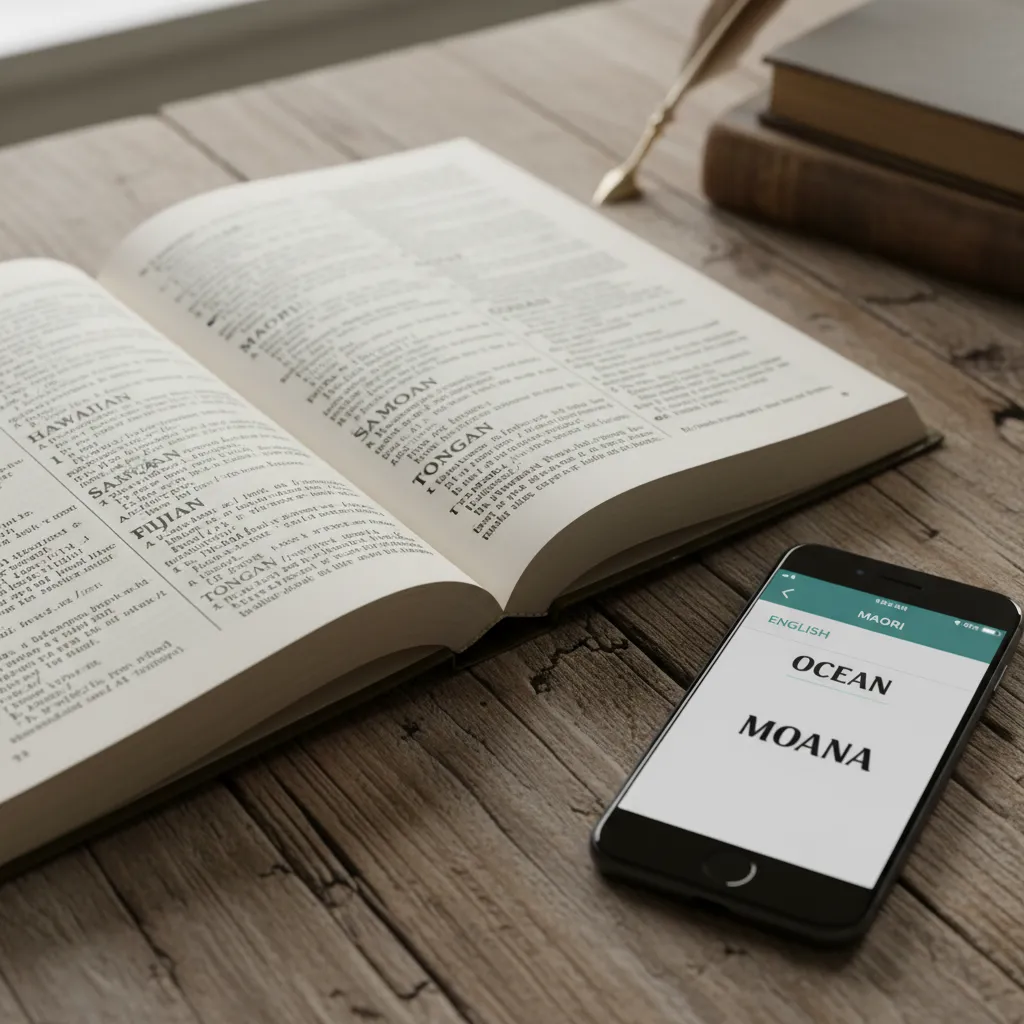
Crowley’s Dictionary of Bislama
Terry Crowley was the preeminent linguist regarding Bislama. His work, “A New Bislama Dictionary,” is the authoritative text. While the physical book is a travel essential, several online databases have indexed his work. When using an online search for Bislama words, ensure the source references Crowley. This ensures you are learning standard Bislama rather than an anglicized variation.
Online Translation Tools vs. Reality
Warning: Automated translation tools (like Google Translate) often struggle with Bislama. They tend to treat it as broken English rather than a distinct language with its own syntax. For example, typing “He is eating” might yield a literal translation rather than the correct “Hem i stap kakae.”
Instead of general translators, utilize:
- Bislama Online Dictionary (BOD): Various wiki-style projects exist where users contribute definitions. Cross-reference these with Crowley’s work.
- Memrise Decks: Community members have created flashcard decks on Memrise specifically for Bislama. These are excellent for rote memorization of the top 500 most common words, such as “kakae” (eat), “tumas” (very/too much), and “tankyu” (thank you).
How to Immerse Yourself in Bislama from Home
Language acquisition theory suggests that input is critical. You must hear the language used in natural contexts. Fortunately, digital broadcasting makes it possible to transport yourself to Port Vila from your living room.

VBTC (Vanuatu Broadcasting and Television Corporation)
VBTC is the national broadcaster. They offer live streams of their radio stations, particularly Radio Vanuatu. Listening to the news in Bislama is one of the best exercises for intermediate learners. The newsreaders speak clearly, use formal register, and cover topics that provide context clues (weather, government announcements, shipping schedules).
Exercise: Listen to the 6:00 PM news bulletin. Try to pick out the “loan words” from English and French. Notice how they are adapted phonetically. For instance, “development” becomes “divelopmen.”
Vanuatu Music and String Bands
Music is a memory aid. Vanuatu has a vibrant music scene ranging from traditional String Band music to modern Reggae and Hip Hop. Artists like Vanessa Quai or bands like Stan and the Earth Force sing largely in Bislama. The lyrics are often repetitive and catchy, perfect for internalizing sentence structures.
- Search Terms: Look for “Vanuatu String Band,” “Vanuatu Reggae,” or “Vanuatu Gospel” on YouTube or Spotify.
- Lyric Analysis: Find the lyrics (often in video descriptions or comments) and translate them. Songs often use slang and colloquialisms that formal textbooks miss.
Social Media and News Sites
Follow the Vanuatu Daily Post on Facebook. While their main articles are in English, the comment sections are a goldmine of vernacular Bislama. This is where you will see how people actually type, abbreviate, and joke with one another. It is “Real-world Bislama” versus “Textbook Bislama.”
Mastering Bislama Grammar: The “I” and the “We”
To learn Bislama online, you must move beyond vocabulary and understand the grammar that defines it as a Melanesian Pidgin. The two most difficult concepts for English speakers are usually the Predicate Marker and the complex Pronoun system.
The Predicate Marker “i”
In Bislama, you generally cannot place a verb directly after a subject (unless the subject is “mi” or “yu”). You must use the predicate marker “i” (pronounced ‘ee’).
- English: He goes to the market.
- Bislama: Hem i go long market.
If you say “Hem go long market,” you sound like a tourist. If you say “Hem i go long market,” you sound like a local. This tiny letter is the glue of the language.
The Complexity of “We”
English has one word for “us/we.” Bislama has two, and using the wrong one can cause significant confusion.
- Yumi (Inclusive): This includes the speaker and the person being spoken to. (You + Me).
Example: “Yumi go kakae” (Let’s go eat—you and I together). - Mifala (Exclusive): This includes the speaker and others, but EXCLUDES the person being spoken to.
Example: “Mifala i go kakae” (We are going to eat, but you are staying here).
Mastering this distinction is vital for social inclusion and clarity.
How to Find Language Exchange Partners
Speaking is the final frontier. Since the Ni-Vanuatu population is relatively small (approx. 300,000), finding language partners on major apps like HelloTalk or Tandem can be challenging, but not impossible.

Leveraging Community Groups
The best place to find conversation partners is through digital communities focused on the Pacific.
- Facebook Groups: Search for “Expats in Vanuatu,” “Vanuatu Seasonal Workers,” or “Yumi Toktok Stret.” The latter is a very popular forum for political and social discussion in Vanuatu. While it is better to observe at first, you can eventually ask if anyone is willing to offer paid tutoring via Zoom or WhatsApp.
- Seasonal Worker Programs: Many Ni-Vanuatu citizens work in Australia and New Zealand on seasonal fruit-picking visas. If you are in these regions, local community centers often host events where you can practice in person. Online, these networks are active in regional groups.
Hiring Tutors
There are very few formal Bislama tutors on platforms like iTalki. However, you can often find freelancers on general skill-sharing sites or through Vanuatu-based travel agencies who offer “Pre-arrival cultural briefings.” Framing your request as a “cultural consultation” rather than a “language lesson” often yields better results.
Conclusion
Learning Bislama online requires a patchwork approach. By combining the structure of the Peace Corps manual, the vocabulary of Crowley’s dictionary, and the immersion of VBTC radio, you can build a robust proficiency. Remember that Bislama is a language of connection; it is meant to be spoken with a smile and a sense of humor. Start with “Halo,” master the “i” marker, and soon you will be navigating the islands with the confidence of a local.
People Also Ask
Is Bislama hard to learn for English speakers?
Bislama is generally considered one of the easiest languages for English speakers to learn. Approximately 90-95% of the vocabulary is derived from English. However, the grammar is Melanesian, so while words may sound familiar, the sentence structure requires study. Most English speakers can achieve basic conversational fluency in 3 to 6 months of consistent study.
Can I use Google Translate for Bislama?
Google Translate does support Bislama, but it is often inaccurate for complex sentences. It tends to translate literally word-for-word, missing the nuances of the predicate marker “i” and the grammatical subtleties of pronouns like “yumi” vs “mifala.” It is useful for single words but unreliable for full sentences.
Is Bislama the same as Tok Pisin?
No, but they are very closely related. Both are Melanesian Pidgins. Bislama (Vanuatu), Tok Pisin (Papua New Guinea), and Pijin (Solomon Islands) are mutually intelligible to a high degree. If you learn Bislama, you will likely be able to understand 70-80% of Tok Pisin, though vocabulary and spelling conventions differ.
What is the best app to learn Bislama?
There is no single dedicated app like Duolingo for Bislama. The best “app” approach is to use Memrise (searching for user-generated Bislama decks) for vocabulary, combined with a PDF reader app to study the Peace Corps Language Manual.
How do you say Hello in Bislama?
The standard greeting is “Halo.” To ask “How are you?”, you say “Olsem wanem?” (literally: Like what?). A common casual response is “I stret nomo” (It’s straight/good only) or “No problem.”
Why is Bislama called Bislama?
The word “Bislama” comes from the French “Bêche-de-mer” (Sea Cucumber). In the 1800s, the language developed aboard trading ships harvesting sea cucumbers in the Pacific. The pidgin English used between traders and islanders eventually evolved into the creole language spoken today.