
Pentecost land diving, locally known as Nagol or N’gol, is an ancient ritual performed on Pentecost Island, Vanuatu. Men jump from tall wooden towers with vines tied to their ankles as a harvest ceremony to ensure a bountiful yam crop and prove their manhood. It is widely considered the precursor to modern bungee jumping.
What is the History Behind Pentecost Land Diving?
The origins of land diving are rooted in a folklore legend that is as dramatic as the jump itself, centering not on a man’s bravery, but on a woman’s cunning escape. According to local oral history, a woman named Murimuri ran away from her abusive husband, Tamalie. She climbed a tall banyan tree to escape him. When Tamalie pursued her up the tree, she tied liana vines to her ankles and jumped. Tamalie, distraught and failing to notice the vines, jumped after her to his death. The woman survived because the vines broke her fall.
Originally, women performed the dive to honor this event. However, over generations, the men of the tribe took over the ritual. They began performing the jump to address the shame of Tamalie’s death and to prove that they could not be tricked again. Today, it has evolved into a sophisticated rite of passage and a crucial agricultural ceremony. While the legend provides the narrative backdrop, the modern practice is strictly a male domain, though women play a vital role in the ceremony through song, dance, and moral support from the ground.
Anthropologists and historians regard the Nagol as one of the oldest continuing traditions in the Pacific. Unlike many cultural practices that have been diluted by modernization, the people of Pentecost have fiercely protected the authenticity of the Nagol. It remains a raw, powerful demonstration of faith and courage, untouched by safety equipment or modern engineering.
Why is the Nagol Ritual Performed?
While the spectacle of human flight captures the tourist’s eye, the true purpose of Pentecost land diving is deeply spiritual and agricultural. The ritual is inextricably linked to the yam harvest, the primary staple crop of the island. The timing of the dives coincides with the beginning of the yam harvest, and the jump is believed to fertilize the soil.
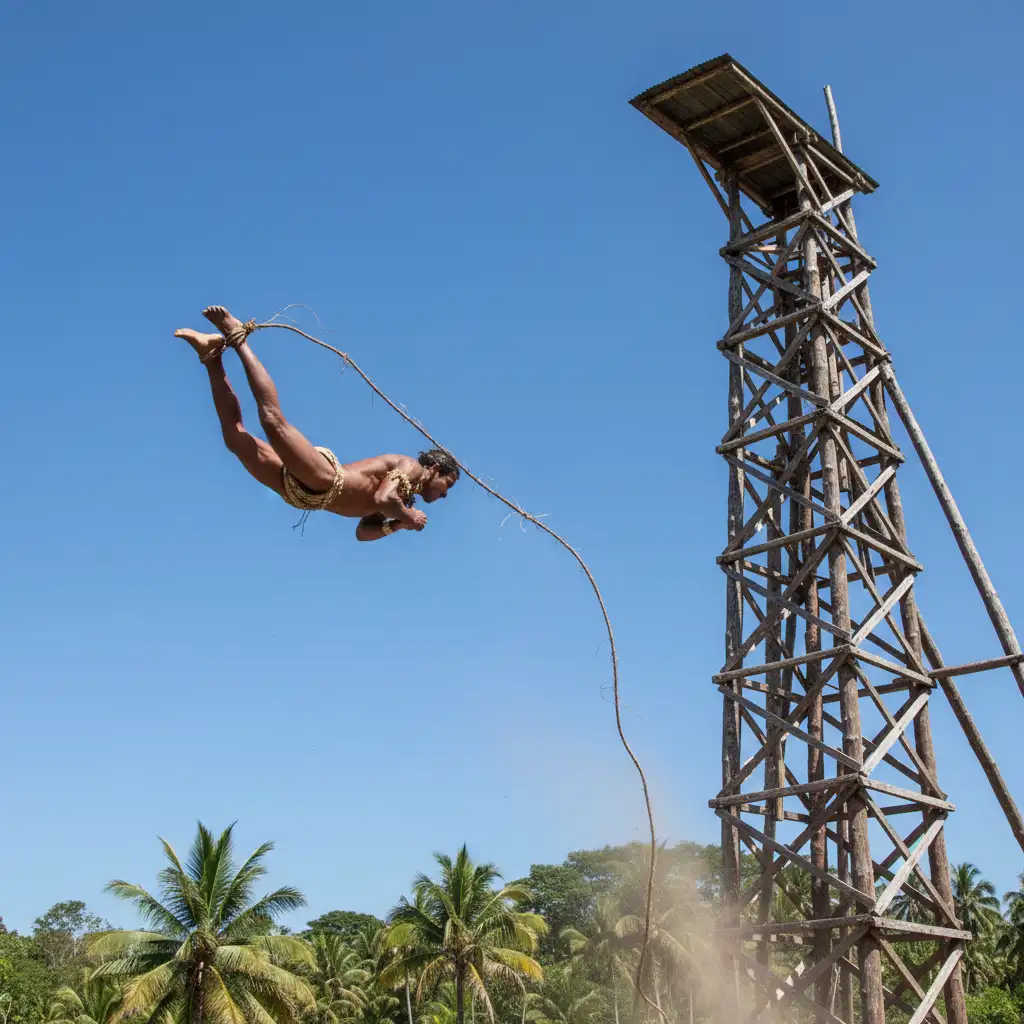
The goal of the diver is not just to survive the fall, but to brush his shoulders against the earth. This contact is said to bless the ground, ensuring that the yams will be plentiful in the coming year. A successful dive where the jumper touches the soil is considered a guarantee of a good harvest, while accidents or broken vines can be seen as bad omens for the village’s food supply.
Furthermore, the Nagol serves as a rite of passage for the men of the Sa speaker tribes in South Pentecost. Boys as young as seven or eight begin jumping from the lowest platforms. As they grow older and prove their courage, they move to higher platforms. The jump is a public declaration of manhood, resilience, and trust in the spirits of their ancestors. It is also a time for men to clear the air; before diving, a man may shout out unresolved grievances or confessions, symbolically leaving his burdens on the tower before returning to the earth reborn.
How is the Land Diving Tower Constructed?
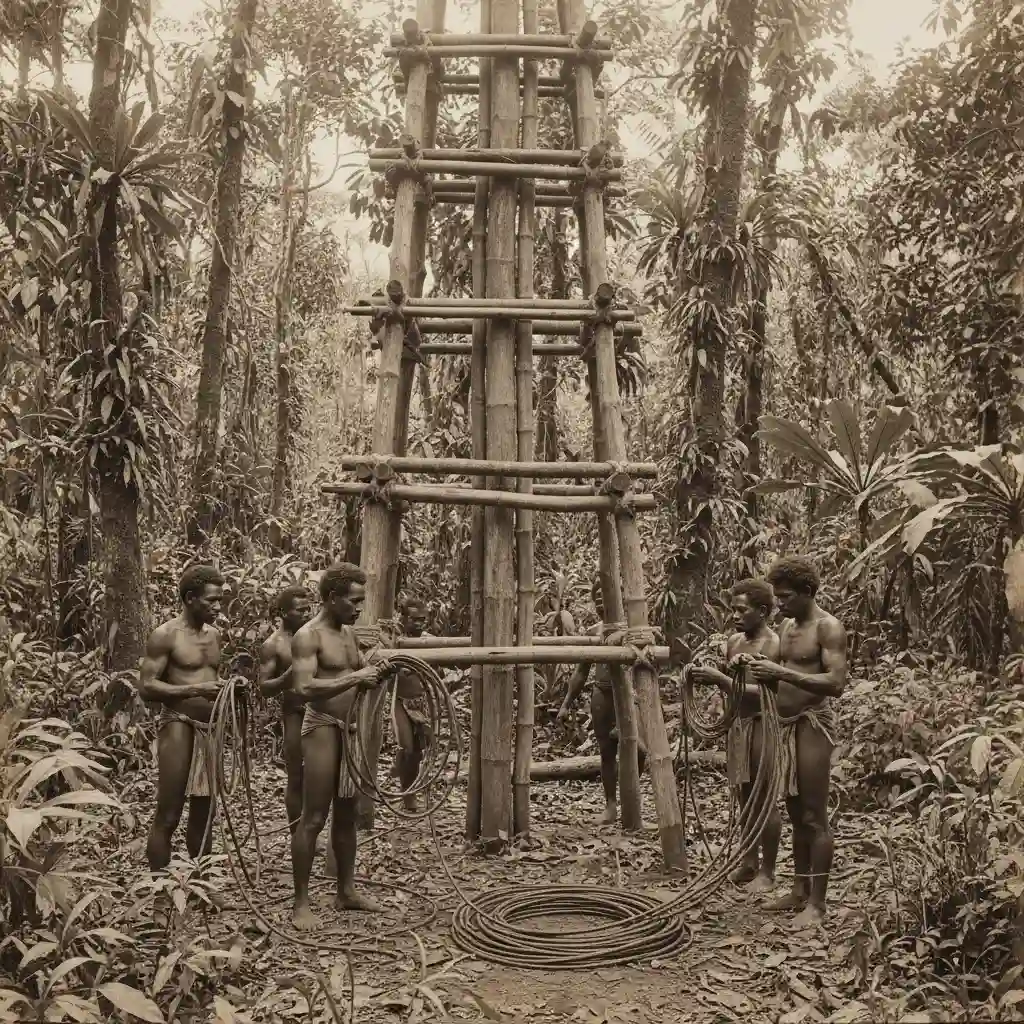
The construction of the land diving tower is a marvel of organic engineering. No nails, metal, or modern ropes are used. The entire structure is built from materials gathered from the surrounding jungle, and the process takes several weeks of dedicated labor. The tower is usually situated on a slope, which provides a better angle for the fall and allows the divers to land on soft, tilled soil.
The construction team follows strict taboos during the building phase. They must abstain from sex and certain foods, as it is believed that any violation of these taboos could weaken the vines or the tower, leading to tragedy. The tower is built around a tall, living tree that serves as the main spine. Poles and branches are lashed together to create a lattice structure that can reach heights of 20 to 30 meters (65 to 100 feet).
The Physics of the Vines
The selection of the liana vines is the most critical aspect of the preparation. Elders with years of experience select vines that are full of sap. The sap content is vital because it gives the vine elasticity. If a vine is too dry, it will snap; if it is too old, it may lack the necessary spring.

Each vine is measured specifically for the individual diver. The length must be calculated with extreme precision: long enough to allow the diver to reach the ground, but short enough to break his fall just before impact. The platforms themselves are designed to snap downward upon the moment of maximum tension, acting as a shock absorber to reduce the G-force on the diver’s ankles. This sophisticated understanding of physics—using the breaking platform as a recoil mechanism—predates modern engineering studies on shock absorption.
What Happens During the Dive Ceremony?
On the day of the Nagol, the atmosphere is electric. The entire village gathers at the foot of the tower. The women and children dress in traditional grass skirts and chant rhythmically, stomping the ground to encourage the divers and ward off evil spirits. This whistling and chanting create a trance-like environment that helps the divers focus.
The diving order is hierarchical. It begins with the youngest boys jumping from the lowest rungs. These jumps are often only a few meters high, but they are treated with the same seriousness as the main event. As the day progresses, the platforms get higher and the divers more experienced.
When a diver steps onto the platform, silence falls briefly over the crowd, or the chanting intensifies. The diver crosses his arms over his chest, looks to the horizon, and often gives a short speech. He then leans forward. The dive is not a feet-first jump; it is a forward fall. The diver must keep his body straight to ensure the vines pull evenly. As he plummets, the vines tighten, the platform snaps, and he swings in an arc, ideally brushing the soil with his shoulders before the recoil pulls him back. The villagers then rush in to cut him loose and check for injuries, celebrating his courage.
When is the Best Time to See Land Diving?
Timing is critical for witnessing the Nagol. The ceremony is seasonal and dependent on the biology of the liana vines. The land diving season typically runs from April to June.
- April: The vines are at their most supple and full of sap. This is the safest time for the divers and the beginning of the season.
- May: The peak of the season. The weather is generally favorable, and the ceremonies are in full swing.
- June: The season begins to wind down. By the end of June, the vines start to dry out and become brittle, making the jump too dangerous. The towers are dismantled shortly after the season ends.
Do not plan a trip to see land diving outside of these months. The towers do not exist year-round, and the locals will not perform the ritual for tourists out of season due to the extreme risk of vine failure.
How to Witness the Dive: A Travel Guide
Pentecost Island is remote, and reaching it requires planning. Most travelers arrive via domestic flights from Port Vila (the capital of Vanuatu) or Santo to Lonorore Airport in South Pentecost. The flights are operated by Air Vanuatu and are small, propeller-based aircraft.
Booking Your Experience
It is highly recommended to book a tour through a reputable Vanuatu travel agency or the Pentecost Tourism Association. While it is possible to show up, the logistics of transport on the island (which has very few vehicles) can be difficult. Organized tours often include:
- Return flights from Port Vila.
- Truck transfers from the airstrip to the land diving site (usually a bumpy 20-30 minute ride).
- Entry fees (which go directly to the village and the divers).
- A local guide to explain the proceedings.
Day trips are possible, but staying overnight in a local bungalow offers a deeper immersion into the island’s culture. Accommodation is basic—expect thatched roofs, shared facilities, and no electricity, but the hospitality is warm and genuine.

Visitor Etiquette and Safety
As a visitor, you are witnessing a sacred tradition, not a theme park show. Respect is paramount.
- Dress Modestly: While the divers wear traditional nambas (penis sheaths), visitors should dress modestly. Swimwear is not appropriate for the village.
- Photography: Photography is generally permitted, but there is often a fee for professional cameras or drones. Always ask for permission before taking close-up portraits of individuals, especially the elders.
- Do Not Interfere: Stay behind the designated rope or barrier. The area directly beneath the tower is dangerous.
- Silence: Be respectful during the moments of concentration before a jump.
Can Tourists Jump? No. Under no circumstances are tourists allowed to participate in the land diving. It is spiritually significant to the local tribes and extremely dangerous for anyone not trained from childhood in the technique. The vines are measured for specific individuals, and the risk of injury or death for an untrained jumper is near 100%.
Witnessing the Pentecost land diving is a once-in-a-lifetime experience. It offers a glimpse into a world where man and nature are intimately connected, and where faith is proven not by words, but by a leap into the void.
People Also Ask
Is Pentecost land diving dangerous?
Yes, land diving carries significant risks. While fatalities are rare due to the expertise of the builders, injuries such as broken bones, concussions, or whiplash can occur. The wet season ensures the vines are elastic, which mitigates some risk, but the lack of modern safety equipment makes it inherently dangerous.
What is the difference between bungee jumping and land diving?
The main difference is the material and the goal. Bungee jumping uses elastic rubber cords designed to bounce the jumper back up repeatedly. Land diving uses non-elastic liana vines intended to break the fall just as the diver touches the ground, with no bouncing. Land diving is a spiritual ritual, whereas bungee jumping is a recreational sport.
How high are the land diving towers?
The towers typically range from 20 to 30 meters (65 to 100 feet) in height. The highest platforms are reserved for the most experienced divers, while lower platforms are used by younger initiates.
Why do the divers want to touch the ground?
touching the ground is symbolically vital. It is believed that when the diver’s shoulders brush the earth, he is blessing the soil. This act is thought to ensure a bountiful yam harvest for the coming year.
Can women participate in land diving?
Currently, only men dive. However, the origin story of the ritual involves a woman, and women play a crucial role in the ceremony by singing, dancing, and providing spiritual support from the ground. There have been rare historical anecdotes of women diving, but it is not standard practice today.
How much does it cost to watch land diving in Vanuatu?
The cost varies depending on the tour operator, but entry fees to the site generally range from $100 to $200 USD per person. This fee is crucial for the local economy and supports the village and the divers who risk their lives.