
Vanuatu European explorers were led by the Spanish navigator Pedro Fernández de Quirós, who first arrived in 1606, naming the largest island Espiritu Santo. He was followed by Louis Antoine de Bougainville in 1768 and Captain James Cook in 1774, who comprehensively charted the archipelago and named it the New Hebrides, opening the region to traders and missionaries.
The history of European exploration in Vanuatu is a complex narrative of discovery, cultural collision, and colonial ambition. While the indigenous Melanesian population had inhabited these islands for thousands of years, the arrival of European ships marked a pivotal turning point that would shape the nation’s political and social trajectory for centuries. From the religious fervor of Spanish crusaders to the scientific precision of British cartographers, the early contact period set the stage for the unique Anglo-French Condominium that followed.
Who Was the First European to Reach Vanuatu?
The first recorded European contact with the islands of Vanuatu occurred in 1606, led by the Portuguese navigator Pedro Fernández de Quirós, who was sailing on behalf of the Spanish Crown. Unlike later explorers driven by scientific curiosity or commerce, Quirós was motivated by a fervent religious mission: to find the legendary southern continent, Terra Australis Incognita, and claim it for the Catholic Church.
Quirós commanded an expedition that departed from Peru. After a long and arduous voyage across the Pacific, his fleet sighted a mountainous landmass which he believed to be the great southern continent. He anchored in a massive bay in the north of the archipelago, which he named the Big Bay (Bahía de San Felipe y Santiago).

The Short-Lived Settlement of New Jerusalem
Convinced he had discovered a continent, Quirós named the land La Austrialia del Espíritu Santo (The Southern Land of the Holy Spirit), a name that survives today for Vanuatu’s largest island, Espiritu Santo. His ambitions were grand; he established a settlement named “New Jerusalem” and even founded a chivalric order, the Knights of the Holy Ghost, to protect it.
However, the Spanish presence was fleeting. The settlement lasted only a few weeks due to a combination of internal dissent among the crew, illness, and hostile relations with the Ni-Vanuatu people. The Spanish attempt to impose authority and seize resources led to violent skirmishes. Ultimately, Quirós was forced to retreat, sailing back to the Americas. His second-in-command, Luis Vaez de Torres, sailed westward, proving that the land was an island and discovering the Torres Strait, though this information was suppressed by the Spanish for decades.
The French Connection: Bougainville’s Voyage
Following the departure of the Spanish, the islands remained unvisited by Europeans for over 160 years. It was not until 1768 that the French explorer Louis Antoine de Bougainville rediscovered the archipelago. Sailing the frigate La Boudeuse and the store ship L’Étoile, Bougainville approached the islands from the east.
Bougainville did not stay long, nor did he attempt to establish a settlement. However, his visit was significant for cartography. He realized that the landmass was not a single continent but a series of islands. He named the group the “Great Cyclades” because the arrangement of the islands reminded him of the Cyclades archipelago in the Aegean Sea. His brief interaction laid the groundwork for the more comprehensive survey that was to follow just a few years later.
How Did Captain James Cook Shape Vanuatu’s History?
While Quirós discovered the islands and Bougainville rediscovered them, it was the British explorer Captain James Cook who truly put Vanuatu on the map. During his second voyage of discovery aboard the HMS Resolution in 1774, Cook spent several weeks meticulously charting the archipelago.
Cook’s survey was remarkably accurate. He sailed through the entire chain, determining the coordinates of most major islands. It was Cook who renamed the islands the “New Hebrides,” noting a resemblance between the rugged, mountainous terrain of these Pacific islands and the Hebrides islands off the coast of Scotland. This name would persist for over two centuries until the nation’s independence in 1980.
The Landing at Port Resolution
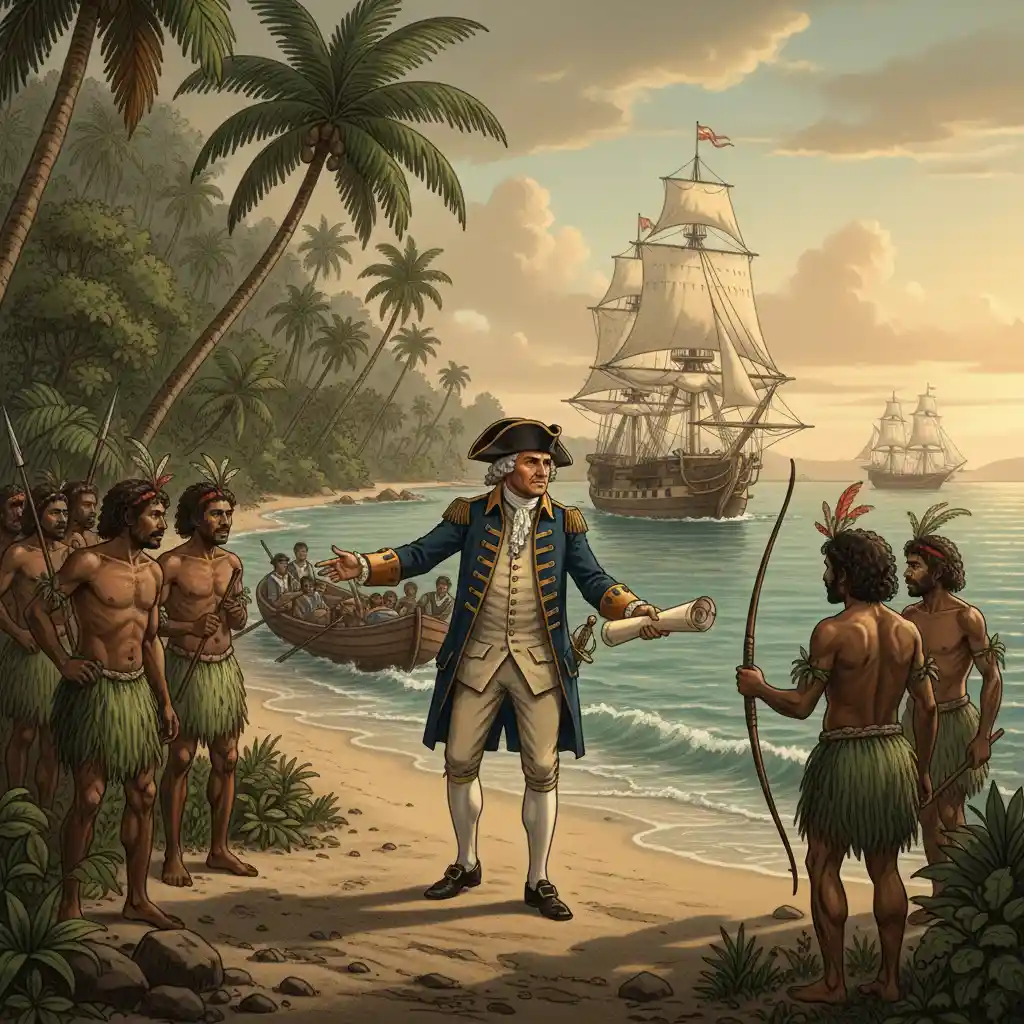
One of the most significant events of Cook’s voyage was his landing on the island of Tanna. Attracted by the glow of the active volcano Mount Yasur, Cook guided the Resolution into a harbor he named Port Resolution. Here, the British crew had extensive interactions with the Tannese people.
Cook’s journals provide some of the earliest detailed ethnographic descriptions of the Ni-Vanuatu people, their customs, agriculture, and weaponry. While relations were generally cautious but peaceful, there were instances of cultural misunderstanding. Cook also landed on Erromango and Malekula, though the reception there was more hostile, leading to brief skirmishes. Cook’s legacy in Vanuatu is profound; he not only defined the geography of the nation for the Western world but also introduced the first iron tools and European goods, initiating a shift in local economies.
The Era of Whalers and Sandalwood Traders
Following the publication of Cook’s journals, the isolation of the New Hebrides was effectively ended. In the early 19th century, the waters around the islands became a hunting ground for whalers. However, it was the discovery of sandalwood in 1825 by the Irish explorer Peter Dillon on the island of Erromango that triggered a chaotic and violent rush of commercial activity.
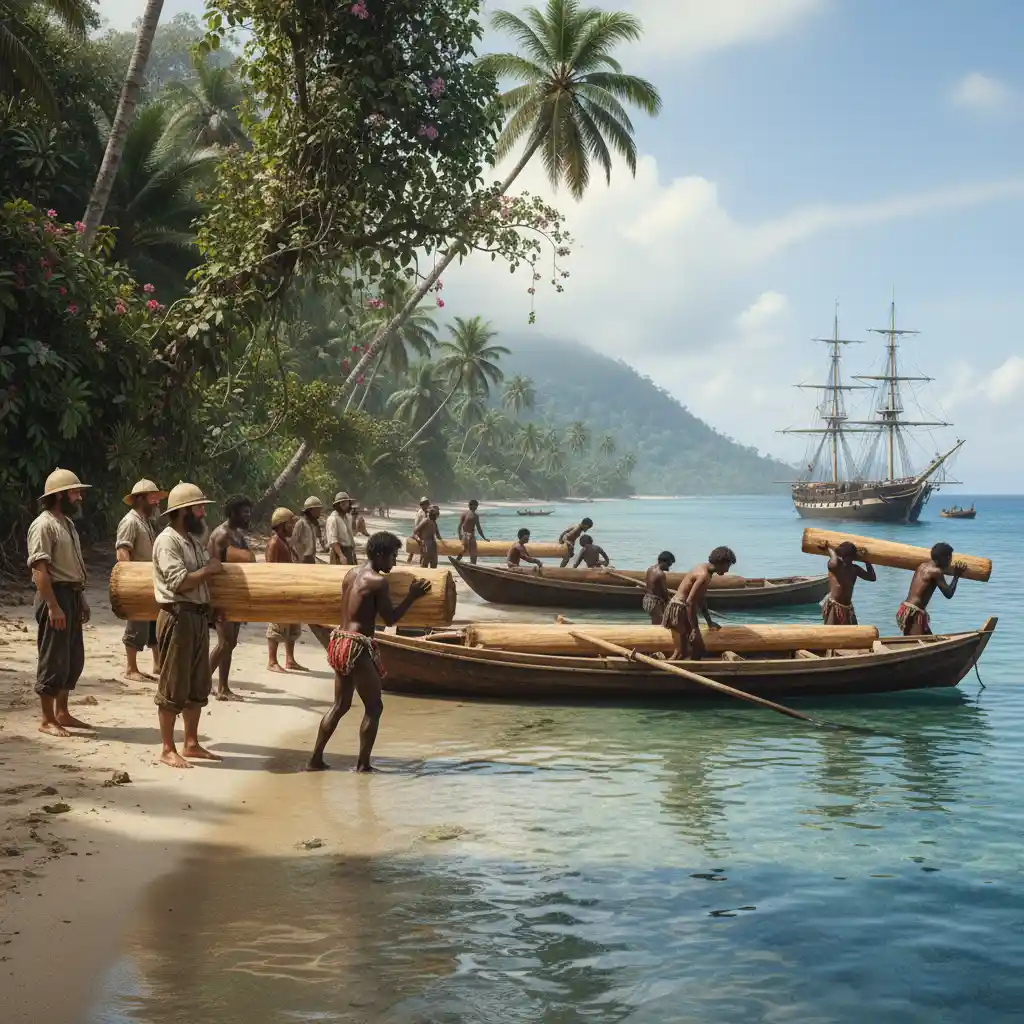
Sandalwood was highly prized in China, and traders from Australia, Fiji, and Polynesia flocked to the southern islands of Vanuatu to exploit this resource. This period, often referred to as the “Sandalwood Wars,” was characterized by exploitation and bloodshed. Traders often used unscrupulous methods to obtain the wood, leading to violent retaliation from local chiefs.
The Rise of Blackbirding
As the sandalwood supplies dwindled, a darker form of commerce emerged in the 1860s: “Blackbirding.” This was the practice of recruiting—often through coercion, deception, or outright kidnapping—Pacific Islanders to work on sugar and cotton plantations in Queensland (Australia), Fiji, and New Caledonia.
Tens of thousands of Ni-Vanuatu men and women were taken during this period. The labor trade decimated local populations, introduced new diseases, and disrupted traditional social structures. It created a deep-seated distrust of Europeans that missionaries and colonial administrators would later have to navigate. The demographic collapse on islands like Aneityum and Erromango during this era was catastrophic, with populations falling by over 90% in some areas.
When Did Missionaries Arrive in the New Hebrides?
Parallel to the arrival of traders, Christian missionaries began to arrive in the islands, driven by the “Great Commission” to evangelize the Pacific. The first attempt was tragic. In 1839, John Williams of the London Missionary Society (LMS) arrived on Erromango. Within minutes of landing, he and his companion James Harris were killed by locals. At the time, the people of Erromango had been brutalized by sandalwood traders, and they associated all white visitors with violence and theft.
Despite this violent beginning, missionary societies persisted. The Presbyterian Church, in particular, focused its efforts on the southern islands (Aneityum, Tanna, Erromango), while the Anglican Melanesian Mission, led by Bishop George Augustus Selwyn and later John Coleridge Patteson, focused on the northern islands. The Catholic Church arrived slightly later, establishing missions in the late 19th century, often in competition with the Protestants.
Cultural Impact and Transformation
The missionaries brought more than just religion; they brought education, medicine, and new moral codes. They discouraged warfare, cannibalism, and certain traditional practices, while introducing literacy and western clothing. The conversion process was slow and often dangerous—Erromango became known as “The Martyr’s Isle” due to the number of missionaries killed there.
However, by the early 20th century, Christianity had become the dominant religion in the archipelago. The missionaries often acted as intermediaries between the indigenous population and the increasingly aggressive traders and settlers, though they also contributed to the erosion of Kastom (traditional culture).
The Establishment of First European Settlements
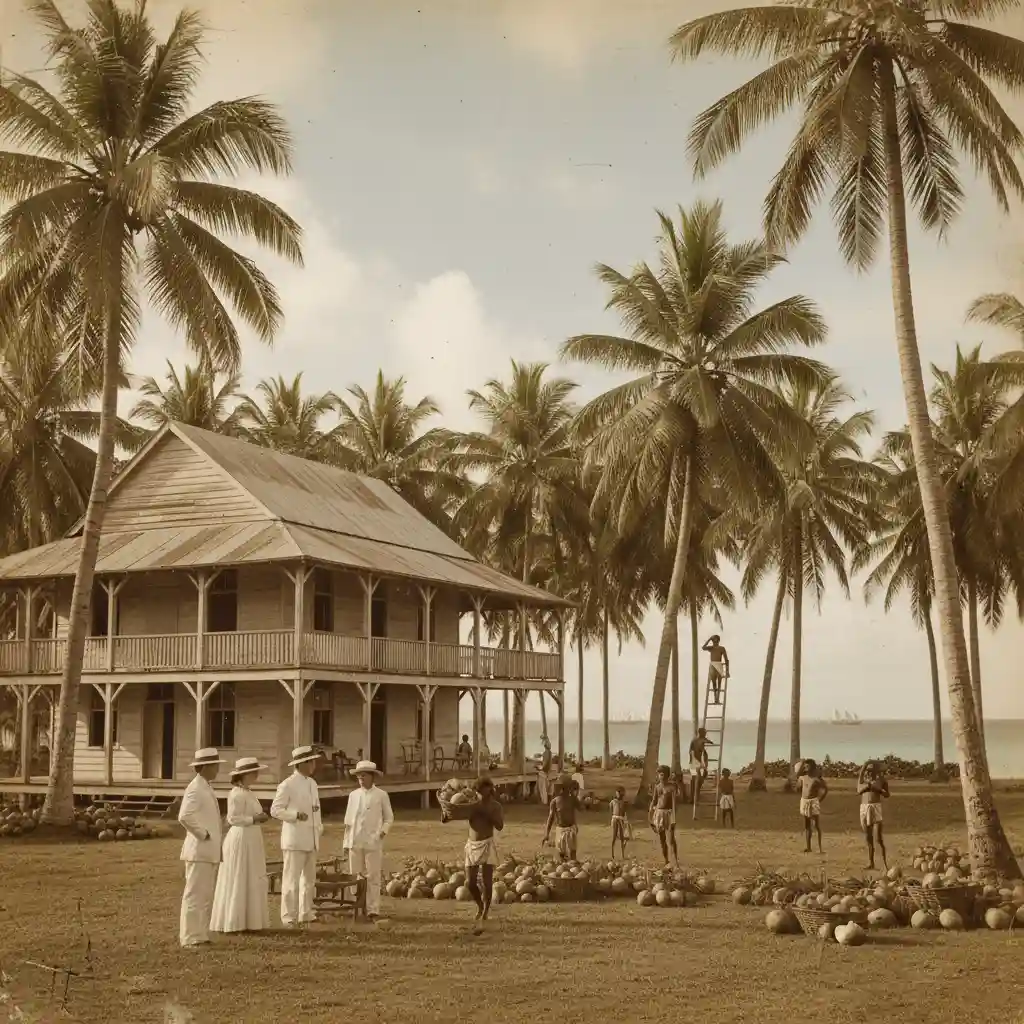
By the late 19th century, the transient presence of traders gave way to permanent European settlement. French and British planters began to acquire land—often through dubious transactions where vast tracts were exchanged for muskets, tobacco, or cloth—to establish coconut (copra), cotton, and later cocoa and coffee plantations.
The town of Port Vila on Efate became the center of this burgeoning colonial society. The French established the dominance in the plantation sector, founding the Compagnie Calédonienne des Nouvelles-Hébrides to encourage French settlement and counterbalance British influence. This economic rivalry created a unique political situation.
The Path to the Condominium
With no established government to enforce law and order, the islands became a chaotic frontier. British settlers petitioned for annexation by the UK, while French settlers demanded annexation by France. Neither European power wanted to cede the territory to the other, nor did they want the expense of full colonization.
This diplomatic stalemate led to the formation of the Joint Naval Commission in 1887, and eventually, the signing of the Condominium Convention in 1906. This established the “New Hebrides” as a territory jointly administered by both Britain and France—a unique and often inefficient system of dual government that would last until 1980. The early exploration and settlement period thus concluded with the formalization of a colonial structure that was distinct in world history.
People Also Ask (PAA)
What did Captain Cook name Vanuatu?
Captain James Cook named the archipelago the “New Hebrides” in 1774. He chose this name because the rugged, mountainous islands reminded him of the Hebrides islands located off the west coast of Scotland. This name remained in official use until the country achieved independence in 1980 and was renamed Vanuatu.
Why did the Spanish fail to settle in Vanuatu?
The Spanish settlement of “New Jerusalem” on Espiritu Santo in 1606 failed due to several factors: the crew suffered from tropical diseases and food shortages, there was significant internal dissent and mutiny within the Spanish ranks, and relations with the indigenous population turned violent quickly, making the settlement indefensible.
Who was the first missionary in Vanuatu?
John Williams of the London Missionary Society is considered the first prominent missionary to attempt landing in Vanuatu (then the New Hebrides). He arrived on the island of Erromango in November 1839 but was killed by locals shortly after stepping ashore, becoming a martyr for the missionary cause in the Pacific.
What was the sandalwood trade in Vanuatu?
The sandalwood trade was a period of intense commercial activity starting in the 1820s where European and Polynesian traders harvested aromatic sandalwood from Vanuatu for sale in China. It was characterized by high profits but also extreme violence, exploitation of local tribes, and the introduction of diseases that devastated the population.
Did the French or British colonize Vanuatu?
Technically, neither nation colonized Vanuatu exclusively. Instead, they formed a “Condominium” government in 1906. This meant that Britain and France jointly administered the islands. There were two police forces, two education systems, and two currencies, leading to the territory being humorously referred to as the “Pandemonium.”
What is Blackbirding in Vanuatu history?
Blackbirding refers to the coercive recruitment of Pacific Islanders, including thousands of Ni-Vanuatu, to work as indentured laborers on plantations in Australia (Queensland) and Fiji between the 1860s and early 1900s. It is considered a dark chapter in history, akin to slavery, which severely depopulated many islands.