
Kastom practices in Vanuatu refer to the traditional customs, social structures, and indigenous laws that govern daily life for the Ni-Vanuatu people. Far from being historical artifacts, these living traditions dictate land tenure, conflict resolution via the nakamal, ceremonial exchanges, gender roles, and community etiquette, forming the foundation of national identity and social order.
What is Kastom in Contemporary Vanuatu?
To understand Vanuatu, one must first understand kastom. The term is derived from the English word “custom,” but its meaning is infinitely more profound. It encapsulates the entire worldview of the Ni-Vanuatu people—their religion, economics, art, and justice systems. While Vanuatu is a modern democratic nation, kastom remains the primary operating system for the vast majority of the population, particularly in rural areas and outer islands.
Kastom is not a monolithic set of rules; it varies significantly across the archipelago’s 83 islands. What is standard practice on Tanna may be taboo on Malekula. However, the underlying principles remain consistent: respect for ancestors, the sanctity of land, and the preservation of community harmony. In daily life, kastom dictates everything from who owns a breadfruit tree to how a chief is elected.
Community Living and the Nakamal
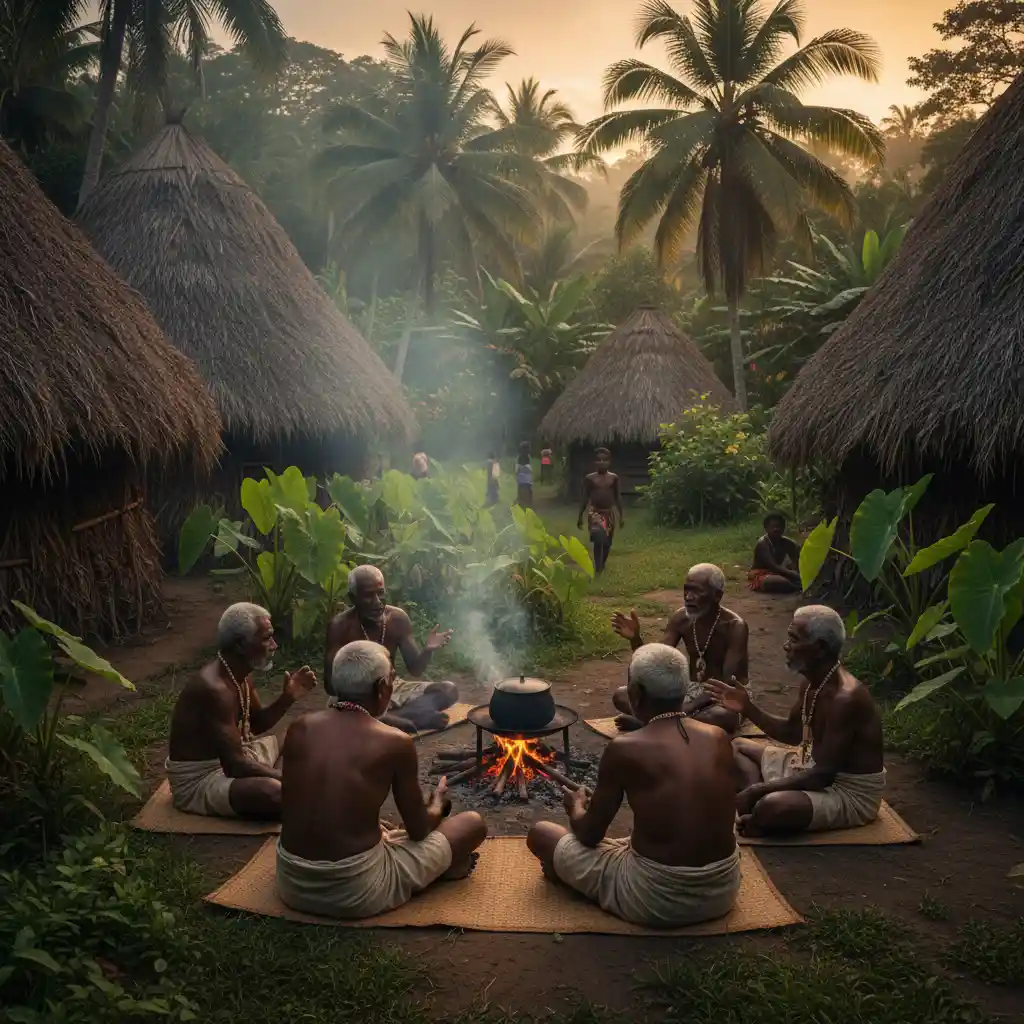
The concept of individualism is largely foreign to kastom practices in Vanuatu. Daily life revolves around the community, the clan, and the extended family. At the heart of this communal structure is the nakamal.
The Role of the Nakamal
While tourists often associate the nakamal solely with kava drinking, its true function is that of a parliament, courthouse, and community center rolled into one. It is a sacred meeting place where chiefs and elders gather to discuss village affairs, resolve disputes, and make decisions that affect the community.
In daily practice, when a dispute arises—be it a land boundary disagreement or a theft—the issue is rarely taken to the state police immediately. Instead, it is brought to the nakamal. Here, through a process of consensus and mediation overseen by chiefs, justice is dispensed. This restorative justice focuses on reconciling the parties to maintain social harmony, often involving the exchange of mats, pigs, or kava as fines.
Communal Labor and Land Tenure
Kastom dictates that labor is often shared. If a family needs to build a new cyclone-proof hut or clear a large garden plot, the village mobilizes. This reciprocity ensures survival and reinforces social bonds. You will rarely see a Ni-Vanuatu person working alone on a significant project.
Furthermore, land is central to kastom. In Vanuatu, land is not merely a commodity; it is the mother of the people. Land is owned customarily by tribes and clans, not individuals. It cannot be bought or sold in the western sense, only leased. For a visitor, this means that every inch of ground, every beach, and every reef belongs to someone. Walking across a specific path or swimming in a specific cove requires permission, as trespassing is a violation of kastom rights.
Gender Roles in Traditional Society
Gender dynamics in Vanuatu are deeply rooted in kastom, though they are evolving with modern education and urbanization. Traditionally, spheres of influence are distinct, yet complementary.
The Public and Private Spheres
Generally, men dominate the public political sphere within the nakamal. They are the orators, the chiefs, and the guardians of oral history. Their daily life involves heavy agricultural labor, fishing, and the maintenance of kastom rituals.
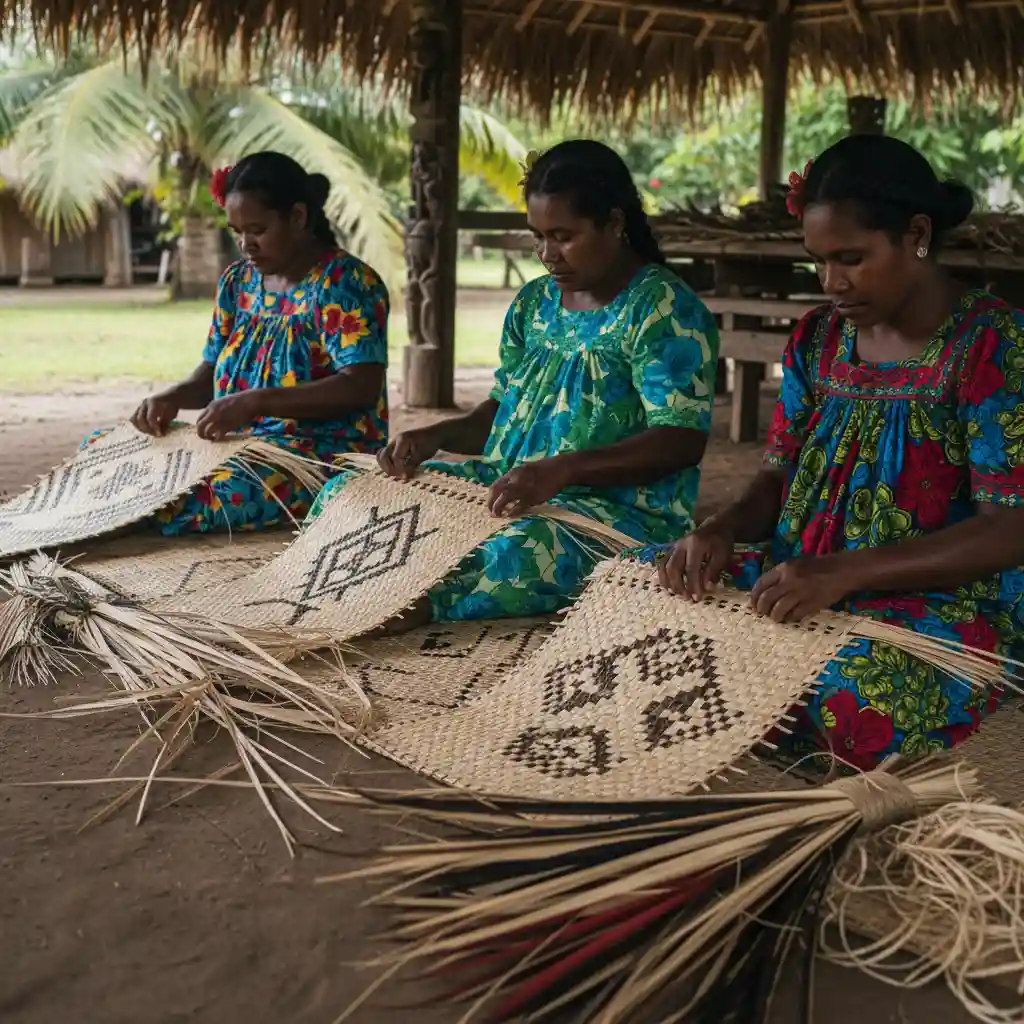
Women, conversely, hold immense power in the domestic and economic spheres. They are the primary producers of food for the family and the market. In many islands, women control the production of woven mats and baskets, which are essential currency in the kastom economy. A woman’s daily routine involves gardening, food preparation, and child-rearing, but also managing the intricate web of exchange relationships that bind families together.
Matrilineal vs. Patrilineal Systems
It is crucial to note that kastom varies regarding lineage. In central Vanuatu (like Efate and parts of Malekula), society is often matrilineal. This means land rights and lineage are passed down through the mother’s side. A man’s most important male relative is not his father, but his maternal uncle. In contrast, islands like Tanna operate on strong patrilineal systems. These structures dictate daily interactions, such as who a child looks to for discipline or who is responsible for paying school fees.
Respect, Etiquette, and Taboos
Navigating daily life in Vanuatu requires a keen understanding of respect, known as respek in Bislama. Protocol is paramount, and violations can cause shame or demand compensation.
Clothing and Modesty
Kastom emphasizes modesty. While traditional attire (nambas for men, grass skirts for women) is worn during ceremonies, daily attire is conservative. For women, the “Mother Hubbard” dress or island dress is standard. Wearing revealing clothing like bikinis or short shorts outside of designated resort areas is considered disrespectful to the local community. Visitors observing kastom practices should cover their shoulders and knees when entering villages.
Tapu (Taboo) Areas
The concept of tapu (taboo) is a powerful regulator of daily movement. A chief may place a tapu on a reef to allow fish stocks to regenerate. During this time, no one may fish there. A tapu might be placed on a specific path during a mourning period. These prohibitions are marked by namele leaves (fern leaves) crossed or stuck in the ground. Ignoring a namele leaf is a grave offense against the chief’s authority and the community’s kastom.

Interpersonal Interaction
Direct confrontation is avoided in kastom culture. Communication is often indirect. When walking past a group of people, it is polite to bow one’s head slightly and say “excuse.” It is considered rude to step over someone’s legs or to stand higher than a chief or elder. Physical contact between genders in public is also minimized.
Ceremonial Gatherings and Exchange
Ceremonies are not merely parties; they are the glue of the social fabric. They facilitate the redistribution of wealth and the solidification of alliances.
Grade-Taking Ceremonies (Nimangki)
On islands like Malekula and Ambrym, daily life is motivated by the pursuit of status through the Nimangki or grade-taking system. Men (and in some areas, women) earn higher social standing not by hoarding wealth, but by giving it away. To ascend a grade, a man must sponsor a massive feast, sacrifice pigs with curved tusks, and present gifts to the community. This ensures that leaders are those who have proven their ability to provide for others.
Life Cycle Events
Birth and Circumcision: The birth of a child involves specific seclusion rituals for the mother. Later, for boys, circumcision is a major rite of passage, involving weeks of seclusion and healing in the bush, followed by a public feast marking their entry into manhood.
Marriage: Kastom marriages involve complex negotiations between families. The “bride price” is a misnomer; it is actually a “bride wealth” exchange. The groom’s family presents pigs, kava, mats, and cash to the bride’s family to compensate them for the loss of her labor and fertility. This exchange legitimizes the union and the children born from it.
Death and Mourning: Funerary kastom is elaborate. When a person passes, the community halts daily work. Mourning feasts take place at specific intervals (e.g., 5 days, 100 days) to guide the spirit to the afterlife and settle the deceased’s debts. The exchange of goods during funerals is critical to restoring balance among the living.

The Kastom Economy
Parallel to the Vatu (the national currency), a vibrant kastom economy operates daily. In this system, wealth is stored in pigs (specifically those with circle tusks) and red mats. These items have fixed values and can be used to pay for school fees, settle disputes, or purchase land leases in traditional contexts. A pig with a fully curved tusk is worth infinitely more than a regular pig because the curvature requires years of hand-feeding the animal, demonstrating the owner’s dedication and resources.
People Also Ask
Is kava drinking considered a kastom practice?
Yes, kava is central to kastom. While recreational kava bars exist, traditional kava drinking is a solemn ritual used to open meetings, seal agreements, and communicate with ancestors. It is prepared fresh from the root and consumed in the nakamal.
What is the significance of pig tusks in Vanuatu?
Pig tusks represent wealth and prosperity. The more curved the tusk (spiraling into a circle), the higher its value. They are featured on the national flag and are used as currency for bride wealth, fines, and grade-taking ceremonies.
Can tourists visit a nakamal?
Tourists can visit urban kava bars (often called nakamals). However, entering a traditional village nakamal usually requires permission from the chief. Some nakamals are strictly men-only, and entering without invitation can be a breach of taboo.
How should I dress to respect kastom practices?
Modesty is key. Men should wear shirts and shorts/trousers. Women should wear clothing that covers the shoulders and knees. Swimwear is only appropriate at the beach or pool, not in the village or town centers.
What is the meaning of the Namele leaf?
The Namele leaf (fern) is a symbol of authority and peace. When crossed and planted, it signifies a “taboo” (do not enter/touch). It is also featured on the Vanuatu coat of arms, representing the nation’s motto: “In God we stand.”
Do kastom practices conflict with modern law?
Sometimes conflicts arise, but the Vanuatu Constitution recognizes kastom law. Courts often take kastom settlements into account. For example, if a thief pays a kastom fine (pigs/mats) to the victim, the state court may reduce their sentence, acknowledging that social harmony has been restored.