
The average cost of travel in Vanuatu ranges from 10,000 VT ($85 USD) per day for budget backpackers to over 40,000 VT ($340 USD) per day for luxury travelers. This estimate encompasses accommodation, local transportation, dining, and island activities. While Port Vila prices rival Australia, outer islands like Tanna and Santo offer variable costs but require significant cash reserves due to limited banking infrastructure.
What is the Currency in Vanuatu?
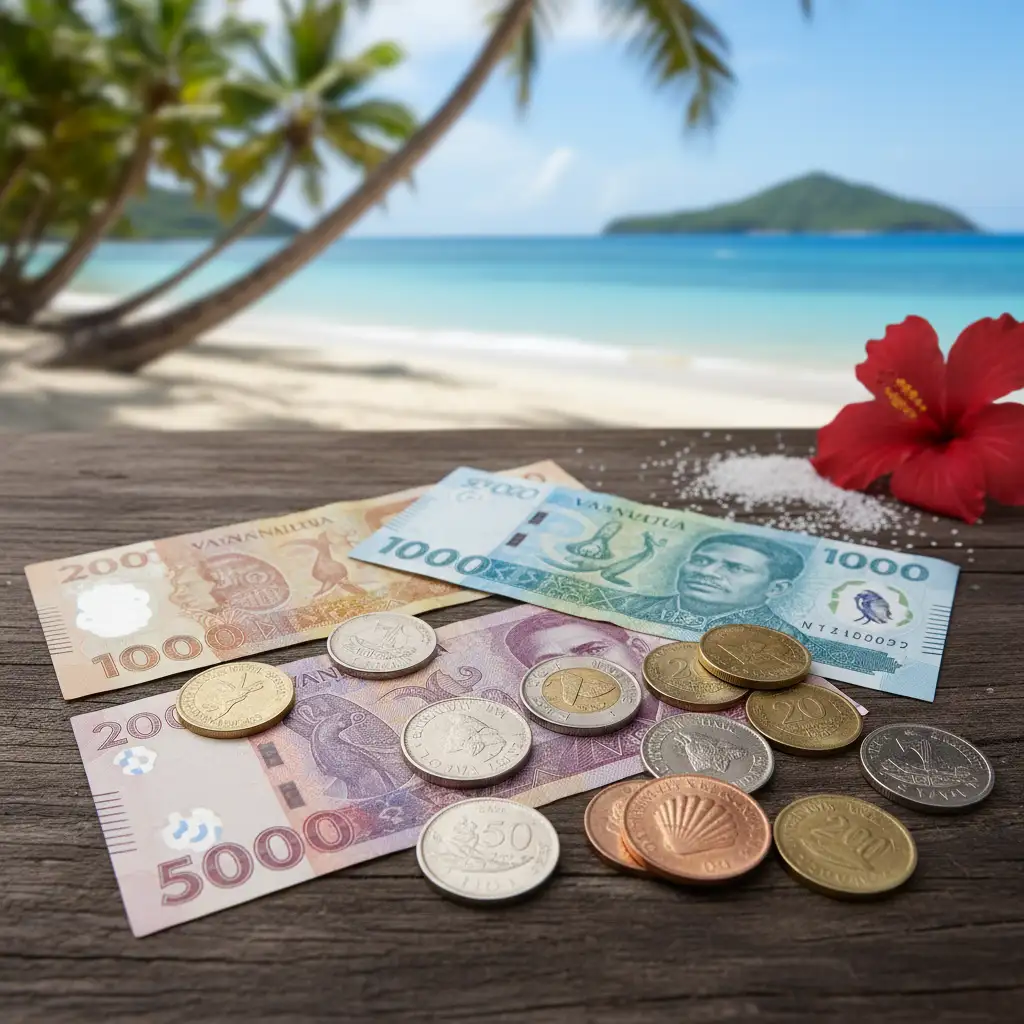
Before diving into the specific cost of travel in Vanuatu, it is imperative to understand the medium of exchange. The official currency of Vanuatu is the Vatu (VT). Unlike many other currencies, the Vatu does not have a subdivision (there are no cents). This can initially be confusing for travelers used to decimal currency systems, but it simplifies calculations once you adjust.
The currency code is VUV, but you will see prices locally marked as VT. Coins are issued in denominations of 5, 10, 20, 50, and 100 VT. Banknotes are available in 200, 1,000, 2,000, 5,000, and 10,000 VT denominations. The polymer notes are durable and feature vibrant depictions of Vanuatu’s culture and wildlife, making them distinct and easy to identify.
Exchange Rate Context:
While exchange rates fluctuate, a rough rule of thumb for quick mental math is that 100 VT is approximately equal to:
- $0.85 USD
- $1.25 AUD
- $1.35 NZD
- €0.78 EUR
It is highly recommended to familiarize yourself with the current rate before departure, as airport exchange booths often offer less favorable rates than banks in Port Vila.
Are ATMs and Credit Cards Widely Accepted?
Managing your liquidity is the most critical aspect of budgeting for your Vanuatu trip. The financial infrastructure varies drastically between the capital city, Port Vila, and the outer islands.
ATM Availability
ATMs are readily available in Port Vila (Efate) and Luganville (Santo). The primary banks operating in Vanuatu are ANZ, BSP (Bank South Pacific), Bred Bank, and National Bank of Vanuatu (NBV). International cards (Visa and Mastercard) are generally accepted at these machines.
However, once you leave these two urban hubs, ATMs become virtually non-existent. If you plan to visit Tanna to see Mount Yasur, or travel to Pentecost for land diving, you must withdraw sufficient cash in Port Vila or Luganville before boarding your domestic flight. Running out of cash on an outer island can effectively strand you or severely limit your ability to buy food and transport.
Credit Card Usage and Surcharges
Credit cards are widely accepted at mid-range to luxury resorts, large supermarkets (like Au Bon Marché), and established tour operators in Port Vila. However, reliance on plastic comes with caveats:
- Surcharges: It is standard practice for merchants to pass on credit card processing fees to the customer. Expect to pay a surcharge of 3% to 5% on top of the transaction amount.
- Minimum Spends: Many smaller shops may require a minimum purchase (often 1,000 VT) to use a card.
- Cash Economy: Taxis, buses, local markets, small village bungalows, and roadside stalls operate exclusively on cash.
How Much Does a Trip to Vanuatu Cost?
The cost of travel in Vanuatu is often higher than in Southeast Asian destinations like Bali or Thailand. Being an island nation in the South Pacific, many goods are imported, driving up prices. Below is a detailed breakdown based on traveler profiles.
1. The Budget Traveler (Backpacker)
Estimated Daily Cost: 8,000 VT – 12,000 VT ($65 – $100 USD)
To stay within this bracket, you will need to be disciplined. Budget accommodation in Vanuatu is limited compared to other destinations.
- Accommodation: Dorm beds or simple village bungalows (3,000 – 5,000 VT per night).
- Food: Shopping at local markets for fresh fruit and vegetables, eating “tuluk” (meat wrapped in manioc), and avoiding resort restaurants.
- Transport: Exclusively using local minibuses and walking.
- Activities: Free activities like snorkeling off the beach (bring your own gear) and hiking unguided trails.
2. The Mid-Range Traveler
Estimated Daily Cost: 20,000 VT – 35,000 VT ($170 – $300 USD)
This is the most common traveler profile. You prioritize comfort but look for value.
- Accommodation: 3-star hotels, private bungalows, or Airbnb apartments (12,000 – 18,000 VT per night).
- Food: A mix of café breakfasts, supermarket lunches, and restaurant dinners.
- Transport: Combination of buses, occasional taxis, and perhaps a 2-day car rental.
- Activities: Paid tours like the Mele Cascades, a guided cultural village tour, or a sunset cruise.
3. The Luxury Traveler
Estimated Daily Cost: 50,000 VT+ ($420+ USD)
Vanuatu offers world-class luxury, particularly in boutique resorts and private island retreats.
- Accommodation: Overwater villas or beachfront resorts (30,000 VT+ per night).
- Food: Fine dining at top-tier restaurants in Port Vila featuring Santo beef and fresh lobster.
- Transport: Private drivers, helicopter transfers, and domestic flights between islands.
- Activities: Private fishing charters, scuba diving packages, and exclusive volcano fly-overs.

What are the Transportation Costs?
Understanding the local transport pricing structure is the easiest way to save money on your cost of travel in Vanuatu.
Public Minibuses (The “B” Plates)
In Port Vila and Luganville, the public transport system consists of minibuses identifiable by the letter “B” on their license plate. There are no fixed routes; you simply flag one down and tell the driver your destination. If it’s generally in the direction they are going, they will take you.
- Short trips within town: 150 VT per person.
- Longer trips (e.g., Vila to Mele): 300 – 500 VT per person.
This is significantly cheaper than taxis and offers a fun way to interact with locals.
Taxis (The “T” Plates)
Taxis are marked with a “T” on the number plate. They are unmetered, so you must agree on a price before getting in. While there are standard rates, tourists are often quoted higher prices.
- Short trip within Vila: 500 – 700 VT.
- Airport transfer to Port Vila: 2,500 – 3,000 VT (Standard fixed rate).
- Half-day hire: 8,000 – 12,000 VT.
Inter-Island Flights
If you plan to visit Tanna (for the volcano) or Santo (for Champagne Beach), you must budget for Air Vanuatu domestic flights. These are not cheap.
- Return flight Vila to Tanna: Approx. 30,000 – 45,000 VT ($250 – $380 USD).
- Return flight Vila to Santo: Approx. 30,000 – 40,000 VT ($250 – $340 USD).
Cost of Food and Drink
Food prices vary wildly depending on whether you eat like a local or a tourist. Imported goods (cheese, wine, cereal) are expensive due to shipping costs and taxes.
Restaurant Dining
Port Vila is known as the culinary capital of the South Pacific. Dining out is a highlight but impacts the budget.
- Burger and Fries at a pub: 1,800 – 2,200 VT.
- Main course (Steak/Seafood) at a nice restaurant: 3,500 – 5,500 VT.
- Local beer (Tusker): 500 – 800 VT in a bar.
- Glass of wine: 900 – 1,200 VT.
Market Dining
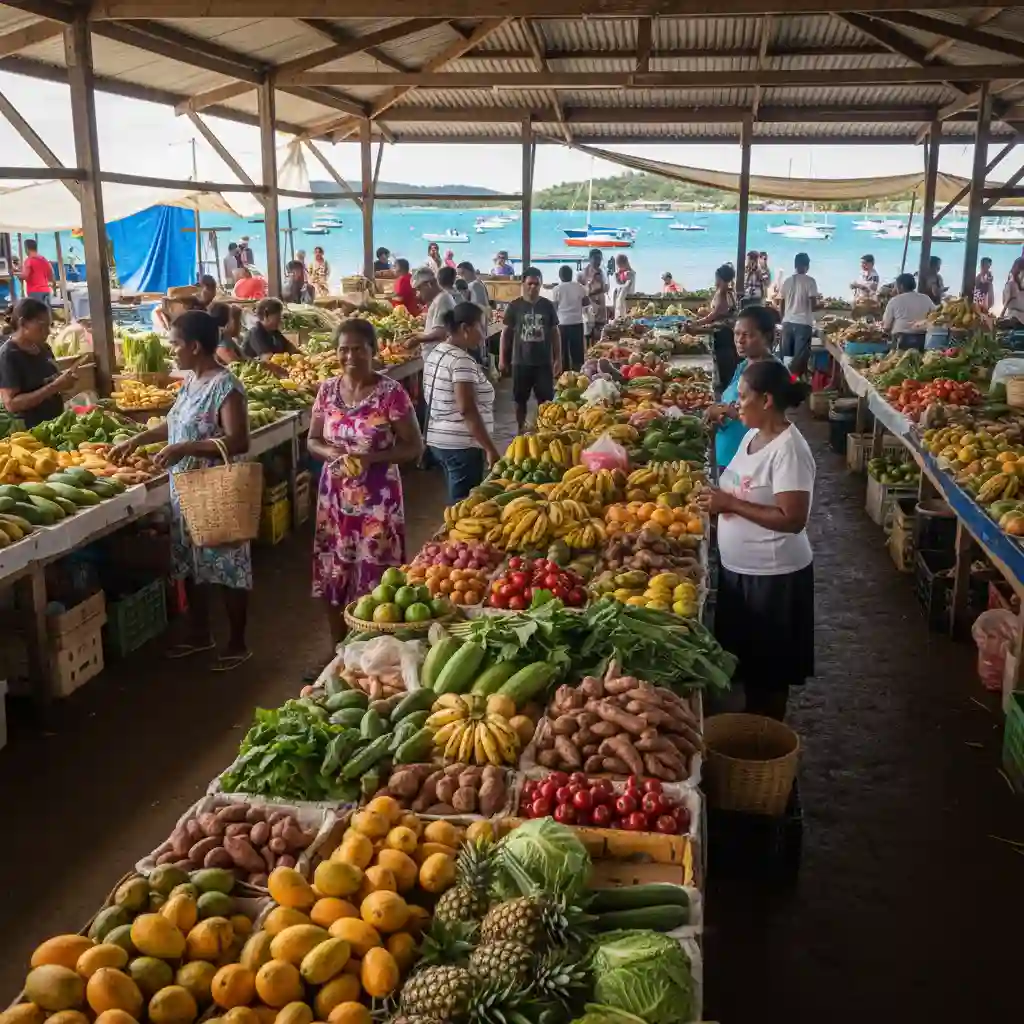
For significant savings, visit the Port Vila Market (open 24/7 from Monday to Saturday morning).
- Fresh Raspberries (punnet): 200 VT.
- Bunch of Bananas: 100 – 200 VT.
- Pre-cooked meals (Laplap or stew): 300 – 500 VT.
- Drinking Coconut: 50 – 100 VT.
Budgeting for Activities
Vanuatu is an adventure destination. While beaches are free, most land in Vanuatu is customarily owned, meaning you often have to pay an “entry fee” or “kastom fee” to access waterfalls, beaches, or caves.
Major Attractions
- Mount Yasur Volcano (Tanna): This is the big-ticket item. Entrance fees are approximately 9,750 VT per person. This does not include the transfer to the volcano, which can cost another 5,000 – 10,000 VT depending on your location.
- Mele Cascades (Efate): Entrance fee is around 2,500 VT per adult.
- Blue Lagoon (Efate): Entrance fee is roughly 1,500 VT.
- Scuba Diving: A single tank dive typically costs 8,000 – 10,000 VT, including gear hire.
- Cultural Village Tours: Expect to pay between 3,000 and 5,000 VT for a half-day experience including lunch.
How to Reduce the Cost of Travel in Vanuatu
Even with high import taxes, there are strategic ways to lower your overall spend without sacrificing the quality of your experience.
1. Utilize Duty-Free Allowances
Alcohol is expensive in Vanuatu due to taxation. If you enjoy a drink at sunset, maximize your duty-free allowance upon arrival at Bauerfield International Airport. You are generally allowed 2.5 liters of spirits or wine per adult. Buying a bottle of gin for 3,000 VT at the airport is far cheaper than paying 1,000 VT per cocktail at a resort.
2. Eat Local Beef
Vanuatu beef is world-renowned, organic, and grass-fed. Because it is produced locally (mostly on Santo), it is often cheaper and better quality than imported meats like chicken or pork. Look for steak nights at local pubs for great value.
3. Snorkel from the Shore
You do not always need a boat charter to see amazing coral. Hideaway Island (accessible by a free ferry, though there is an island entry fee of roughly 1,500 VT) has a marine sanctuary right off the beach. Bring your own mask and snorkel to avoid rental fees.
4. Avoid “Resort” Taxis
Resorts often have preferred taxi drivers waiting in the lobby. These drivers usually charge a premium. Walk out to the main road and flag down a passing bus or taxi to negotiate a standard local rate.

People Also Ask
Is Vanuatu expensive to visit for tourists?
Yes, compared to Southeast Asia, Vanuatu is relatively expensive. Prices for food, accommodation, and tours are comparable to Australia or New Zealand. However, budget options exist if you stay in locally-run bungalows and eat at markets.
Can I use US Dollars or Australian Dollars in Vanuatu?
While some major resorts and tour operators in Port Vila may accept AUD or USD, the exchange rate offered will be poor. It is strongly advised to exchange your money for Vatu (VT) to get the best value and to pay for small items in local shops.
Do you tip in Vanuatu?
Tipping is not a custom in Vanuatu and is generally not expected. In traditional Melanesian culture, tipping can sometimes be seen as confusing or contrary to the custom of hospitality. However, a smile and a sincere “thank you” (or “tankyu tumas”) are greatly appreciated.
How much cash should I carry?
If staying in Port Vila, you can rely on ATMs and cards. However, if traveling to outer islands like Tanna or Santo, carry enough cash to cover your entire stay, including accommodation, meals, and transfers, as ATMs are unreliable or non-existent.
Is the water safe to drink in Vanuatu?
In Port Vila, tap water is generally considered safe, but many tourists prefer bottled water to avoid any stomach issues. On outer islands, you should strictly stick to bottled or boiled water. Bottled water costs around 100-200 VT per bottle.
What is the departure tax in Vanuatu?
Departure tax is now typically included in your international airline ticket price, so you do not need to pay a separate fee at the airport upon leaving. It is always worth checking your ticket breakdown to confirm.