
Vanuatu independence was officially achieved on July 30, 1980, marking the end of the unique Anglo-French Condominium known as the New Hebrides. Led by Father Walter Lini and the Vanua’aku Pati, the movement overcame complex colonial governance and internal secessionist struggles, known as the Coconut War, to establish the sovereign Republic of Vanuatu.
The history of the Pacific is replete with stories of decolonization, but few are as complex or politically intricate as the story of Vanuatu independence. Unlike other colonies administered by a single power, the archipelago formerly known as the New Hebrides was governed by two competing European nations simultaneously—Great Britain and France. This unique structure, often derisively termed the “Pandemonium,” created a specific set of frustrations that fueled the rise of nationalism in the 1970s.
For the traveler or history enthusiast visiting this Melanesian paradise, understanding the struggle for sovereignty adds profound depth to the cultural experience. From the bustling markets of Port Vila to the remote villages of Espiritu Santo, the legacy of 1980 remains a vibrant part of the national identity.
What was the Anglo-French Condominium?
To understand the drive for Vanuatu independence, one must first comprehend the administrative absurdity that preceded it. Established in 1906, the Anglo-French Condominium of the New Hebrides was a territory of dual sovereignty. It was not a colony of Britain, nor a colony of France, but a territory jointly administered by both.
This system resulted in three separate administrations: the British administration, the French administration, and the Joint administration (which handled native affairs, posts, and public works). For the indigenous Ni-Vanuatu population, this created a bureaucratic nightmare. There were two police forces, two health services, two education systems, and two currencies. However, until late in the colonial period, the Ni-Vanuatu people were technically stateless—they were neither British subjects nor French citizens.
The inefficiency of the Condominium meant that development was often stalled by diplomatic squabbles between London and Paris. The French were generally keen to retain influence to protect their interests in nearby New Caledonia, while the British were increasingly looking to divest themselves of colonial responsibilities in the Pacific. This divergence in colonial intent created the cracks through which the independence movement would eventually grow.
How did Nationalism Grow in Vanuatu?
The seeds of nationalism were sown not in government halls, but in the soil itself. Land alienation was the primary catalyst for the early protest movements. By the 1960s, a significant portion of the best agricultural land in the New Hebrides was owned by foreign settlers, predominantly French plantation owners. The indigenous population, seeing their ancestral lands cleared for coconuts and cattle, began to organize.
The Role of Nagriamel
One of the earliest and most significant movements was Nagriamel, founded in the mid-1960s by the charismatic Jimmy Stevens on the island of Espiritu Santo. Originally, Nagriamel was a movement dedicated to the protection of custom land against encroachment by European settlers. It operated on a platform of “Dark Bush”—a return to traditional ways and the rejection of European land laws.
While Nagriamel would later become a controversial force opposing the central independence movement, its initial formation proved that the Ni-Vanuatu people could organize politically on a large scale. It signaled to the colonial powers that the indigenous population was no longer passive.
The Rise of Political Parties
As the 1970s progressed, the desire for self-determination evolved from land disputes to demands for political sovereignty. This era saw the transition from cultural associations to formal political parties.
The New Hebrides National Party (NHNP)
In 1971, the New Hebrides Cultural Association was formed, which soon transformed into the New Hebrides National Party (NHNP). This party was largely supported by English-speaking Protestants and was driven by a young, educated elite who had returned from studies in Fiji and New Zealand. Their platform was clear: immediate independence and the return of alienated land.
In 1977, the NHNP rebranded as the Vanua’aku Pati (VP), meaning “Party of Our Land.” This rebranding was significant; it linguistically claimed the nation for its people. The VP organized an effective grassroots network throughout the islands, establishing “commissars” in villages to spread the message of independence.
The Francophone Opposition
In response to the rise of the Anglophone VP, Francophone parties began to emerge, often with the tacit or explicit support of the French administration and French settlers (colons). Parties like the Union des Communautés des Nouvelles Hébrides (UCNH) advocated for a slower transition to independence, fearing that a VP government would marginalize the French language and French interests. This created a deep political cleavage along linguistic lines—Anglophone vs. Francophone—that complicated the road to sovereignty.

Who Was Father Walter Lini?
No discussion of Vanuatu independence is complete without examining the life and legacy of Father Walter Lini. Often referred to as the “Father of the Nation,” Lini was an Anglican priest who became the defining figure of the independence movement.
Born on Pentecost Island, Lini was educated in the Solomon Islands and New Zealand. His theological background heavily influenced his political philosophy, which he termed “Melanesian Socialism.” This ideology sought to blend traditional Melanesian communal values (sharing, consensus, custom) with Christian principles and modern socialist thought.
Lini’s leadership style was characterized by a quiet but steely determination. He was able to articulate the frustrations of the Ni-Vanuatu people in a way that resonated both locally and internationally. As the leader of the Vanua’aku Pati, he navigated the treacherous diplomatic waters between the British, who were willing to grant independence, and the French, who were dragging their feet. His insistence on “Independence Now” became the rallying cry for the nation.
What Was the Coconut War?
The path to July 1980 was not smooth. As the date for independence approached, tensions boiled over into what became known as the Coconut War. This was a brief but critical secessionist conflict centered on the island of Espiritu Santo.
Jimmy Stevens and his Nagriamel movement, feeling marginalized by the Vanua’aku Pati’s dominance and encouraged by French settlers and the Phoenix Foundation (a libertarian group from the USA looking to establish a tax-free nation), declared the independence of the “Republic of Vemerana” on Espiritu Santo in mid-1980.
This rebellion posed an existential threat to the new nation before it was even born. The British and French colonial troops, still technically in charge, were reluctant to use force against the rebels. The French, in particular, were accused of covertly supporting Stevens to destabilize the incoming Anglophone government.
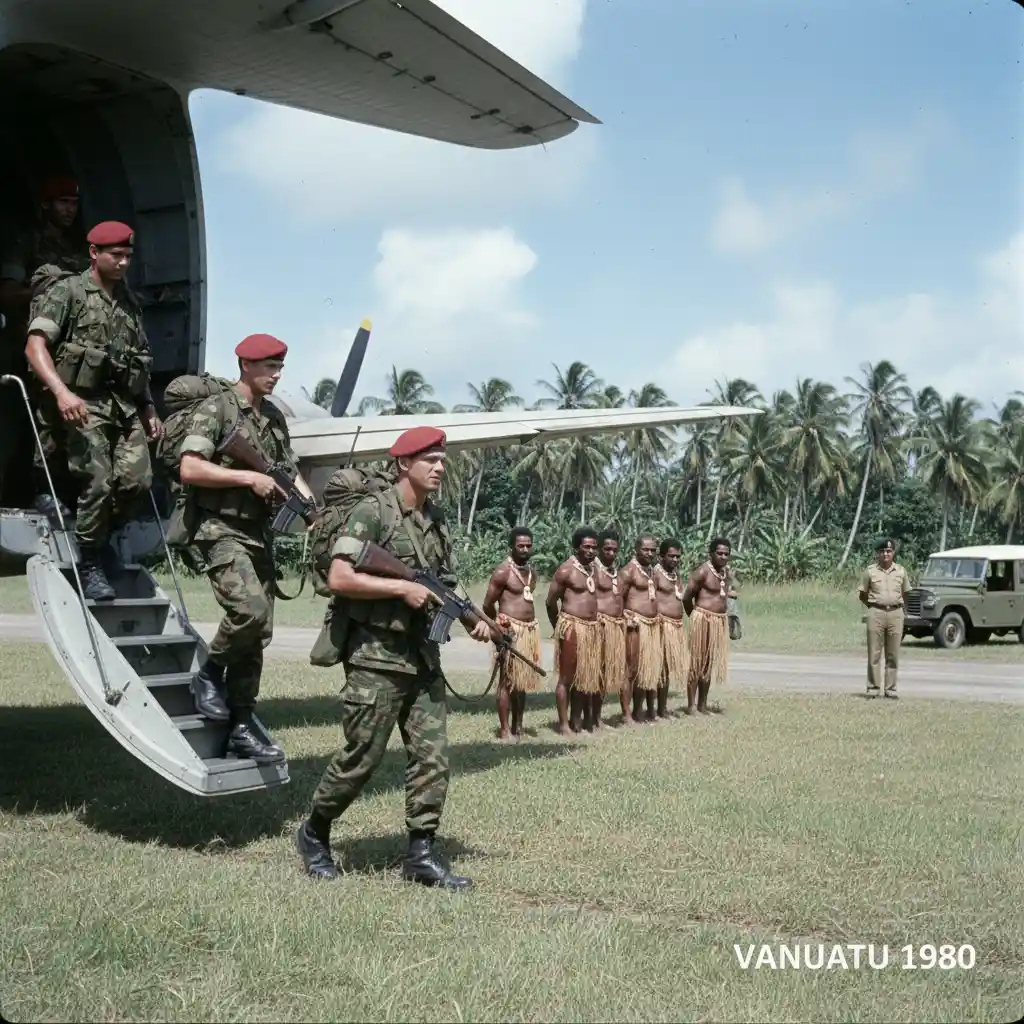
Ultimately, Walter Lini, as the incoming Prime Minister, took a decisive step. Lacking a military of his own and frustrated by the inaction of the colonial powers, he requested assistance from Papua New Guinea. The Kumul Force (PNG Defense Force) arrived shortly after independence, quelled the rebellion with minimal casualties, and arrested Jimmy Stevens. This act solidified the central government’s authority and ended the separatism threat.
The Achievement of Independence (July 30, 1980)
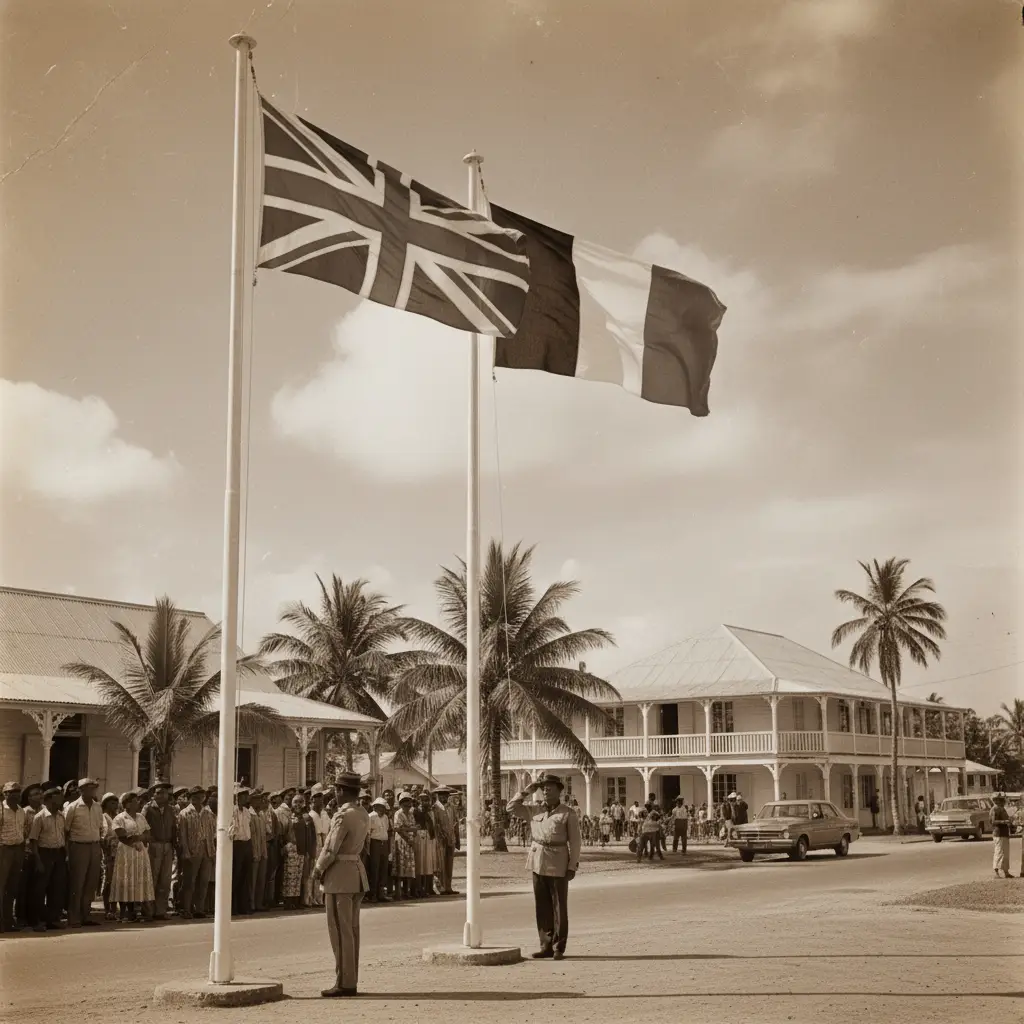
Despite the rebellions and diplomatic stalling, the Republic of Vanuatu was officially born on July 30, 1980. The event was marked by ceremonies in Port Vila where the Union Jack and the French Tricolor were lowered together, and the new flag of Vanuatu—featuring the colors red, green, black, and yellow, with a boar’s tusk emblem—was raised.
The Constitution adopted was notable for its strong emphasis on indigenous land ownership. It declared that all land in Vanuatu belongs to the indigenous custom owners and their descendants. This was a direct answer to the decades of land alienation that had sparked the movement.
At independence, Vanuatu joined the Commonwealth of Nations and the United Nations, asserting its status as a sovereign state. The transition ended 74 years of the Condominium and launched a new era of self-governance.
The Legacy of the Independence Movement
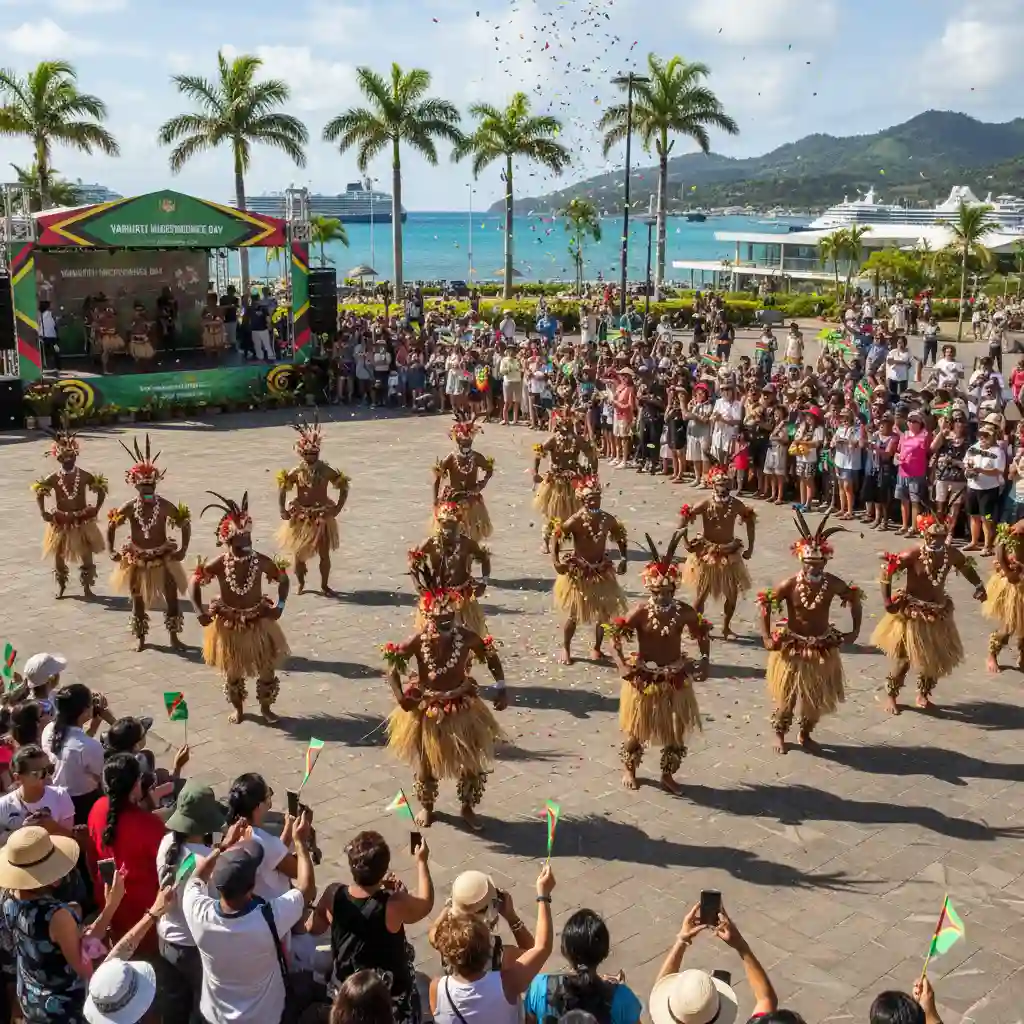
Today, the legacy of the independence movement is visible everywhere in Vanuatu. July 30th is the most significant public holiday in the country, celebrated with week-long festivities, custom dancing, and parades. The political landscape is still influenced by the families and parties that formed during the struggle.
For the digital encyclopedia of Vanuatu, it is crucial to note that the independence movement did more than just change the flag. It revived Kastom (traditional culture). During the colonial era, many traditional practices were discouraged by missionaries and administrators. The independence movement, particularly under Lini’s philosophy, validated Kastom as a pillar of national identity.
However, challenges remain. The linguistic divide between Anglophones and Francophones persists in the education system and politics, though it is less volatile than in the 1980s. Economic independence has proven harder to achieve than political independence, with the nation relying heavily on tourism and aid.
Understanding this history allows visitors to appreciate the resilience of the Ni-Vanuatu people. When you walk through the National Museum in Port Vila or speak with elders in the villages, you are engaging with a people who fought against the odds—and against two world powers—to reclaim their home.
Who was the first Prime Minister of Vanuatu?
Father Walter Lini was the first Prime Minister of Vanuatu. An Anglican priest and leader of the Vanua’aku Pati, he served as Prime Minister from independence in 1980 until 1991. He is widely regarded as the “Father of the Nation.”
Why was Vanuatu called the New Hebrides?
The islands were named the New Hebrides by Captain James Cook in 1974. He felt the rugged islands resembled the Hebrides islands off the coast of Scotland. The name remained in official use until independence in 1980 when the nation was renamed Vanuatu, meaning “Land Eternal” or “Our Land.”
What role did the Phoenix Foundation play in Vanuatu independence?
The Phoenix Foundation was a libertarian group from the United States that supported the Nagriamel secessionist movement on Espiritu Santo. They provided financial support and advice to Jimmy Stevens, hoping to establish a tax-free, libertarian state, but their efforts were thwarted when the rebellion was crushed.
What is the significance of the Vanuatu flag?
The Vanuatu flag features the colors of the Vanua’aku Pati: red (blood of boars and men), green (richness of the islands), black (the Ni-Vanuatu people), and yellow (the light of the gospel). The emblem is a boar’s tusk (symbol of prosperity) and namele fern fronds (symbol of peace).
Did France oppose Vanuatu independence?
France was generally more reluctant than Britain to grant independence. They feared that independence in the New Hebrides would encourage pro-independence movements in their other Pacific territories, specifically New Caledonia and French Polynesia. This led to diplomatic delays and alleged support for Francophone opposition parties.
How is Independence Day celebrated in Vanuatu?
Independence Day (July 30) is a major national holiday. Celebrations often span several days or a week, featuring military parades, speeches by government officials, string band music, sports competitions, and traditional custom dancing. It is a time of great national pride and unity.