
Vanuatu traditional music, known locally as kastom music, is a rhythmic cultural expression characterized by percussive instruments like the iconic Tamtam slit drums, bamboo stamping tubes, and conch shells. It serves as a fundamental pillar of Ni-Vanuatu society, accompanying ceremonial rituals, oral storytelling, and community gatherings to preserve ancestral history and spiritual connections across the archipelago.
What Are the Main Types of Traditional Instruments in Vanuatu?
The soundscape of the Vanuatu archipelago is defined not by melody in the Western sense, but by complex, polyrhythmic percussion that mimics the heartbeat of the islands. Traditional instruments are crafted entirely from organic materials found in the immediate environment, reinforcing the deep bond between the Ni-Vanuatu people and their land.
The Tamtam: The Voice of the Ancestors
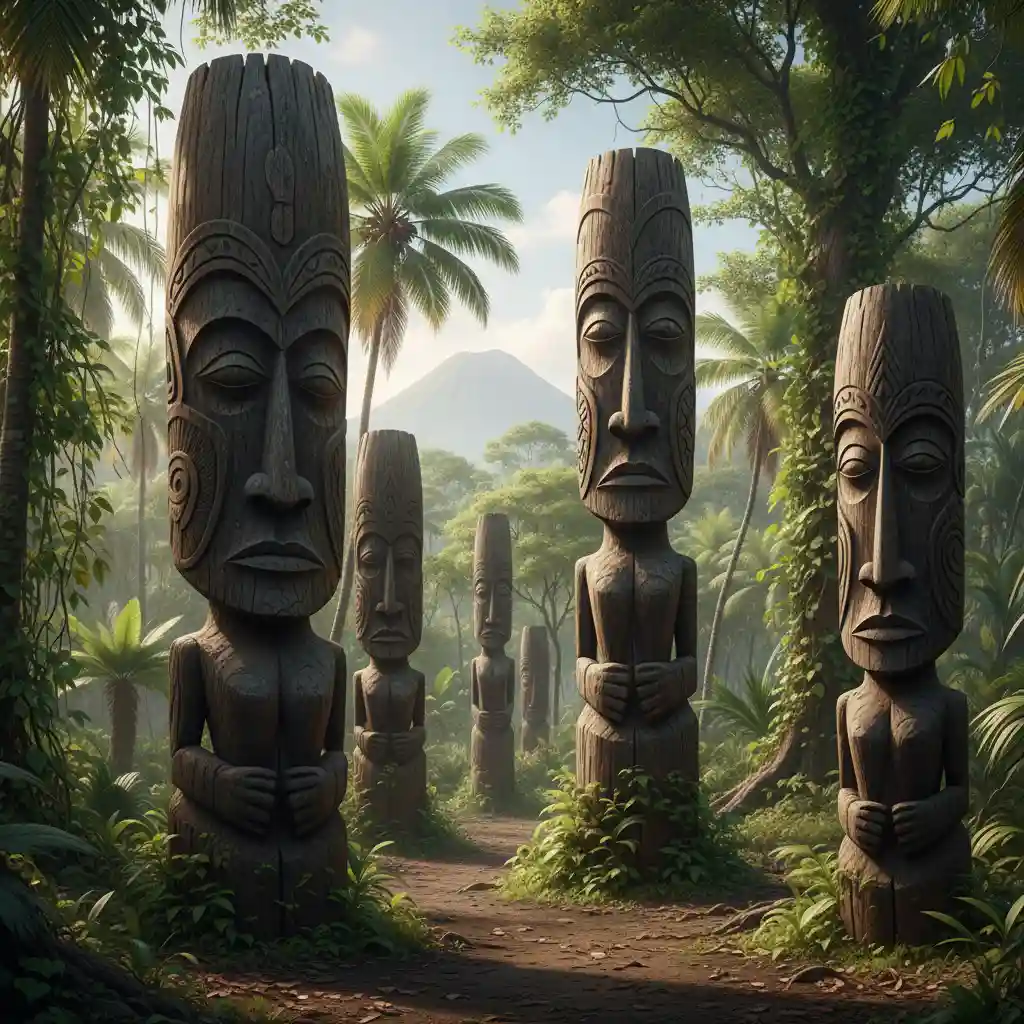
The most iconic instrument in Vanuatu traditional music is the slit drum, known locally as the Tamtam. Particularly prominent on the island of Ambrym, these are not merely musical instruments but sacred totems. Carved from the trunks of breadfruit or teak trees, they can stand several meters high. The carving process itself is a ritual, often involving the entire community.
Functionally, the Tamtam acts as a long-distance communication device. By striking the lip of the slit with a heavy wooden club, villagers can produce a resonant thud that travels for miles through the dense jungle. Different rhythmic patterns convey specific messages—announcing a birth, a death, a feast, or a chiefly gathering. Spiritually, the sound is believed to be the voice of the ancestors speaking to the living, bridging the gap between the physical and spiritual realms.
Bamboo Stamping Tubes and Flutes
While the Tamtam provides the bass, higher frequencies in Vanuatu traditional music are often supplied by bamboo. Bamboo stamping tubes are varying lengths of bamboo, open at one end and closed at the other. When struck against the ground or a stone, they produce a hollow, resonant pitch. An ensemble of players, each holding tubes of different sizes, creates complex melodic rhythms that accompany dances.
Bamboo flutes (panpipes) are also common, particularly in the northern islands. These instruments are often used in more intimate settings or specific rituals where the aggressive power of the slit drum is not required. The breathy, ethereal sound of the bamboo flute is frequently associated with love songs or lullabies, contrasting sharply with the martial intensity of the war drums.
The Conch Shell (Pu)
The conch shell, or ‘Pu’, serves as the herald of Vanuatu traditional music. It is almost exclusively used as a signaling instrument. The piercing, trumpet-like call of the conch shell marks the beginning of ceremonies, the arrival of dignitaries, or the start of a significant community event. Its sound cuts through the ambient noise of the village and the ocean, demanding immediate attention and reverence.
What is the Significance of Ceremonial Dances?
Dance in Vanuatu is never performed for entertainment alone; it is a manifestation of ‘Kastom’ (customary law and tradition). Dances are functional, serving to seal alliances, grade-taking ceremonies (Namangi), or ensure a bountiful harvest. The movement is inextricably linked to the music, with dancers often providing their own percussion through ankle rattles made from dried seed pods.
The Rom Dance of Ambrym
One of the most secretive and visually striking traditions is the Rom dance of Ambrym. This dance involves male initiates wearing elaborate, conical masks and costumes made of dried banana leaves that cover the entire body. The masks represent spirits, and it is believed that once a dancer dons the mask, he ceases to be human and becomes the spirit itself.
The dance is accompanied by the thunderous rhythm of the Tamtam drums. The atmosphere during a Rom dance is charged with spiritual intensity; it is a dangerous time where the boundaries between the human and spirit worlds are thin. The identity of the dancers is strictly guarded, and the masks are often destroyed after the festival to prevent the spirits from lingering.

The Toka Festival of Tanna
On the island of Tanna, the Toka festival represents one of the most magnificent displays of alliance and friendship. Unlike the mysterious Rom, the Toka is a celebration of unity between tribes. It involves hundreds of dancers, both men and women, painting their faces with designs representing their clan.
The choreography of the Toka is synchronized and stamina-testing, often lasting for days. The music is driven by the clapping of hands and the stomping of feet, creating a hypnotic, earth-shaking rhythm. The festival culminates in the exchange of gifts—pigs, kava, and mats—reinforcing social bonds and resolving inter-tribal conflicts.
Women’s Water Music of Gaua
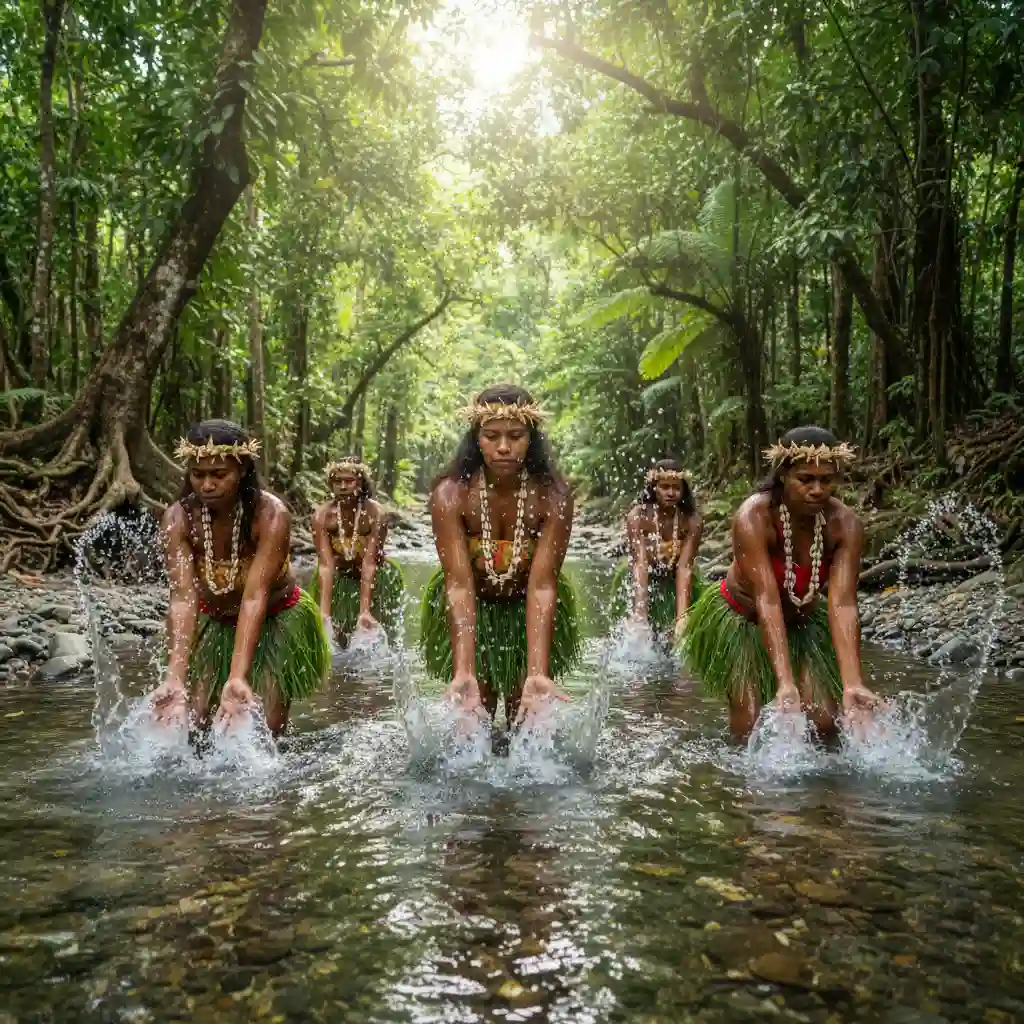
A unique phenomenon in the world of ethnomusicology is the Women’s Water Music from the Banks Islands, specifically Gaua. Standing waist-deep in the ocean or a river, women use their hands to strike the water’s surface, creating a variety of percussive sounds.
These sounds are not random splashes; they are precise notes ranging from deep, bass-like thuds to light, splashing trebles. The water itself becomes the instrument. The rhythms mimic sounds of nature, such as a whale breaching or rain falling on the ocean. This tradition is exclusive to women and has recently gained international recognition for its ingenuity and sonic beauty.
How Does Oral Storytelling Preserve History?
In a society that traditionally had no written language, history, genealogy, and law were encoded in music and storytelling. The role of the storyteller is revered, serving as the library of the tribe.
The Art of Sand Drawing (Sandroing)
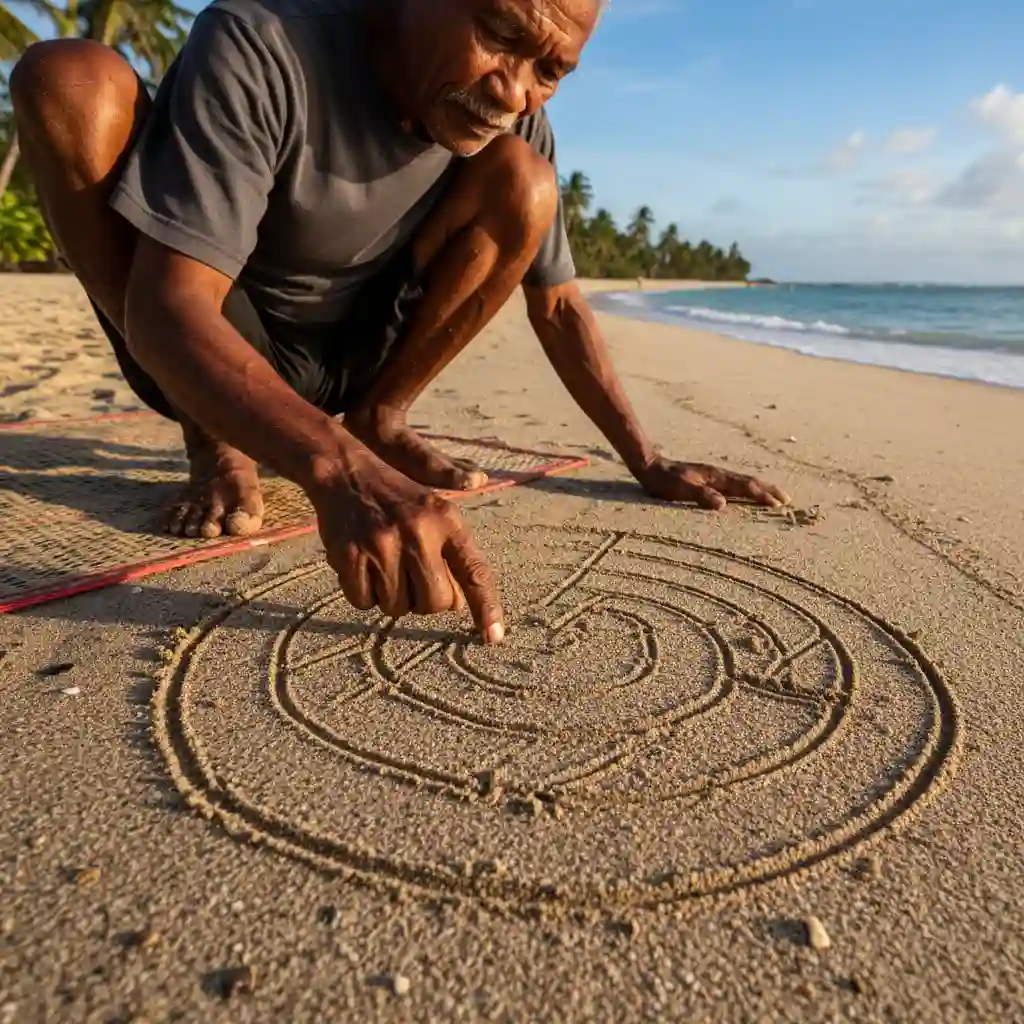
Perhaps the most sophisticated form of storytelling in Vanuatu is Sand Drawing, recognized by UNESCO as a Masterpiece of the Oral and Intangible Heritage of Humanity. This is not merely drawing pictures in the dirt; it is a complex, geometric ritual used to communicate across the archipelago’s 113 different languages.
The artist uses a single finger to trace a continuous, geometric line in the sand, often without lifting the finger until the design is complete. As they draw, they recite a story or a song. The geometric patterns act as mnemonic devices, helping the storyteller recall intricate details of legends, farming techniques, or kinship structures. It is a fleeting art form—erased by the wind or tide—yet it represents a permanent repository of cultural knowledge.
What is the Contemporary Music Scene in Vanuatu?
While Kastom music remains the spiritual core, Vanuatu has a thriving contemporary music scene that blends traditional rhythms with modern influences. This evolution demonstrates the adaptability of Ni-Vanuatu culture.
The Rise of String Band Music
Emerging in the mid-20th century, String Band music is the popular folk sound of Vanuatu. It combines guitars and ukuleles with a “bush bass”—a tea chest connected to a string and a stick. The result is a buoyant, melodic sound that is distinctly Pacific.
String bands are ubiquitous in village life, often providing the soundtrack for weddings and casual gatherings. The lyrics, usually sung in Bislama or local vernaculars, tackle modern issues, romance, and island life, serving as a contemporary extension of the oral storytelling tradition.
Reggae and Hip Hop Influence
In urban centers like Port Vila, the younger generation has embraced Reggae and Hip Hop. However, this is rarely a copy of Western styles. Vanuatu Reggae is heavily influenced by the “One Drop” beat but infused with island percussion and political messages regarding independence, anti-corruption, and cultural pride. Festivals like ‘Fest Napuan’ showcase this fusion, drawing thousands of attendees and proving that Vanuatu traditional music is not a static relic, but a living, breathing entity that continues to evolve.
Preserving Kastom in a Modern World
The preservation of Vanuatu traditional music is a priority for the Vanuatu Cultural Centre (VKS). Fieldworkers are deployed to remote islands to record songs, document dances, and encourage the transmission of skills from elders to the youth. In a rapidly globalizing world, these sounds—the thud of the Tamtam, the splash of the water music, and the strum of the bush bass—are vital anchors of identity for the Ni-Vanuatu people.
People Also Ask
What instruments are used in Vanuatu traditional music?
The primary instruments include the Tamtam (slit drum), bamboo stamping tubes, bamboo flutes (panpipes), conch shells, and seed-pod rattles. These are made entirely from natural materials found in the local environment.
What is the most famous dance in Vanuatu?
The Rom dance from Ambrym island is among the most famous and spiritually significant. It involves dancers wearing iconic conical masks and banana-leaf costumes to represent spirits.
What is Vanuatu sand drawing?
Sand drawing (Sandroing) is a UNESCO-recognized tradition where artists draw complex geometric patterns in the sand with a single continuous line while narrating stories. It serves as a means of communication and a mnemonic device for recording history.
What is a String Band in Vanuatu?
String Band is a popular genre of folk music in Vanuatu featuring guitars, ukuleles, and a bush bass (tea chest bass). It blends Western melodies with island rhythms and is a staple of social gatherings.
Why is the Tamtam drum important?
The Tamtam slit drum is culturally vital as a communication tool between villages and a spiritual link to ancestors. Its resonance is believed to carry the voice of the spirits and is central to major ceremonies.
Where can I see traditional Vanuatu music performed?
Traditional music can be experienced at cultural festivals like the Toka Festival on Tanna, the Rom Festival on Ambrym, or at the Fest Napuan in Port Vila. Cultural villages also offer demonstrations for visitors.