
Getting around Vanuatu islands primarily relies on privately owned minibuses and taxis, identifiable by a “B” or “T” on their license plates. For flexible travel, rental cars are available in Port Vila and Luganville. While there is no standardized public bus timetable, hailing passing minibuses is the most affordable and authentic way to navigate Efate and Santo.
Navigating the archipelago of Vanuatu offers a unique blend of island charm and logistical adventure. Unlike major metropolitan hubs with scheduled subway systems and ride-sharing apps, transportation in Vanuatu is organic, community-driven, and surprisingly efficient once understood. Whether you are exploring the bustling streets of Port Vila, the long coastal roads of Espiritu Santo, or the rugged terrain of Tanna, understanding the local transport etiquette is essential for a seamless journey.
Public Transport: Understanding the Minibus System
The backbone of transportation in Vanuatu, particularly on the main island of Efate and in Luganville on Espiritu Santo, is the minibus system. These are not government-run buses with fixed schedules and designated stops. Instead, they are privately owned vehicles that operate on a fluid, demand-based system.

How to Identify and Hail a Bus
Identifying a public transport bus is straightforward. Look for a license plate that begins with the letter “B”. These vans are ubiquitous in Port Vila. There are no designated bus stops; to catch a bus, you simply stand by the side of the road and wave when you see one approaching. If the bus has seats available, the driver will pull over.
Once the bus stops, tell the driver your destination. If it is along their general route or if they don’t have conflicting drop-offs, they will nod for you to board. It is a shared ride service, meaning the driver will pick up and drop off other passengers along the way. This can make a short journey slightly longer, but it provides a wonderful opportunity to interact with locals and see parts of the town you might otherwise miss.
Cost and Payment Etiquette
Fares are fixed by the government but can vary slightly based on distance. As of the most recent updates, a standard trip within the greater Port Vila area costs approximately 150 VT (Vatu). Trips to villages outside the town center or to specific resorts like Mele or Pango will cost more, ranging from 200 VT to 500 VT.
Payment Rules:
- Pay on Exit: Do not try to pay when you enter. Pay the driver directly when you reach your destination.
- Exact Change: While drivers usually carry change, it is courteous and efficient to carry small coins (100 VT and 20 VT coins) or small notes. Trying to pay a 150 VT fare with a 5,000 VT note is difficult for the driver.
- No Tipping: Tipping is not customary in Vanuatu culture and is not expected on buses.
Taxis and Private Transfers
For those seeking more privacy, air-conditioning, or direct transport without multiple stops, taxis are readily available. Like buses, taxis are easily identifiable by their license plates, which start with the letter “T”.
Taxi Availability and Fares
Taxis are plentiful in urban centers and at the airports. Unlike the buses, taxis can be flagged down, or found at designated ranks outside major hotels, supermarkets, and the market house. Taxis in Vanuatu generally do not use meters. This is a critical point for travelers to remember.
How to handle the fare: You must agree on the price with the driver before you get into the vehicle. Most drivers are honest and adhere to standard rates, but clarifying the cost beforehand prevents misunderstandings. A short trip within town might cost 500 VT to 700 VT, while a trip from the airport to a resort in Port Vila generally has a set standard rate.

Chartering Taxis for Tours
A popular way to see the islands, particularly Efate, is to hire a taxi driver for a half-day or full-day charter. This is often more flexible and cheaper than booking a seat on a large tour bus. You can negotiate a daily rate (typically between 8,000 VT and 12,000 VT depending on the distance and duration) and the driver will act as your private chauffeur, waiting for you at each attraction (like the Blue Lagoon or Cascades Waterfalls).
Car Rental Guide and Driving Tips
Renting a car offers the ultimate freedom to explore at your own pace. Several international rental agencies (like Hertz, Avis, and Budget) operate alongside local companies (like World Car Rentals) in Port Vila and Luganville.
Driving Rules and Regulations
Before you get behind the wheel, you must be aware of the local driving laws. The most significant adjustment for visitors from Australia, New Zealand, or the UK is the side of the road.
- Right-Hand Traffic: Vanuatu drives on the right side of the road. If you are accustomed to driving on the left, this requires constant vigilance, especially at roundabouts and intersections.
- Speed Limits: Speed limits are generally low—50 km/h in town and 80 km/h on the open road. However, road conditions often dictate slower speeds.
- License Requirements: A valid driver’s license from your home country is usually sufficient for rentals if you are staying for less than three months. An International Driving Permit is rarely required for English-language licenses.
Road Conditions and Vehicle Choice
The ring road around Efate is sealed and generally in good condition, making it accessible for compact cars. However, once you venture off the main ring road or explore islands like Tanna, the conditions change drastically. Secondary roads are often unsealed coral tracks, riddled with potholes or subject to washouts after heavy rain.
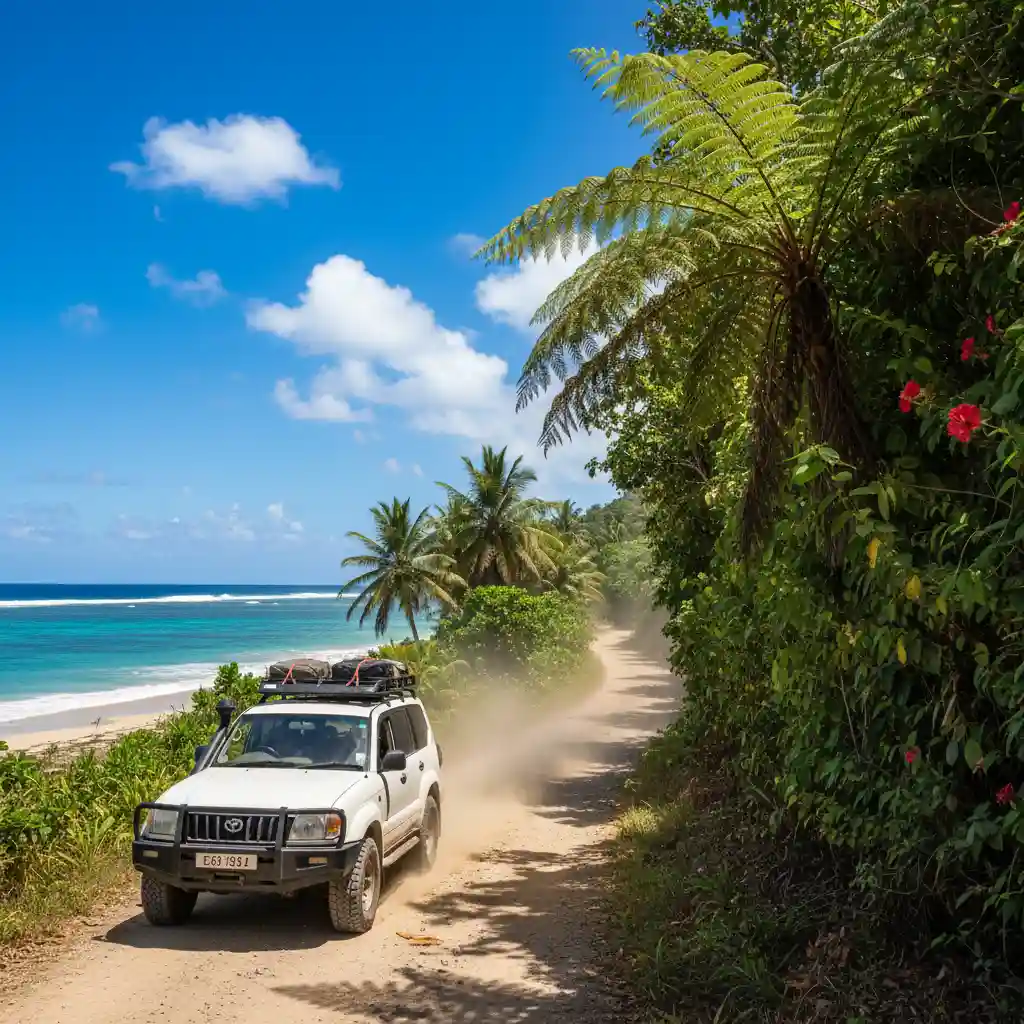
Recommendation: If you plan to explore beyond the paved ring road or are traveling to Espiritu Santo or Tanna, renting a 4WD or a vehicle with high clearance is strongly advised. Insurance policies often exclude undercarriage damage, so drive carefully on unsealed roads.
Transport Nuances by Island
Transport availability varies significantly depending on which island you are visiting. What works in the capital city does not necessarily apply to the outer islands.
Efate (Port Vila)
Efate has the most developed infrastructure. The ring road is fully sealed, buses run frequently until sunset, and taxis are available 24/7. Traffic can get congested in Port Vila during morning and afternoon rush hours.
Espiritu Santo (Luganville)
Santo is Vanuatu’s largest island, and distances are vast. While there are taxis and buses in Luganville, they are less frequent than in Vila. To visit Champagne Beach or Port Olry, which are an hour drive north, you will need to arrange a transfer or rent a car. Hitchhiking (or paying for a seat in the back of a passing utility truck) is common here.
Tanna Island
Tanna is rugged. There are very few paved roads. Transport here is almost exclusively by 4WD utility trucks. Visitors usually arrange transfers through their accommodation or tour operators, specifically for the trip to Mount Yasur volcano. Rental cars are scarce and generally come with a driver due to the challenging terrain.

Walking, Biking, and Scooters
Is it safe to walk?
Port Vila is a walkable city, though the heat and humidity can be intense. The sidewalks can be uneven, with high curbs and occasional missing pavers, so watch your step. Walking at night in unlit areas is generally discouraged, not necessarily due to crime, but due to hazards like deep drainage ditches and stray dogs.
Scooters and Quad Bikes
Scooters are available for rent but are only recommended for experienced riders. The combination of sand on the roads, potholes, and unpredictable driving from other vehicles makes two-wheeled travel risky. Quad bikes (ATVs) are a popular alternative and are often rented as part of guided tours, allowing you to access off-road jungle tracks safely.
People Also Ask
Is there Uber or rideshare in Vanuatu?
No, there is no Uber, Lyft, or Grab in Vanuatu. You must rely on the local “T” plate taxis or “B” plate minibuses. However, the local system is very dense in Port Vila, so you rarely wait more than a few minutes for a ride.
How much is a bus ride in Vanuatu?
A standard bus fare within Port Vila is 150 VT per person. Fares increase for longer distances, such as traveling from town to Mele Cascades, which may cost between 300 VT and 500 VT.
Do I need an international driver’s license in Vanuatu?
Generally, no. Tourists can drive using their valid home country driver’s license for up to three months. If your license is not in English or French, it is advisable to have an International Driving Permit or a certified translation.
What side of the road do they drive on in Vanuatu?
Vehicles in Vanuatu drive on the right-hand side of the road. This is opposite to Australia, New Zealand, and the UK, but the same as the USA and most of Europe.
Are taxis safe in Vanuatu?
Yes, taxis are generally very safe in Vanuatu. Drivers are local, friendly, and helpful. However, as with travel anywhere, it is wise to agree on a price before starting the journey and avoid unmarked vehicles.
Can I rent a car on islands other than Efate?
Yes, car rentals are available on Espiritu Santo (Luganville). On Tanna and other outer islands, self-driving rentals are very rare; transport is usually arranged via accommodation providers using 4WD trucks with drivers.