
Vanuatu traditional crafts encompass a diverse range of handmade artifacts deeply rooted in ‘Kastom’ culture. Primary forms include intricate pandanus weaving produced by women, ceremonial wood carvings like Tam Tams from Ambrym, and ancient Lapita-style pottery. These items serve both utilitarian purposes and vital ceremonial roles within village life, preserving centuries of indigenous knowledge.
What defines Vanuatu Weaving Traditions?
Weaving is arguably the most ubiquitous and culturally significant of all Vanuatu traditional crafts. While wood carving is often the domain of men, weaving is the mastercraft of Ni-Vanuatu women. It is not merely a hobby or a means of producing souvenirs; it is a fundamental aspect of daily life, social status, and economic exchange across the 83 islands of the archipelago.
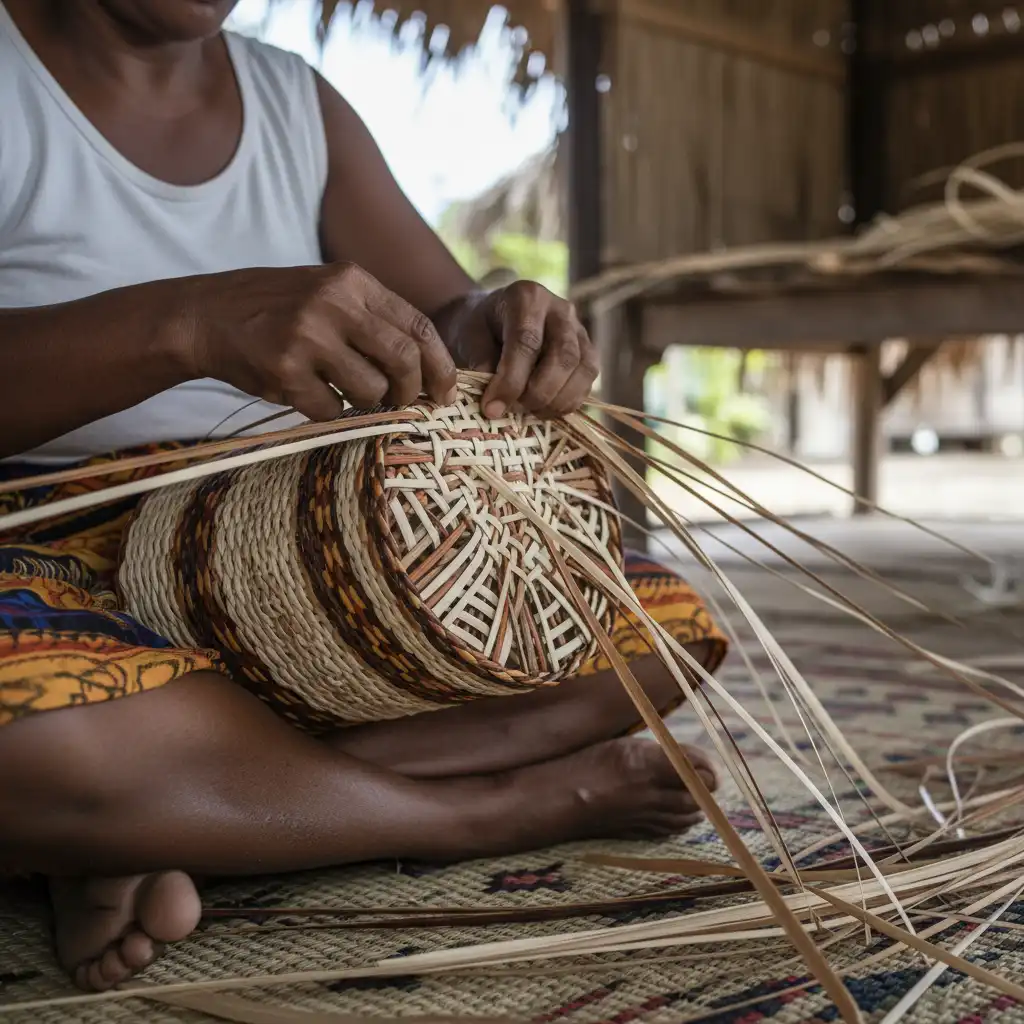
The primary material used is the pandanus leaf. The process begins long before the first strand is woven. Women harvest the long, spiky leaves from the pandanus tree. These leaves must be stripped of their thorns, boiled or soaked in seawater to preserve them and prevent rotting, and then bleached in the sun for days to achieve a light, straw-colored hue. Once dried, they are smoothed using a shell or a dull knife to make them pliable.
Types of Woven Artifacts
The output of this labor-intensive process is varied. The most common items are baskets and bags, often referred to as distinct regional styles. For example, the sturdy, tightly woven baskets from the Shepherd Islands differ significantly from the softer, more flexible bags found in the northern provinces.
However, the most culturally valuable woven item is the fine mat. In Central Vanuatu, particularly on Pentecost, Ambae, and Maewo, red mats are a form of traditional currency. These mats are dyed using the roots of local plants and stenciled with complex geometric patterns. They are essential for ‘kastom’ ceremonies, including weddings, grade-taking ceremonies (where men ascend the social hierarchy), and funerals. The exchange of these mats cements alliances and settles disputes.
Dyeing and Patterning
The vibrant colors seen in Vanuatu traditional crafts are derived entirely from nature. While modern synthetic dyes are creeping into the market, purists and high-value cultural artifacts still rely on botanical sources. Yellow is often obtained from turmeric or ginger roots, while deep purples and reds come from the bark of specific trees or berries. The intricate patterns woven into the mats and baskets often tell a story, representing clan totems, local flora, or historical events.
Why is Wood Carving Significant in Vanuatu?
Wood carving in Vanuatu is far more than decorative art; it is a conduit to the spiritual world. The carvings are physical manifestations of ancestors, spirits, and mythological figures. While carvings can be found throughout the archipelago, the islands of Ambrym and Malekula are world-renowned for their distinct and powerful styles.
The Tam Tam (Slit Drums)
The most iconic symbol of Vanuatu traditional crafts is the Tam Tam, or slit drum. Originating from Ambrym, these are large, hollowed-out logs carved from the breadfruit tree or teak. They stand vertically, often reaching heights of several meters. The top of the drum is carved into a face with large, staring eyes, representing an ancestor watching over the village.

Functionally, the Tam Tam is a musical instrument and a communication device. By striking the slit in the wood with a club, the drum produces a deep, resonant sound that can travel for miles through the dense jungle. Different rhythms communicate different messages—announcing a birth, a death, or a call to a meeting. Culturally, the carving of a Tam Tam is a sacred act, often accompanied by specific rituals and taboos.
Fern Tree Carvings
Another unique medium is the trunk of the tree fern. Unlike the hard wood of the Tam Tam, the tree fern is fibrous and porous. These carvings are typically associated with the grade-taking ceremonies in the northern islands. As a man rises in rank within his tribe, he commissions specific figures to be carved from tree ferns. These figures are often painted with natural pigments—lime for white, charcoal for black, and ochre for red. Over time, as the fern wood decays, the spirit is said to be released, symbolizing the transient nature of life.
Masks and Spirit Figures
Masks are integral to ritual dances, particularly the Rom dance on Ambrym. These masks are constructed from a variety of materials, including wood, coconut fiber, and clay. They are designed to conceal the identity of the dancer, allowing them to embody the spirit they are portraying. The craftsmanship involves not just carving, but the attachment of hair (often made from spider webs or hibiscus fibers) and the painting of fierce expressions to ward off evil spirits.
How is Vanuatu Pottery Produced?
Pottery is one of the oldest of Vanuatu traditional crafts, with a lineage tracing back to the Lapita people who settled the Pacific over 3,000 years ago. While pottery traditions have vanished from many islands due to the introduction of metal pots by Europeans, the tradition remains vibrant on the west coast of Espiritu Santo, specifically in the village of Wusi.

The Wusi Technique
The potters of Wusi do not use a potter’s wheel. Instead, they utilize the coil method. Clay is harvested from specific riverbanks, cleaned of impurities, and rolled into long, snake-like strips. These strips are coiled upon one another to build the walls of the vessel. The potter then uses a flat piece of wood or bamboo to smooth the coils together, creating a seamless surface.
Decoration is applied while the clay is still damp. Incised geometric patterns, similar to those found on ancient Lapita shards, are carved into the rim and body of the pot. These designs are not random; they belong to specific families and are passed down through generations.
Firing and Finishing
The firing process is primitive yet effective. The dried pots are not placed in a kiln but are piled together and covered with dried coconut husks, bamboo, and wood. The pile is set alight, and the pots are fired in the open air. While the pots are still hot from the fire, they are often rubbed with a resin from the localized ‘nali nut’ tree. This resin melts into the porous clay, acting as a varnish that waterproofs the vessel and gives it a distinct, glossy finish.
What is Vanuatu Sand Drawing?
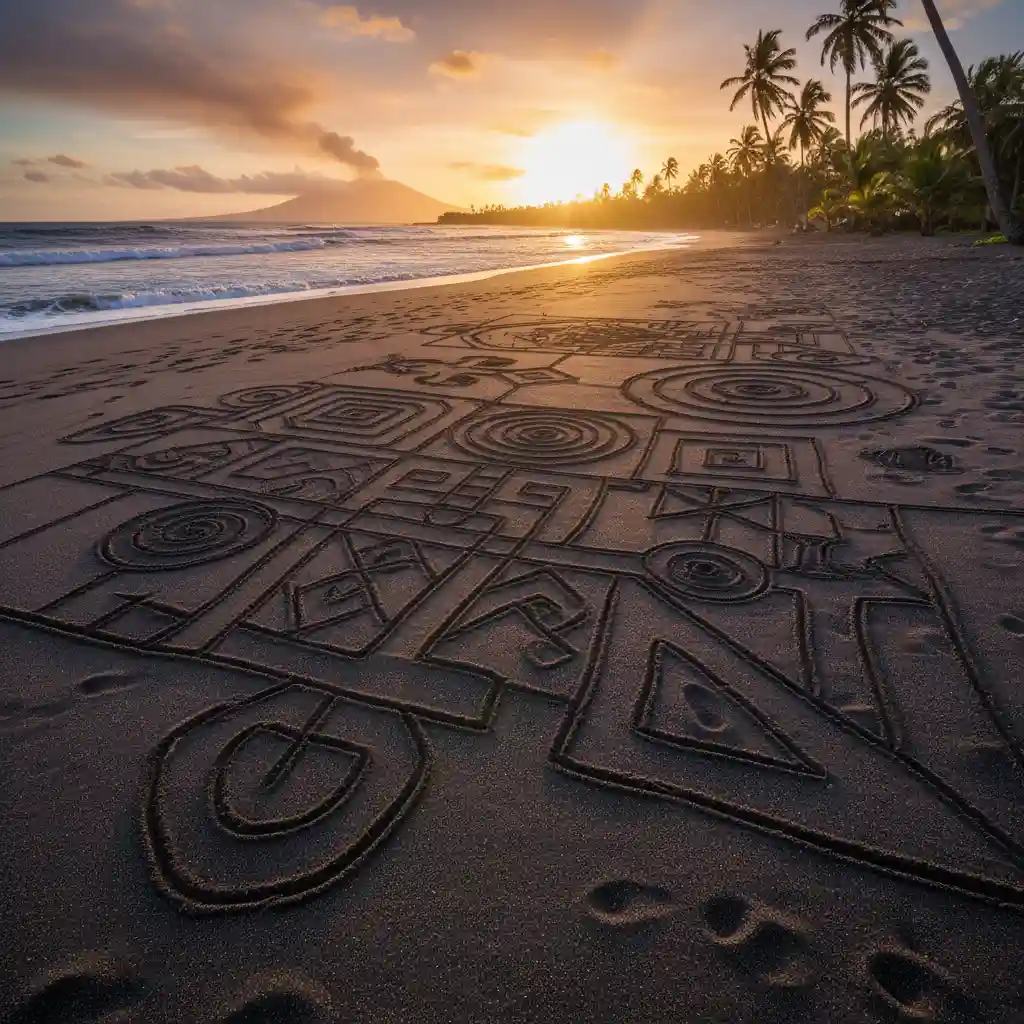
While not a physical object you can take home, sand drawing (Sandroing) is a critical component of Vanuatu’s artistic heritage and is recognized by UNESCO as a Masterpiece of the Oral and Intangible Heritage of Humanity. It is a graphic tradition practiced primarily in the central and northern islands.
The artist uses a single finger to draw a continuous, geometric line in the sand, volcanic ash, or dust. The line loops and weaves around a grid of points to create a symmetrical composition. These drawings are not just art; they are a complex system of communication, recording rituals, mythological lore, and agricultural cycles. The drawing is often accompanied by a story or song. Once the story is told, the drawing is wiped away, emphasizing the importance of the oral transmission of knowledge.
Where to Buy Authentic Vanuatu Crafts?
For travelers looking to support the local economy and take home a piece of ‘Kastom,’ purchasing authentic Vanuatu traditional crafts is a must. However, it is vital to distinguish between mass-produced imports and genuine local artistry.
Haos Blong Handikraft (Port Vila)
Located in the capital, Port Vila, the Haos Blong Handikraft (House of Handicrafts) is a cooperative dedicated to selling only 100% locally made products. Here, you can find high-quality woven mats, baskets, carvings, and shell jewelry. Buying here ensures that the money goes directly to the artisans in the outer islands.
Port Vila Handicraft Market
Situated on the seafront, this market offers a wide array of goods. While excellent for souvenirs, visitors should verify the origin of the wood carvings. Authentic Tam Tams are heavy and made of dense wood, whereas tourist replicas may be lighter and less detailed.
Direct from the Villages
The best way to acquire authentic crafts is to visit the outer islands. If you travel to Malekula, Ambrym, or Tanna, you can purchase directly from the carvers and weavers. This provides the most authentic experience and often allows you to witness the creation process firsthand. Be aware that prices in villages are often lower than in Port Vila, but the logistics of transport are more challenging.
Biosecurity and Export Rules
When purchasing Vanuatu traditional crafts, particularly wooden carvings and woven mats, be mindful of your home country’s customs regulations. Wood must be treated or free of insects, and plant fibers must be thoroughly dried. Many reputable sellers in Port Vila can provide a fumigation certificate or verify that the wood has been treated, which is essential for re-entry into countries like Australia and New Zealand.
Conclusion
Vanuatu traditional crafts are a testament to the resilience and creativity of the Ni-Vanuatu people. From the rhythmic beating of the Tam Tam to the delicate weave of a pandanus basket, these arts are the heartbeat of the archipelago. By understanding the techniques and cultural significance behind these objects, visitors can appreciate them not just as souvenirs, but as sacred vessels of history and identity.
What is the most popular souvenir from Vanuatu?
The most popular souvenirs are woven pandanus bags and baskets, known for their durability and intricate patterns. Wooden carvings, specifically miniature Tam Tam drums, are also highly sought after by tourists.
Can I take wooden carvings back to Australia or NZ?
Yes, but they must be declared. The wood must be free of bark and insects. It is highly recommended to buy from a certified vendor who can provide a treatment certificate to speed up the customs process.
What is the significance of the pig tusk in Vanuatu art?
The circular pig tusk is a national symbol of Vanuatu, representing wealth and prosperity. It is often featured in jewelry and carvings. A tusk that has grown into a full circle is considered extremely valuable in traditional custom economy.
Where is the best place to see pottery being made?
The village of Wusi on the west coast of Espiritu Santo is the premier location to witness traditional pottery making. It is one of the few places where the ancient Lapita-style techniques are still practiced.
Are Vanuatu crafts expensive?
Prices vary significantly. Small woven items can cost a few dollars, while large, ceremonial grade-taking carvings or fine red mats can cost hundreds or even thousands of dollars due to the time and cultural status associated with them.
What materials are used in Vanuatu weaving?
The primary material is pandanus leaf. However, coconut palm fronds are also used for rougher, utility baskets. Hibiscus fiber and burao (sea hibiscus) bark are used for cordage and finer details.