
During World War II, Vanuatu (then the New Hebrides) served as a vital forward operating base for Allied forces in the Pacific theater. Hosting over 500,000 troops, islands like Espiritu Santo and Efate provided critical supply chains, airfields, and medical facilities to support the Guadalcanal campaign and halt the Japanese advance.
While no major land battles were fought on its shores, the archipelago transformed into one of the largest military bases in the Pacific, leaving a legacy of sunken ships, abandoned machinery, and profound cultural shifts that remain visible today.
The Strategic Importance of the New Hebrides
In early 1942, the Imperial Japanese Navy was advancing rapidly across the Pacific, threatening supply lines between the United States and Australia. The New Hebrides (now Vanuatu), a condominium governed jointly by Britain and France, occupied a pivotal geographic position. Situated northeast of Australia and directly south of the Solomon Islands, the archipelago became the perfect staging ground for the Allied counter-offensive.
Following the attack on Pearl Harbor, the United States recognized that holding the New Hebrides was essential to protecting the lifeline to Australia. The islands offered deep-water harbors and flat land suitable for airfields, yet they were largely undeveloped. The transformation that ensued was nothing short of an engineering miracle, turning quiet colonial outposts into bustling military cities almost overnight.
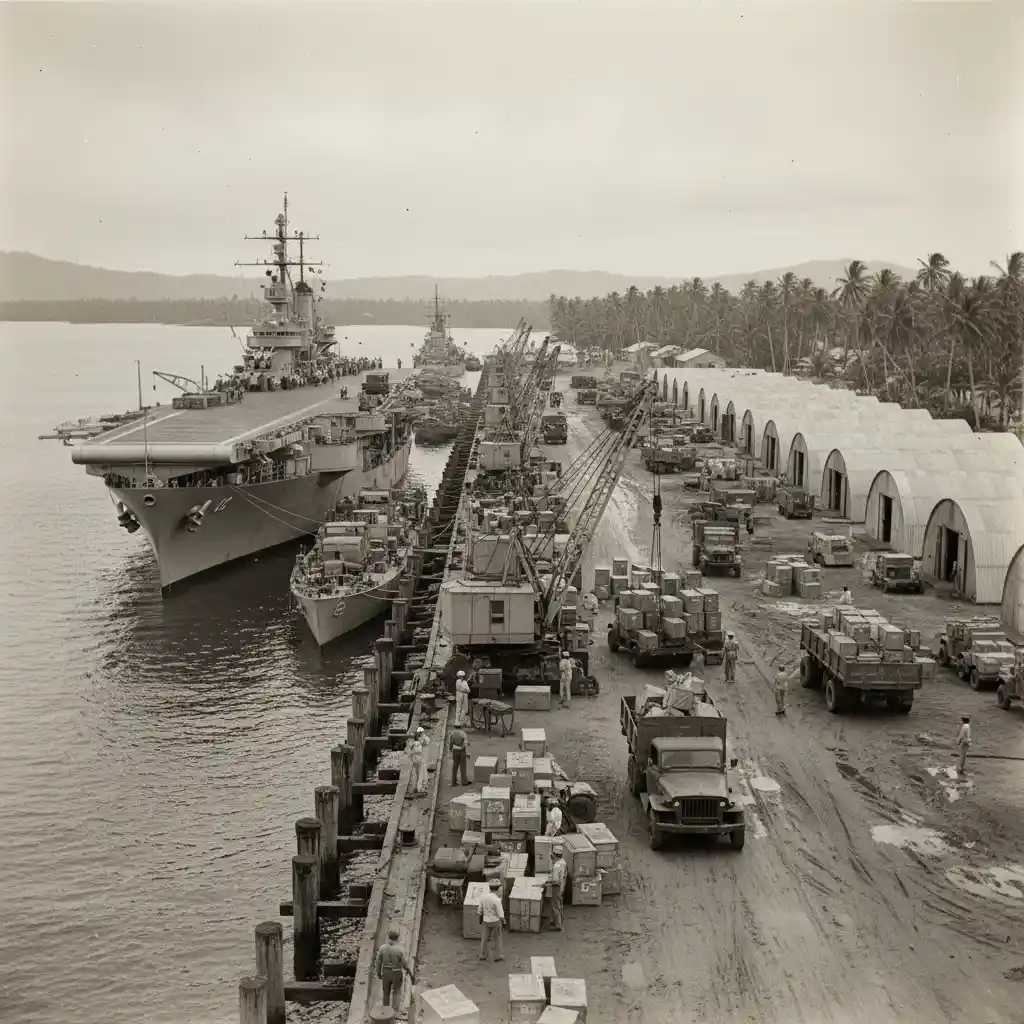
US Military Presence: Base Button and Base Roses
The American occupation was divided primarily between two major bases: Base Roses on Efate (the current capital island) and Base Button on Espiritu Santo. These were not mere encampments; they were fully functioning American cities transplanted into the jungle.
Base Roses (Efate)
Established first, Base Roses on Efate served as the initial headquarters. The calm waters of Havannah Harbour became a sanctuary for the fleet. American engineers, particularly the Seabees (Construction Battalions), constructed Bauerfield International Airport, which remains the country’s main gateway today. At its peak, Efate hosted a significant concentration of troops, hospitals, and administrative centers designed to coordinate the defense of the South Pacific.
Base Button (Espiritu Santo)
The larger and more strategically critical installation was Base Button on Espiritu Santo. As the Allies prepared for the Guadalcanal campaign, Santo became the second-largest US base in the Pacific, surpassed only by Hawaii. It served as a major supply depot, naval repair station, and airbase.
The scale of Base Button was staggering. It housed over 100,000 military personnel at any given time. The infrastructure included:
- Five airfields: Including Bomber 1, 2, and 3, capable of launching B-17 Flying Fortresses.
- Floating dry docks: Capable of repairing battleships damaged in the Solomons.
- 40 cinemas: To entertain the troops.
- Hospitals: With thousands of beds to treat the wounded evacuated from the front lines.
The logistics required to maintain this presence meant that tons of equipment—from Jeeps and bulldozers to Coca-Cola bottles and ice cream machines—poured onto the island. For a brief period, Espiritu Santo had a higher population density and more modern amenities than many towns in the United States.
The Tragedy of the SS President Coolidge
One of the most significant maritime disasters of the Pacific war occurred in Vanuatu waters, creating what is now considered one of the world’s top wreck dives.
The SS President Coolidge was a luxury ocean liner converted into a troopship. On October 26, 1942, carrying over 5,000 troops and critical supplies for the defense of Guadalcanal, the captain feared Japanese submarines and attempted to enter the Segond Channel at Espiritu Santo. Unaware of the defensive minefield laid by the US Navy to protect the base, the massive ship struck two mines.
The captain intentionally grounded the ship on a coral reef to allow troops to evacuate. Remarkably, due to the disciplined evacuation, only two lives were lost out of the thousands on board. However, the ship eventually slid off the reef and sank into the deep channel, settling on its side.
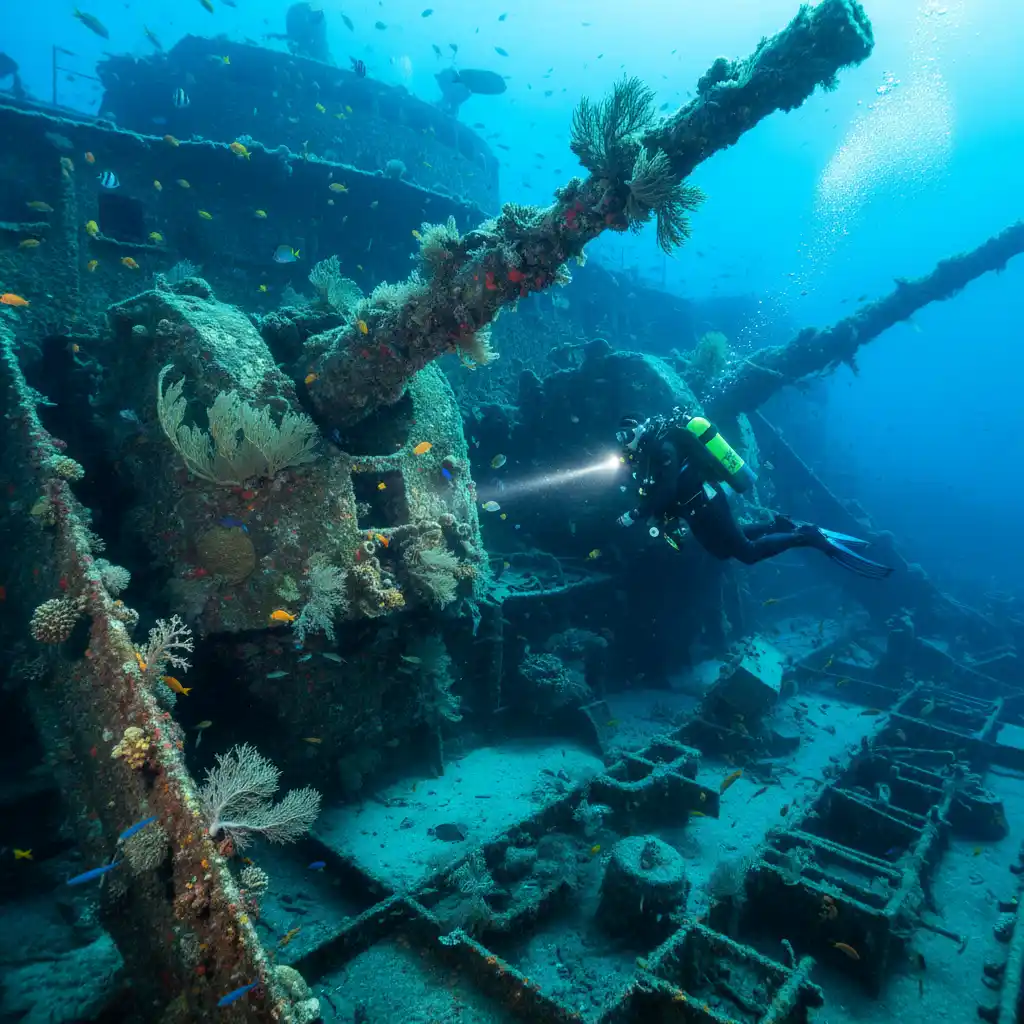
Today, the Coolidge is a major draw for technical divers. The wreck is immense, stretching nearly 200 meters long. Divers can explore the cargo holds still filled with Jeeps, guns, and personal artifacts, as well as the famous “The Lady” ceramic relief in the first-class dining room.
Million Dollar Point: An Underwater Graveyard
Perhaps the most bizarre and poignant remnant of World War II in Vanuatu is Million Dollar Point. Located just east of Luganville on Espiritu Santo, this site represents the immense economic surplus of the American war machine and the complexities of colonial politics.
Why was equipment dumped at Million Dollar Point?
When the war ended in 1945, the US military faced a logistical dilemma. They had millions of dollars worth of heavy equipment—bulldozers, cranes, forklifts, trucks, and building supplies—stockpiled on Santo. Shipping it back to the US was deemed too expensive, and it would have flooded the domestic market, hurting American manufacturers.
The US military offered to sell the equipment to the local colonial administration (the British and French Condominium) at a drastically reduced rate, often cited as pennies on the dollar. However, the colonial powers, believing the Americans would simply leave the equipment behind for free if they refused to pay, declined the offer.
In response, the American commanders ordered the destruction of the assets to ensure they could not be used without payment. For days, Seabees drove trucks, jeeps, and bulldozers onto a ramp and into the ocean. Cases of Coca-Cola, clothing, and tools were tossed into the sea. The total value of the dumped goods was estimated at over a million dollars in 1945 currency—a fortune.
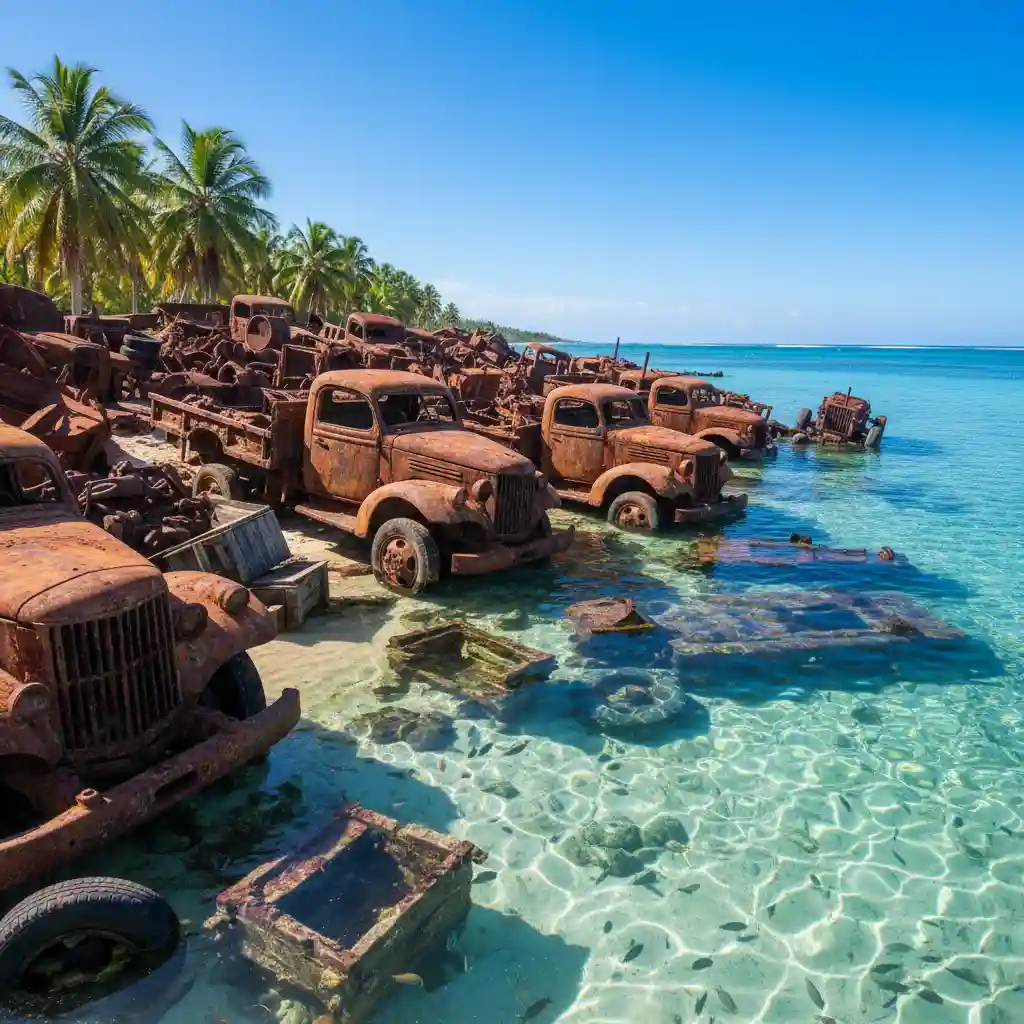
Today, Million Dollar Point is a snorkeling and diving site where visitors can swim over piles of rusting metal, a stark monument to the wastefulness of war and the friction of colonial politics.
Impact on the Local Population and Culture
The arrival of Americans had a profound sociological impact on the Ni-Vanuatu people. Before the war, the indigenous population lived under a strict colonial hierarchy where British and French masters held absolute authority and wealth.
The Vanuatu Labor Corps
The US military employed thousands of Ni-Vanuatu men in the Vanuatu Labor Corps to help build airstrips and unload cargo. For the first time, many locals were paid fair wages, given ample food, and treated with a degree of familiarity and equality by the American troops (including African American soldiers) that was unheard of under colonial rule. This experience sowed the seeds of discontent with the colonial administration and contributed to the eventual push for independence.
John Frum and Cargo Cults
The influx of massive amounts of material wealth—”cargo”—dropping from the sky and arriving by sea led to the solidification of “Cargo Cults,” most notably the John Frum movement on Tanna Island. While the roots of the movement predate the war, the arrival of the US military (often associated with the figure of John Frum) validated the prophecies that a powerful force would bring wealth and liberation to the islanders.
Followers of John Frum built ceremonial airstrips and drilled with wooden rifles, hoping to entice the planes and cargo to return. To this day, the movement remains an active part of Tanna’s culture, celebrating every February 15th with parades often featuring US flags.
Lasting WWII Sites You Can Visit Today
For history buffs and travelers, Vanuatu offers a unique open-air museum of World War II history. Unlike museums where artifacts are behind glass, here they are often integrated into the jungle or the ocean floor.
1. The Quonset Huts of Luganville
Drive through the main street of Luganville, and you will notice the distinctive curved roofs of Quonset huts. Many of these structures, built by the US Navy in the 1940s, are still in use today as homes, sheds, and workshops. They serve as a testament to the durability of the construction during the base’s peak.
2. Bomber 3 Airstrip
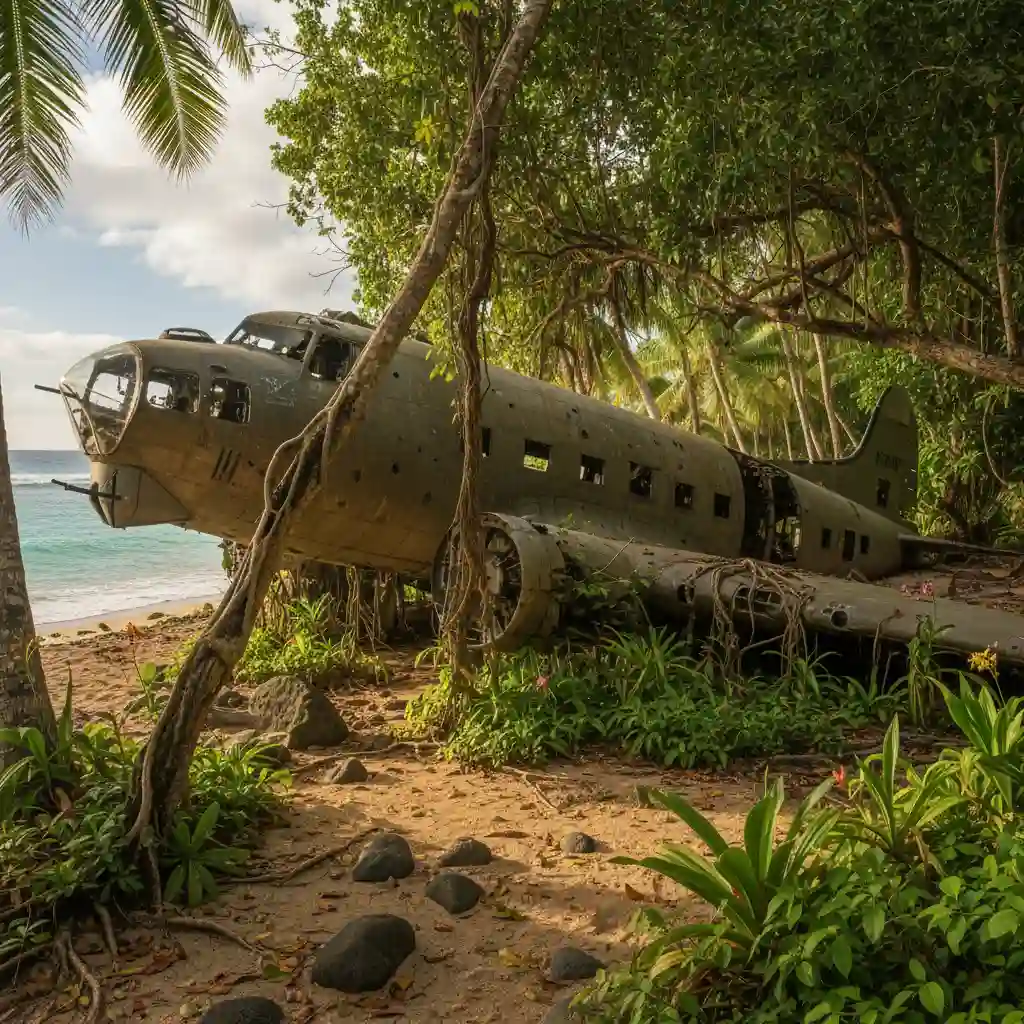
Hidden in the jungle of Espiritu Santo lies the remains of Bomber 3. While nature is reclaiming the tarmac, you can still find the wreckage of a B-17 bomber that crashed on takeoff. It is a solemn site that highlights the risks pilots faced even outside of combat.
3. Havannah Harbour Museum (Efate)
On the island of Efate, Havannah Harbour was a secret naval base. Today, a small roadside museum displays Coca-Cola bottles, shell casings, helmets, and medical supplies dug up from the surrounding area. It provides an intimate look at the daily life of a soldier stationed in the tropics.
The Literary Legacy: Tales of the South Pacific
The American presence in Vanuatu also gave birth to a literary classic. James Michener, a naval historian stationed on Espiritu Santo, wrote Tales of the South Pacific based largely on his experiences there. The island of “Bali Ha’i” described in the book (and the subsequent musical South Pacific) is widely believed to be inspired by Ambae island, visible from Santo on a clear day.
Michener’s stories captured the boredom, the longing, the romance, and the cultural clashes of the rear-guard bases. Reading this book while visiting Vanuatu adds a rich layer of context to the rusting metal and overgrown airstrips.
Vanuatu’s World War II history is not just a footnote; it was a period of radical transformation. From the depths of the Segond Channel where the Coolidge rests to the cultural practices on Tanna, the war shaped the modern identity of this island nation. For the traveler, it offers a raw, tangible connection to the past that few other destinations can match.
Did any fighting happen in Vanuatu during WWII?
No major land battles occurred in Vanuatu. However, there were occasional skirmishes, Japanese reconnaissance flights, and minor bombing raids. The islands served primarily as a supply, medical, and air support base for the fighting in the Solomon Islands.
Can you dive the SS President Coolidge without certification?
No, the SS President Coolidge is a deep dive, starting at around 20 meters and going down to 70 meters. Open Water certification is the absolute minimum for the shallow parts, but Advanced Open Water or Deep Diver certification is highly recommended to fully explore the wreck safely.
What is the best island to visit for WWII history in Vanuatu?
Espiritu Santo is the best island for WWII history. It was the site of the massive Base Button and hosts the SS President Coolidge wreck, Million Dollar Point, several abandoned airstrips, and numerous Quonset huts.
Why is it called Million Dollar Point?
It is named for the estimated value of the military equipment dumped there by US forces in 1945. The equipment, worth over a million dollars at the time, was destroyed to prevent the colonial government from acquiring it for free after they refused to buy it.
Are there still landmines in Vanuatu from WWII?
Vanuatu is generally considered safe from landmines. The defensive minefields laid in the channels were maritime mines, most of which were cleared or detonated after the war. However, unexploded ordnance (UXO) can still occasionally be found in the jungle, so it is best not to touch rusting metal found off the beaten path.
How did WWII affect the independence of Vanuatu?
The presence of US troops, particularly African American soldiers, showed the Ni-Vanuatu people that the colonial racial hierarchy was not absolute. The fair treatment and wages provided by the US military fostered a sense of self-worth and dissatisfaction with British and French rule, contributing to the independence movements that arose in the following decades.