The official currency of Vanuatu is the Vatu (VUV or VT). Travelers should budget approximately 10,000 VT ($85 USD) per day for mid-range travel, covering accommodation, local food, and transport. While Credit cards are accepted in Port Vila resorts, cash is strictly required for outer island travel, markets, and rural transport.
Traveling to the South Pacific archipelago of Vanuatu offers an immersive experience into Melanesian culture, pristine blue holes, and active volcanoes. However, the financial logistics of an island nation—specifically one comprised of 83 geographically dispersed islands—can be challenging for the unprepared traveler. Understanding the nuances of the Vanuatu Vatu, the scarcity of ATMs outside the capital, and the local etiquette regarding tipping is essential for a stress-free journey.
This comprehensive guide details everything you need to know about managing your money in Vanuatu, ensuring you spend less time worrying about exchange rates and more time enjoying the island’s natural beauty.
What is the Vanuatu Currency (Vatu)?
The unit of currency in Vanuatu is the Vatu, abbreviated internationally as VUV and locally as VT. Unlike many other currencies, the Vatu has no subdivisions; there are no cents. This can initially be confusing for travelers used to decimal currency systems, but it simplifies transactions once you adjust to the larger numbers.
The Reserve Bank of Vanuatu issues the currency, which features distinct cultural iconography. In recent years, Vanuatu has transitioned to polymer notes, which are durable and water-resistant—a practical feature for a tropical climate where humidity and water activities are prevalent.
Notes and Coins
Familiarizing yourself with the physical currency before you arrive can speed up transactions at local markets:
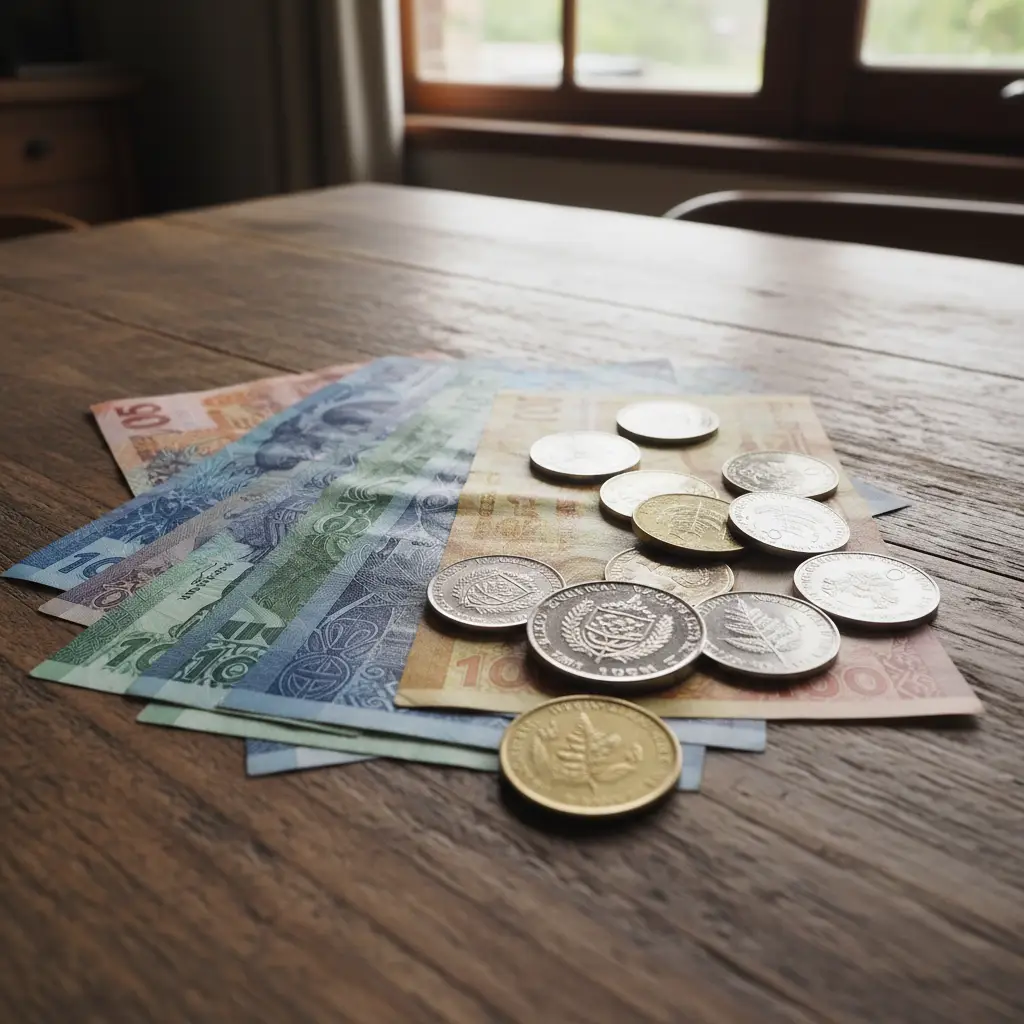
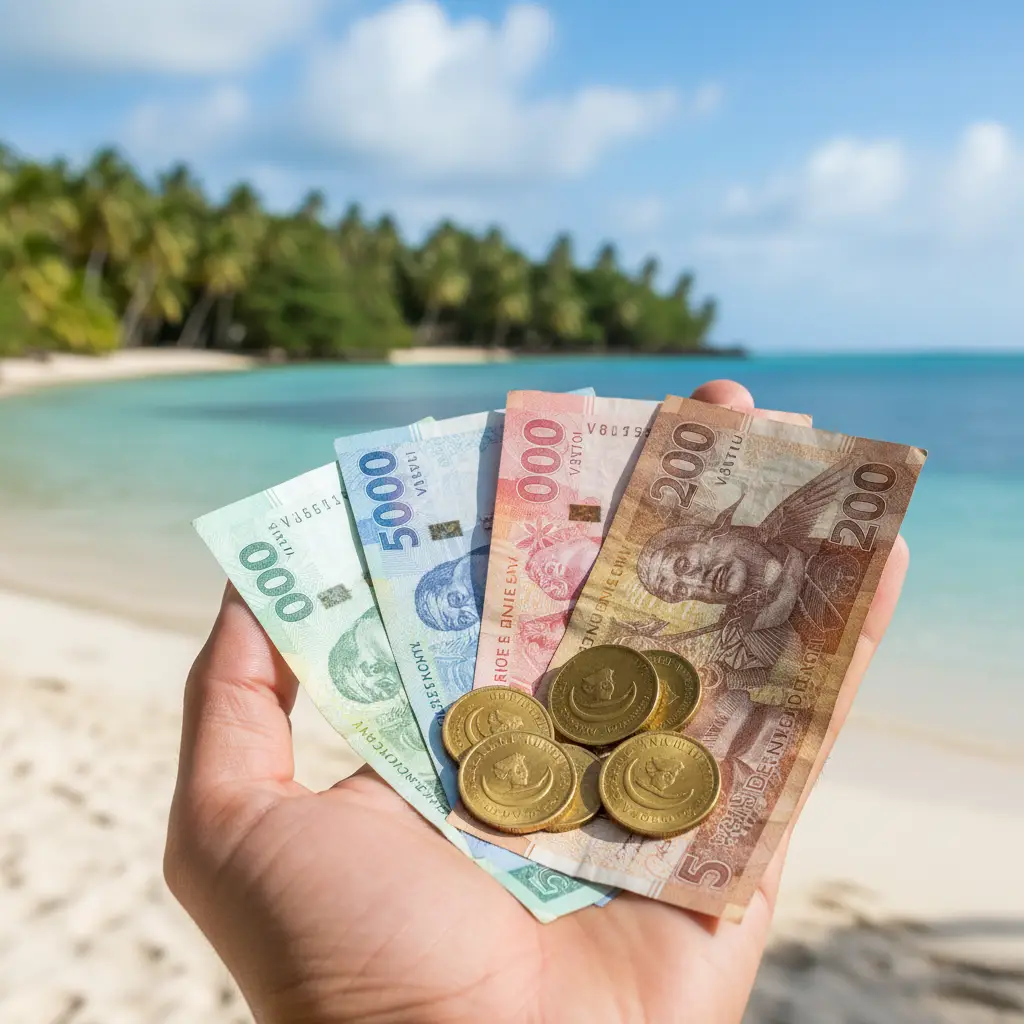
- Coins: 5, 10, 20, 50, and 100 VT. The coins depict local wildlife like coconut crabs and traditional canoes.
- Banknotes: 200, 500, 1,000, 2,000, 5,000, and 10,000 VT. The 10,000 VT note is the highest denomination and can be difficult to break at small roadside stalls or in taxis.
Vatu Conversion Cheat Sheet
Exchange rates fluctuate, but having a mental baseline helps prevent overspending. As of late 2023/early 2024, a simplified rule of thumb for major currencies is roughly:
- 100 VT ≈ $0.85 USD / $1.30 AUD / €0.78 EUR
- 1,000 VT ≈ $8.50 USD / $13.00 AUD / €7.80 EUR
For quick mental math, many Australian travelers simply divide the Vatu amount by 100 and add roughly 30% to get the AUD equivalent, or treat 1000 VT as roughly $10 USD (knowing it’s actually a bit less, providing a safety buffer).
Where to Exchange Money
The best rates are typically found at Goodies Money Exchange or No1 Currency in Port Vila. While the airport has exchange bureaus (ANZ and BSP), their rates are generally less favorable than those in town. Hotels and resorts offer the poorest exchange rates and should be used only in emergencies.
How much does a trip to Vanuatu cost?
A realistic daily budget for Vanuatu ranges from 5,000 VT ($42 USD) for backpackers to over 40,000 VT ($340 USD) for luxury travelers. While local produce is cheap, imported goods and island transfers can significantly increase costs.
Vanuatu is often perceived as an expensive destination compared to Southeast Asia, more comparable to costs in Australia or New Zealand for manufactured goods, though local services remain affordable.
The Backpacker Budget (5,000 – 8,000 VT per day)
To stick to this budget, you will be staying in village guesthouses or dorms, eating at local markets, and using public minibuses.
- Accommodation: Dorm beds or village bungalows (2,500 – 3,500 VT).
- Food: Market meals like “laplap” or “tuluk” (200 – 500 VT).
- Transport: Local minibuses (150 VT per trip in Vila).
The Mid-Range Budget (15,000 – 25,000 VT per day)
This allows for private motel rooms or mid-tier resorts, a mix of restaurant and market food, and paid tours.
- Accommodation: 3-star hotel or private bungalow (10,000 – 15,000 VT).
- Food: Café lunches and restaurant dinners (1,500 – 3,000 VT per meal).
- Drinks: Local Tusker beer (400 – 600 VT).
The Luxury Budget (40,000+ VT per day)
For travelers staying at boutique island resorts, hiring private drivers, and flying between islands.
- Accommodation: Luxury resort or overwater villa (30,000+ VT).
- Food: Fine dining in Port Vila (4,000+ VT per meal).
- Transport: Private taxis and domestic flights.
ATM Availability: Efate vs. Outer Islands
Understanding the geography of banking in Vanuatu is arguably the most critical financial preparation you can make. The banking infrastructure is heavily concentrated in the capital.
Port Vila (Efate)
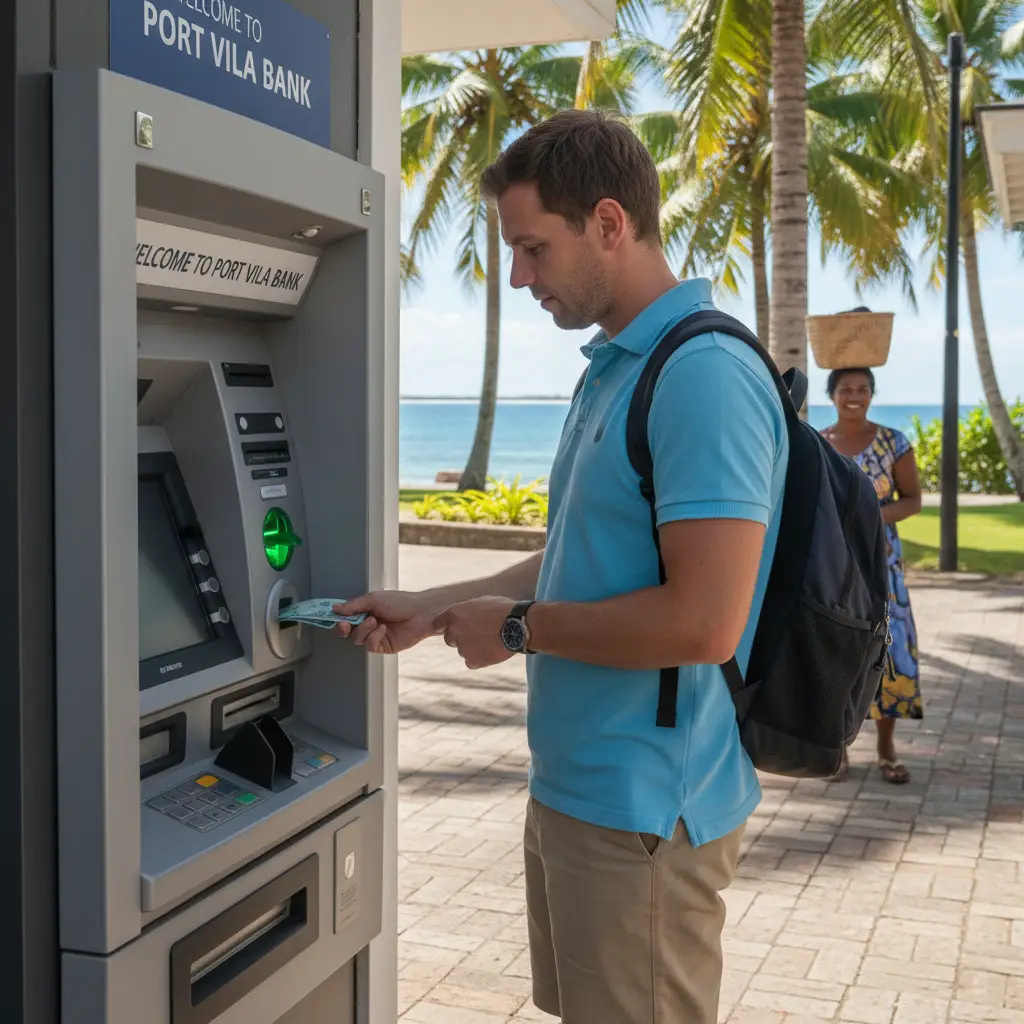
In Port Vila, access to cash is easy. You will find ATMs for ANZ, BSP (Bank South Pacific), BRED Bank, and National Bank of Vanuatu (NBV). International cards (Visa, Mastercard, and sometimes UnionPay) are widely accepted at these machines. There are ATMs at the airport, inside major supermarkets (Au Bon Marche), and along the main street.
Luganville (Espiritu Santo)
Luganville is the second-largest town. You will find branches and ATMs for ANZ, BSP, NBV, and BRED here. However, once you leave the Luganville town limits—for example, heading to Champagne Beach or Port Olry—ATMs vanish. You must withdraw sufficient cash in Luganville before heading north.
Tanna and Outer Islands
Warning: This is where travelers frequently get caught out. Tanna Island has very limited banking facilities. There is an NBV branch at Lenakel (the main town), but the ATM reliability can be spotty due to connectivity issues. There are NO ATMs near the volcano (Mt Yasur) or the resort areas on the other side of the island.
For other islands (Pentecost, Malekula, Ambrym, Banks), assume there are zero ATMs available to tourists. You must carry all the cash you need for the duration of your stay, including small denominations for village purchases.
Credit Card Acceptance & Fees
While Vanuatu is modernizing, it remains a cash-centric society. Relying solely on a credit card is not a viable strategy.
Where Cards Are Accepted
Visa and Mastercard are widely accepted at:
- Major resorts and hotels in Port Vila and Luganville.
- Large supermarkets (Au Bon Marche).
- Western-style restaurants and dive shops.
- Car rental agencies.
American Express and Diners Club are rarely accepted, even in luxury establishments. If you hold these cards, bring a Visa or Mastercard backup.
Surcharges and Transaction Fees
Be prepared for surcharges. It is standard practice for merchants in Vanuatu to pass the merchant service fee on to the customer. This surcharge typically ranges from 3% to 5% on top of the transaction amount. Always ask, “Is there a fee for credit card?” before tapping your card.
Additionally, your home bank will likely charge an international transaction fee (usually 3%) and an ATM withdrawal fee (approx. $5 USD), while the local Vanuatu ATM may charge its own access fee. To minimize costs, withdraw the maximum amount allowed (usually 40,000 to 80,000 VT depending on the machine) to dilute the flat fees.
Tipping Culture and Bargaining
Vanuatu’s money etiquette is distinct from Western norms and deeply rooted in Melanesian “Kastom” (custom).
Is tipping customary in Vanuatu?
No, tipping is not customary in Vanuatu and is traditionally discouraged. In Melanesian culture, hospitality is given freely, and tipping can be interpreted as suggesting the host’s service was not genuine or that they are in need of charity.
However, with the influx of tourism, this is slowly changing in Port Vila. While you should never feel obligated to tip, leaving loose change or a small amount (100-200 VT) at a high-end restaurant for exceptional service is becoming more acceptable. However, in villages and rural bungalows, stick to a warm “Thank you” (Tankyu Tumas) rather than cash tips. If you wish to contribute to a village, donating school supplies or buying local handicrafts is a more culturally appropriate gesture.
Is bargaining acceptable?
Unlike in Bali or Thailand, bargaining is not part of the shopping culture in Vanuatu. Prices at markets, shops, and for transport are generally fixed.
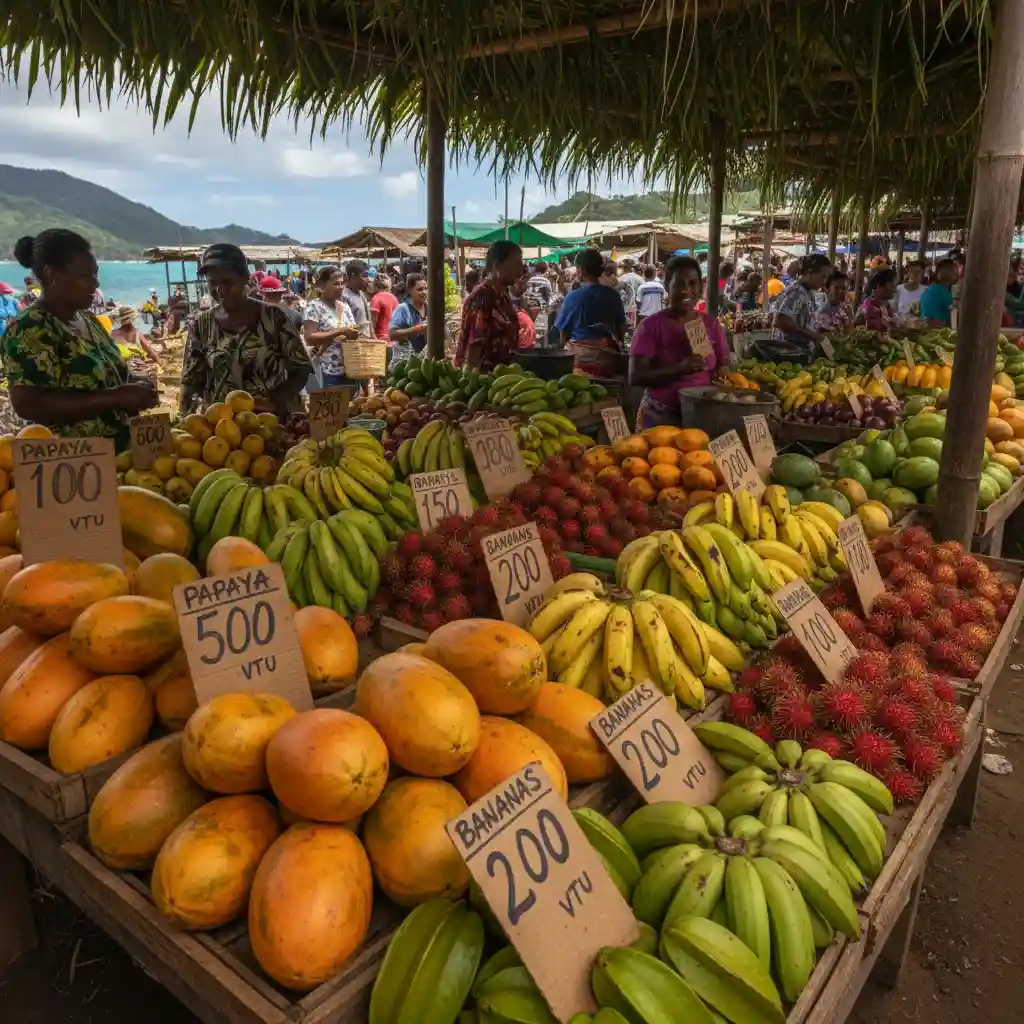
- Markets: The price written on the cardboard sign is the price. Attempting to haggle over the price of bananas or handicrafts is considered rude and disrespectful to the seller’s labor.
- Taxis: Taxis do not have meters, but they have standard fixed rates. However, because these aren’t displayed, you must agree on the price before getting in the car to avoid confusion. This is not bargaining; it is confirming the standard fare.
Cost of Major Attractions
Budgeting for activities is vital, as entrance fees can be surprisingly high due to land access rights (Custom fees).
- Mt Yasur Volcano (Tanna): This is the most expensive activity. Entrance fees are roughly 10,000 – 12,000 VT per person. This must often be paid in cash.
- Mele Cascades (Efate): Entrance is approximately 2,500 VT.
- Blue Holes (Santo): Entry fees usually range from 500 to 1,500 VT.
- Cultural Village Tours: Expect to pay between 1,500 and 3,000 VT depending on the depth of the experience.
Practical Money Safety Tips
1. The “Island Cash” Strategy
When traveling to outer islands, calculate your budget including accommodation, transfers, and food, then add 30% as a contingency. Bring this total in cash. If the flight is delayed or a boat is cancelled, you cannot swipe a card to buy dinner in a remote village.
2. Small Denominations are King
A 5,000 VT note is a fortune in a village. A small market stall selling peanuts for 50 VT will likely not have change for a large note. Hoard your 100 VT and 200 VT coins and 500 VT notes. Break your large bills at supermarkets in Port Vila before heading to the islands.
3. Keeping Money Dry
Vanuatu is humid, rainy, and revolves around water activities. Paper money (though Vanuatu notes are polymer) and receipts can get ruined. Use a waterproof dry bag or a simple Ziploc bag to protect your cash, especially during wet boat landings.
People Also Ask (PAA)
Can I use Australian Dollars or US Dollars in Vanuatu?
Australian Dollars are widely accepted in many tourist shops and restaurants in Port Vila, but the exchange rate offered by the merchant is usually very poor compared to using Vatu. US Dollars are less commonly accepted outside of major hotels. It is always financially better to pay in the local currency (Vatu).
How much cash should I carry to Vanuatu?
If you are staying on the main island (Efate), carrying 10,000 to 20,000 VT in cash is sufficient as you can access ATMs. If traveling to outer islands like Tanna or Santo, you should carry enough cash to cover your entire stay plus emergencies, as ATM access is non-existent in rural areas.
Are things expensive in Vanuatu?
Imported goods (sunscreen, electronics, brand-name foods) are expensive due to shipping costs and taxes. However, local market food, buses, and locally made goods are affordable. Alcohol is generally expensive compared to duty-free prices.
Is there an exit tax in Vanuatu?
Historically, there was a separate departure tax payable at the airport. However, this is now typically included in your international airfare ticket price. It is worth checking your ticket breakdown, but most travelers do not need to pay this in cash anymore.
Do taxis in Vanuatu take credit cards?
No, virtually no taxis or buses in Vanuatu accept credit cards. You must pay in cash (Vatu). Buses are very cheap (around 150VT), while taxis are more expensive. Always carry small change for transport.
What is the best currency to take to Vanuatu?
The best currency to take is Australian Dollars (AUD), which can be easily exchanged at good rates. However, the best strategy is to use an ATM card with low international fees to withdraw Vatu directly upon arrival at Bauerfield International Airport.