Vanuatu entry requirements mandate that international travelers present a passport valid for at least six months beyond their intended date of arrival. Visitors must also possess a confirmed onward or return ticket and proof of sufficient funds. Citizens from over 120 jurisdictions, including Australia, New Zealand, the UK, and Schengen nations, are granted a visitor visa on arrival for stays up to 30 days.
What are the Visa Requirements for Vanuatu?
Navigating the visa policies of Pacific Island nations is generally straightforward for tourists, and Vanuatu is no exception. The government maintains a welcoming stance towards international tourism, which is a vital pillar of the local economy. However, strict adherence to immigration protocols is required to ensure a smooth entry at Bauerfield International Airport (VLI) in Port Vila or Pekoa International Airport (SON) in Santo.

Which Countries are Visa-Exempt?
Vanuatu offers a Visa Waiver program to citizens of over 120 countries. If you hold a passport from one of these jurisdictions, you do not need to apply for a visa before you travel. Instead, you will be issued a Visitor Visa upon arrival, provided you meet the standard entry criteria. This visa is typically stamped directly into your passport by immigration officers.
Key visa-exempt regions include:
- Commonwealth Countries: Citizens of most Commonwealth realms, including Australia, New Zealand, the United Kingdom, and Canada.
- European Union: Nationals from Schengen Area countries generally receive visa-free access.
- United States: US citizens are included in the waiver program.
- Pacific Neighbors: Citizens of Fiji, Solomon Islands, Papua New Guinea, and other regional neighbors.
For citizens of countries not on the exemption list, a visa must be arranged prior to travel through the nearest Vanuatu diplomatic mission or consulate. Attempting to enter without a pre-arranged visa when required will result in immediate deportation.
Visa Duration and Extensions
The standard Visitor Visa granted on arrival is valid for a maximum of 30 days. This is strictly for tourism purposes. Engaging in employment, business, or journalism without the appropriate specific visa is a violation of immigration law.
If you fall in love with the islands—as many do—and wish to stay longer, extensions are possible. You must apply for an extension at the Vanuatu Immigration Department offices located in Port Vila or Luganville. An extension can grant you up to four additional months, but applications must be submitted before your initial 30-day visa expires. Fees for extensions apply and vary based on the duration requested.
Passport and Document Checklist
Even if you are from a visa-exempt country, entry is not guaranteed unless you possess the correct documentation. Immigration officers have the authority to deny entry to anyone who fails to produce the following mandatory items.
1. Passport Validity Rule
Your passport must be valid for at least six months beyond your intended date of arrival. This is a non-negotiable “six-month rule” standard across most of the Pacific. If your passport expires in five months, airlines will likely deny you boarding at your point of origin.
2. Proof of Onward Travel
You must present a confirmed return ticket to your home country or an onward ticket to a third country. Standby tickets or open-ended itineraries may be scrutinized. The immigration officer needs assurance that you do not intend to overstay your visa.
3. Proof of Sufficient Funds
While not always checked for every passenger, you may be asked to prove that you have enough money to support yourself during your stay. This can take the form of:
- Recent bank statements.
- Credit cards with sufficient limits.
- Cash holdings (subject to currency declaration limits).

Vanuatu Customs Regulations Explained
Once you clear immigration, you will proceed to customs. Vanuatu Customs and Inland Revenue enforces strict allowances to protect local revenue and public safety. All baggage is subject to X-ray scanning or physical inspection upon arrival.
Duty-Free Allowances
Travelers aged 18 years and older are permitted to bring the following items into Vanuatu duty-free:
- Tobacco: Up to 250 cigarettes, OR 100 cigarillos, OR 25 cigars, OR 250 grams of tobacco products.
- Alcohol: Up to 2.25 liters of spirits (liquor) OR 2.25 liters of wine OR 9 liters of beer.
- Perfume: Up to 250ml of eau de toilette or 100ml of perfume.
- General Goods: Other taxable goods (gifts, souvenirs) up to a value of 50,000 Vatu (approx. $400 USD) per person.
If you exceed these limits, you must declare the excess items and pay the applicable duty and taxes. Failure to declare excess goods can result in confiscation and fines.
Prohibited and Restricted Items
Strictly prohibited items include illicit drugs, pornography, and weapons (firearms require a special police permit obtained in advance). Vanuatu has zero tolerance for drug trafficking, and penalties are severe.
Biosecurity: Can I Bring Food into Vanuatu?
Vanuatu’s economy relies heavily on agriculture, making biosecurity a critical priority. The country is free from many pests and diseases found elsewhere, and the government works aggressively to keep it that way. Biosecurity Vanuatu operates with similar strictness to Australia and New Zealand.
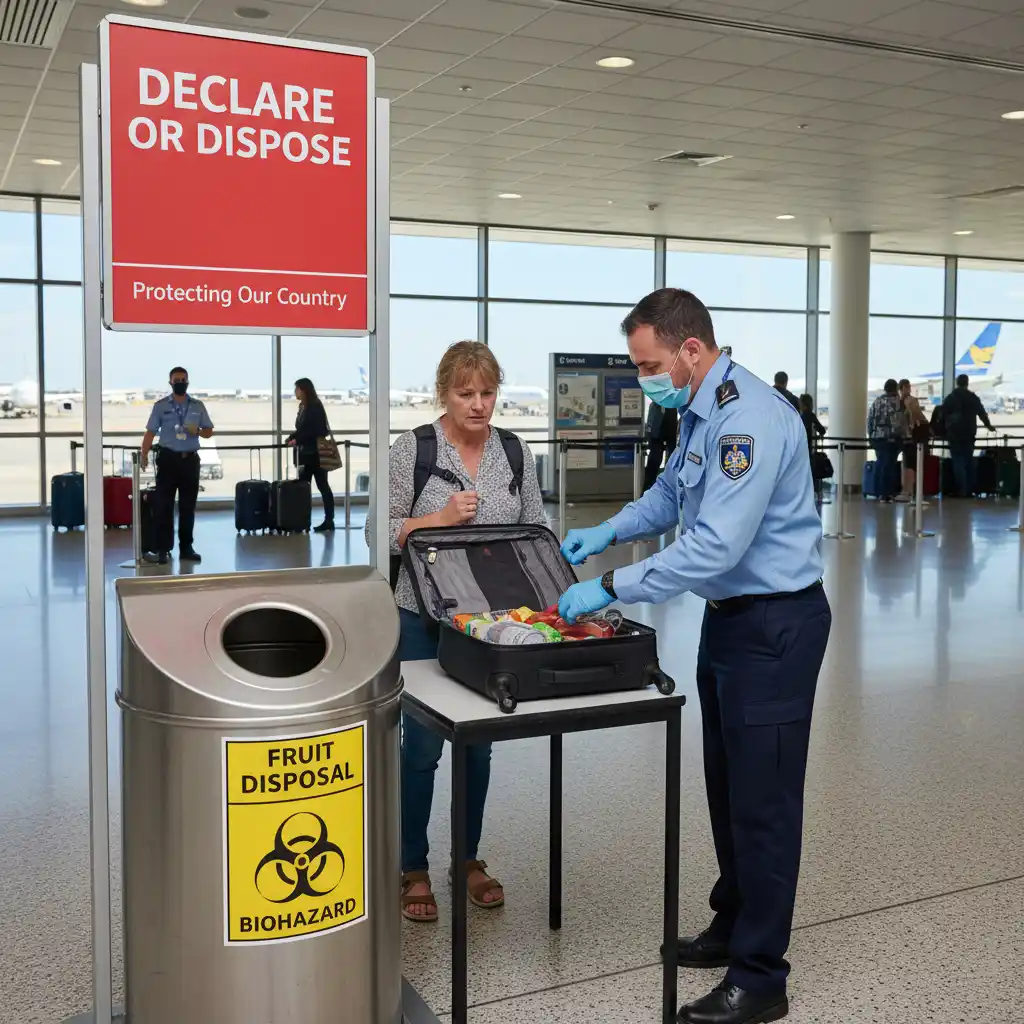
The “Declare or Dispose” Rule
All passengers must complete an Incoming Passenger Card, which includes specific questions about food, plant, and animal products. You must declare all food items, regardless of how they are packaged.
Items that pose a high risk and are often confiscated include:
- Fresh fruits and vegetables.
- Seeds and nuts.
- Meat and dairy products (unless commercially packaged from approved countries).
- Honey and bee products.
- Traditional medicines or herbs.
- Camping equipment carrying soil (tents, hiking boots, golf shoes).
If you are unsure, declare it. If you declare an item and it is prohibited, the officer will simply confiscate and destroy it without penalty. If you fail to declare an item and it is found during inspection, you face an on-the-spot fine of 100,000 Vatu (approx. $840 USD) or prosecution.
Kava Regulations
Vanuatu is the home of Kava. While you can drink it freely on the islands, bringing dried Kava into Vanuatu is generally restricted to prevent the introduction of foreign strains or pests. Conversely, if you wish to take Kava out of Vanuatu, you are usually allowed to take a reasonable amount for personal use, but you must check the entry requirements of your destination country (e.g., Australia has strict limits on Kava importation).
Health and Vaccination Entry Rules
Health requirements for travel have evolved significantly in recent years. As of late 2024, Vanuatu has normalized its entry protocols regarding global health emergencies, but specific standard vaccinations remain relevant.
COVID-19 Requirements
Vanuatu has lifted all COVID-19 specific border restrictions. Travelers are no longer required to present proof of COVID-19 vaccination or a negative test result to enter the country. Quarantine mandates have also been removed. However, travelers are advised to monitor official government advisories as health protocols can change on short notice if global conditions shift.
Yellow Fever Vaccination
A Yellow Fever vaccination certificate is required only if you are arriving from or have transited through (for more than 12 hours) a country with a risk of Yellow Fever transmission. This primarily applies to travelers coming from parts of Africa and South America. If you are flying directly from Australia, NZ, the US, or Europe (without long African/South American layovers), this does not apply to you.
Malaria and Dengue
While not an “entry requirement” in terms of documentation, it is vital to be aware that malaria and dengue fever are present in Vanuatu. There is no vaccine requirement for entry regarding these, but preventative measures (mosquito repellent, long sleeves) are strongly recommended. Prophylactic medication for malaria is often advised for travel to outer islands, though Port Vila is generally considered low risk.
Understanding the Departure Tax
Historically, travelers leaving Vanuatu were required to pay a departure tax in cash at the airport, often leading to a scramble for Vatu coins before passing through security. This process has been modernized.
Currently, the International Departure Tax is included in your airfare. When you purchase your flight ticket, the taxes and fees section covers this charge. You do not need to pay a separate fee at the airport upon departure. However, it is always prudent to keep a small amount of local currency handy for any unforeseen terminal improvement fees or changes in policy, although this is rare.
For domestic travel between islands (e.g., flying from Port Vila to Tanna to see Mount Yasur), a provincial departure tax (usually 200 Vatu) applies. While often included in tickets now, some smaller airstrips may still request a small cash levy.

Frequently Asked Questions
Do US citizens need a visa for Vanuatu?
No, US citizens do not need to apply for a visa in advance. They are eligible for a visitor visa on arrival, valid for up to 30 days, provided they have a passport valid for six months and a return ticket.
What happens if I overstay my visa in Vanuatu?
Overstaying your visa is a serious offense. You will likely be fined for every day you have overstayed and may face deportation and a ban from re-entering the country. If you need to stay longer than 30 days, apply for an extension at the Immigration Department before your visa expires.
Can I bring a drone into Vanuatu?
Yes, you can bring a drone for recreational use. However, you must declare it at customs. If you are using it for commercial filming, you need a permit from the Vanuatu Cultural Centre and the Civil Aviation Authority of Vanuatu (CAAV).
Is travel insurance mandatory for Vanuatu?
Travel insurance is not a legal entry requirement, but it is highly recommended. Medical facilities in Vanuatu are basic, and emergency evacuation to Australia or New Zealand can cost tens of thousands of dollars. Ensure your policy covers medical evacuation and adventure activities.
What currency should I bring to Vanuatu?
The local currency is the Vatu (VUV). Australian Dollars (AUD) are widely accepted in Port Vila, but it is best to exchange money into Vatu for use in local markets, transport, and outer islands. Currency exchange is available at the airport upon arrival.
Are there restrictions on prescription medication?
Travelers should carry prescription medication in its original packaging, clearly labeled with the traveler’s name and dosage. It is advisable to carry a letter from your doctor outlining your medical condition and the necessity of the medication, especially for controlled substances.